Lecture #2
RECITATION QUIZ HINT:
MAKE FLASHCARDS OF THE FUNCTIONAL GROUPS
Follow the three rules for Lewis Dot Structures
(see last lecture)
Lewis Dot Structures:
Formal charge:
The charge on an atom in a molecule
Formal charge = (#ve^-) - (all unshared e^- + ½ all shared electrons)
H3O+
FC = 6 - (2+3) = +1
HCO3+
Functional Group:
Allows for the division of compounds into classes
Exhibit characteristics chemical reactions
Provides basis for naming molecules
Alcohol:
Hydroxyl: alcohol functional group
alcohol: entire molecule
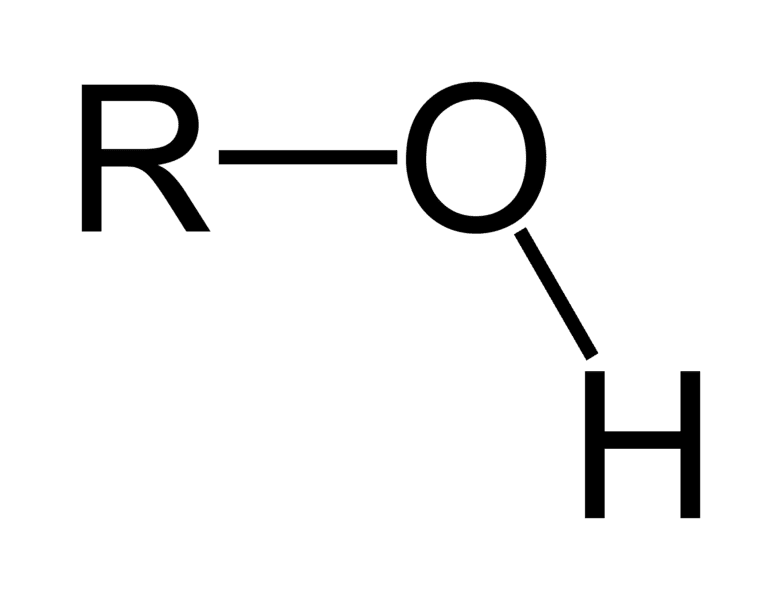
1° - primary
2° - secondary
3° - tertiary
Halides:
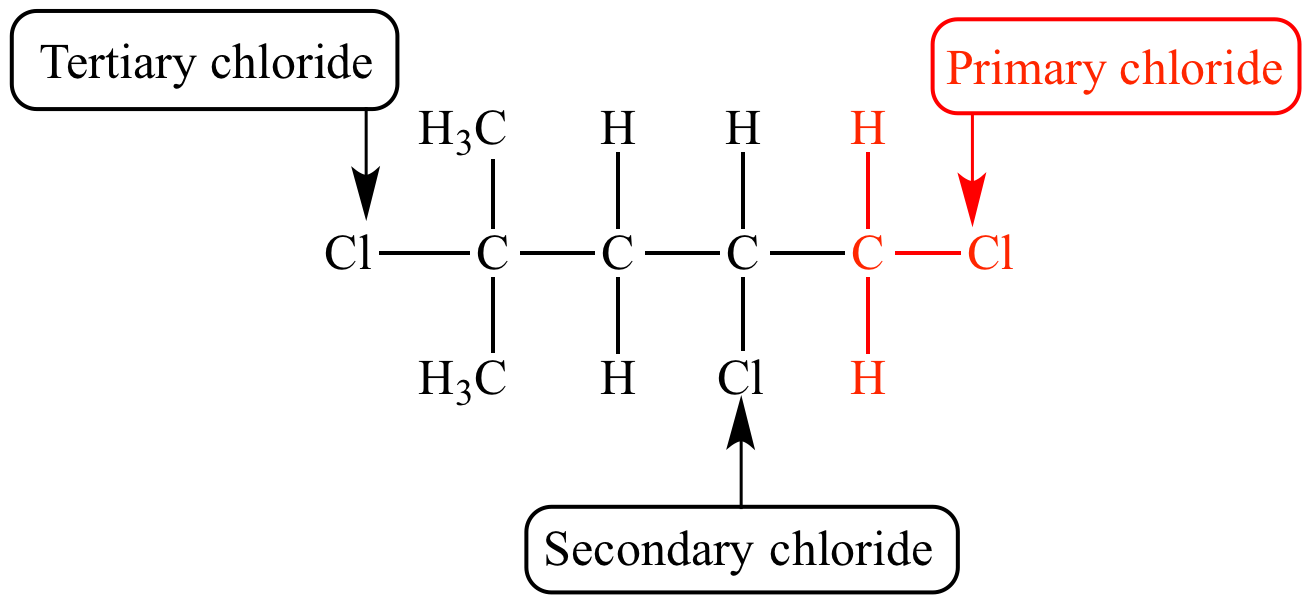
Halogen → functional
F: fluoride
Cl: Chloride
Br: Bromide
I: Iodide
1°
2°
3°
Amines:
Amino: functional group
Amine: entire compound
Classification → how many carbons are attached directly to nitrogen
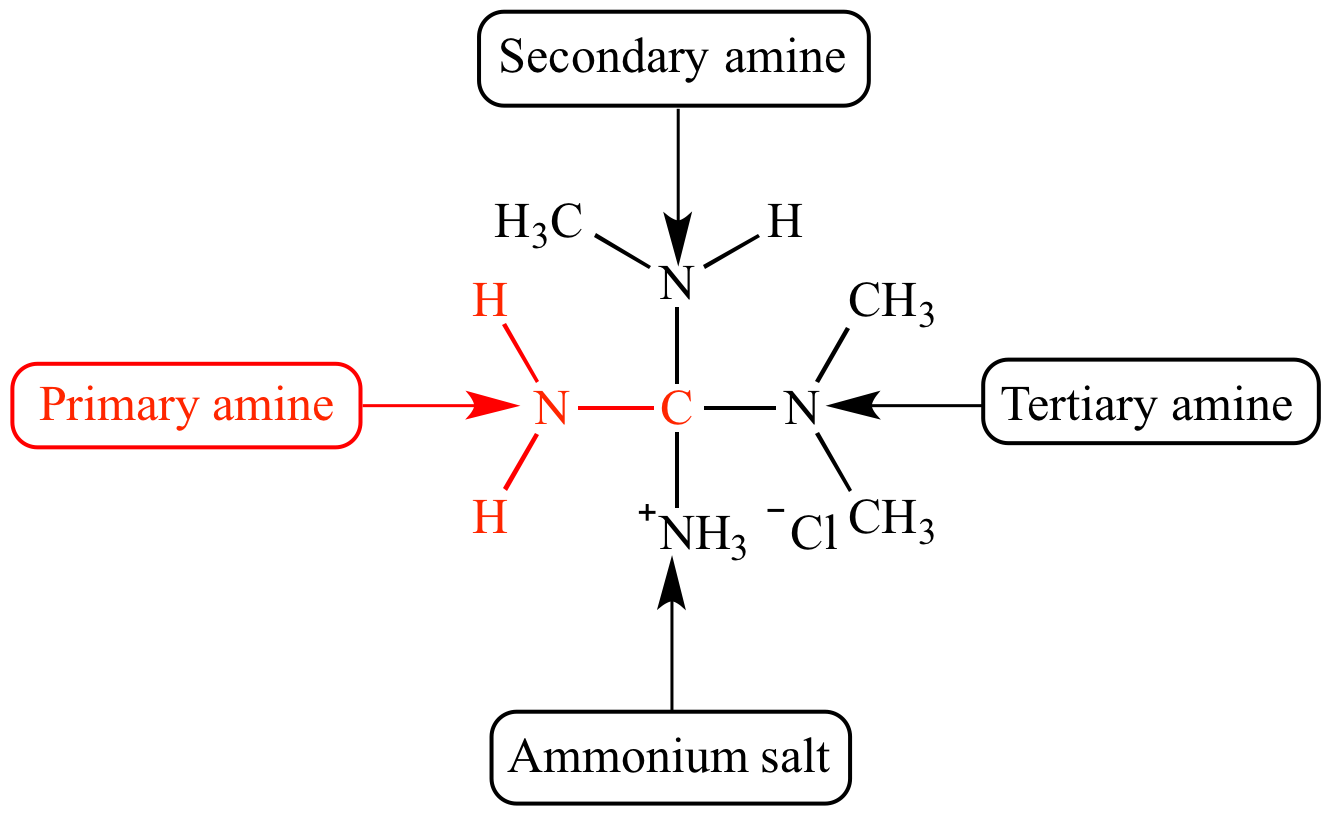
Aldehydes & Keytones
Carbonyl is the key functional group in both aldehydes and ketones
Aldehyde:
Carbonyl + hydrogen
Ketone:
Carbonyl + 2 carbons
Carboxylic Acid, Ester, Amide
Carboxylic acid:
Carboxyl + alcohol
Ester:
Carboxylic acid - H + Carbon
Amide:
Carbonyl + amine
Ether & Thiol
Ether
Think “either ror”
Thiol:
sulfur
Valence- shell Electron-pair repulsion theory
VSPER is based on the electrons in an atom’s valence shell
Remember:
electrons repel each other
the furthest they can be away from each other is 109.5° (tetrahedral)
Lone pairs take more space than bonding groups
Methane
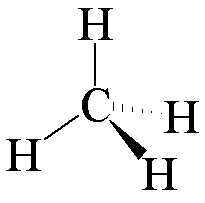
Angles are less than 109.5°
Valence-shell electron-pair repulsion theory
Region of electron density around central atom: 4
Tetrahedral
109.5°
Region of electron density around central atom: 3
trigonal planar
120°
Region of electron density around central atom: 2
Linear
180°
Polar and Nonpolar Molecules
Remember: This class is focused on “where are the electrons and why?”
Polar bonds: Unequal sharing of electrons
Nonpolar bonds: Equal sharing of electrons
Molecular dipole moment (mu): the vector sum of a molecule’s individual dipoles
→ → (add)
← → (subtract)
Vectors cancel out = non polar molecule
Vectors add = polar molecule
Molecular Orbital Theory
Allows us to better predict where an electron might be located
Quantum Mechanics: the branch of science that studies particles and their wave-like properties
Electrons can act as a particle and wave
Schrodinger’s equation: The spatial arrangement of where it is possible to find electrons
(wave functions — AKA — orbitals)
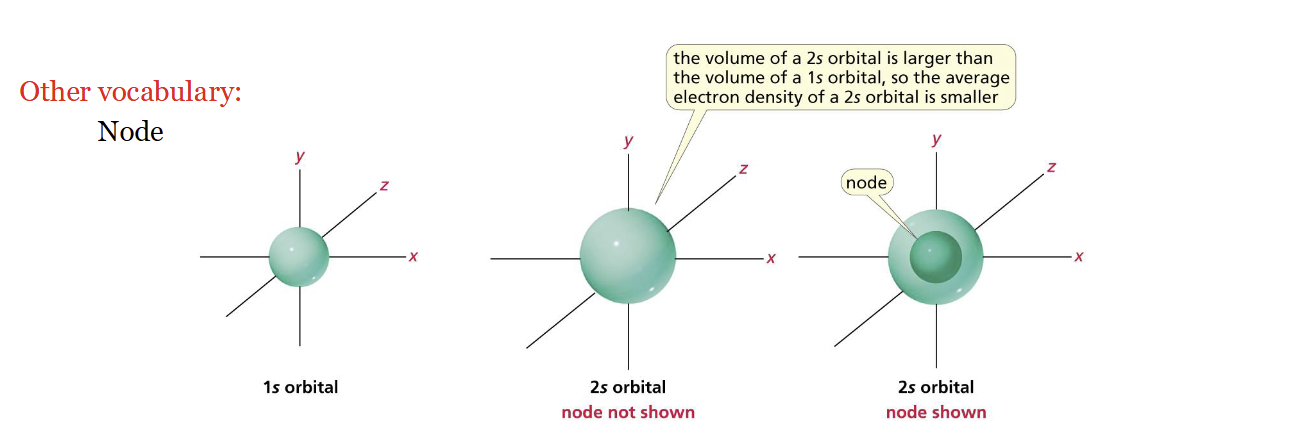
Node shown → no e- density
Molecular Orbital Theory (cont)
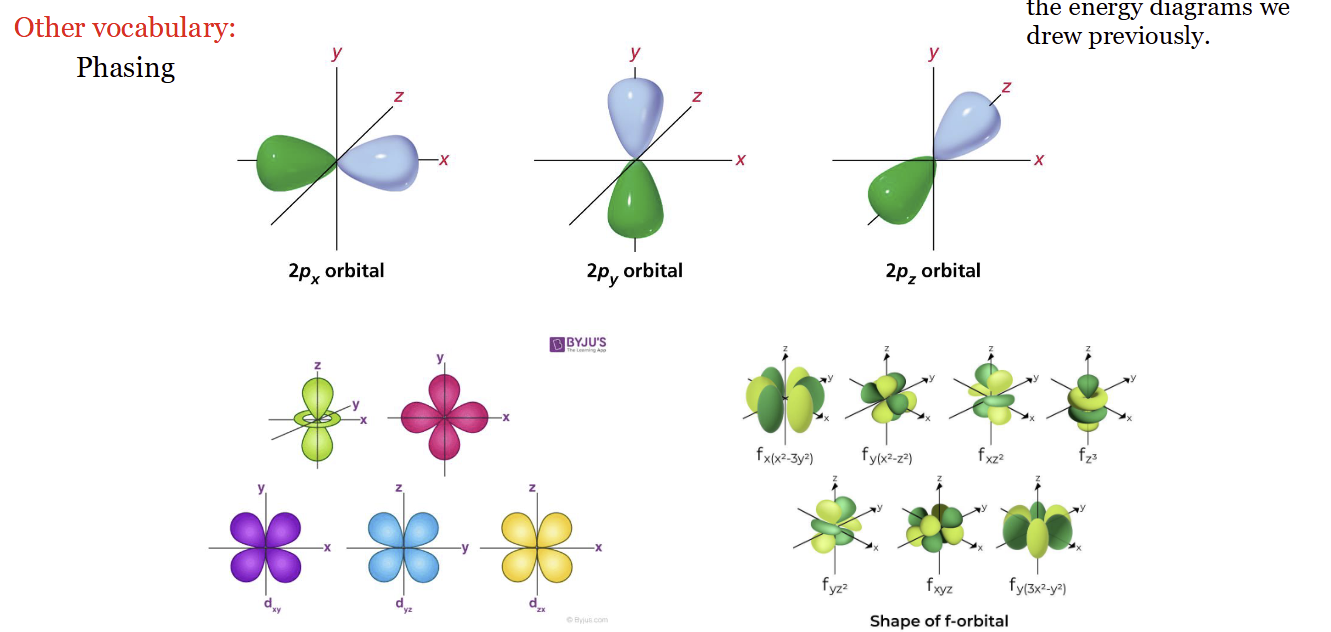
green - in phase (will never be the same color for clarity)
bottom left - d
bottom right - f
Combined VB & MO theory
Most scientists use this model
Other vocab:
Atomic orbitals
molecular orbitals
ground state
excited state
Rules:
# of Atomic orbitals = # of molecular orbitals
molecular orbitals are arranged in increasing energy
see picture from phone
Valence bond theory:
The molecular model that theorizes that bonds are created by the overlap of orbitals on adjacent atoms
The main difference between MO and VB
MO: bonds (electrons) are delocalized across