Cognitive explanations : Gender schema theory
Key terms
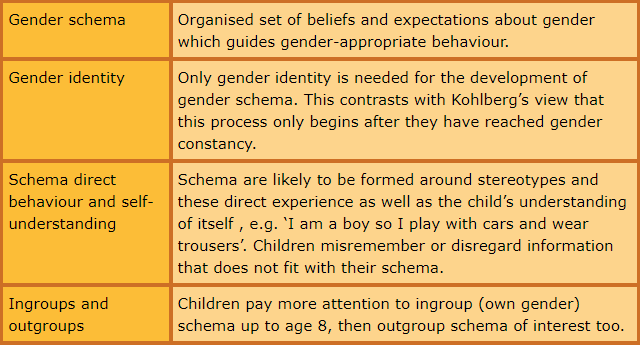
Gender schema - An organised set of beliefs and expectations related to gender that are derived from experience. Such schema guid a person’s understanding of their own gender and gender- appropriate behaviour in general.
Gender schema theory
Like Kohlberg’s theory, Martin and Halverson’s account is a cognitive-developmental theory which argues that children’s understanding of gender increases with age. Gender schema theory shares Kohlberg’s view that children develop their understanding of gender by actively structuring their own learning, rather than by passively observing and imitating role models.
Gender schema acquired with gender identity
Schema are mental constructs that develop via experience and are used by our cognitive system to organise knowledge around particular topics.
A gender schema is a generalised representation of everything we known in relation to gender and gender-appropriate behaviour.
According to Martin and Halverson, once a child has developed gender identity around the ages of 2-3, he or she will begin to search the environment for information that encourages development of gender schema. This contrasts with Kohlberg’s view that this process only begins after they have progressed through all three stages around 7 with gender constancy.
Schema direct behaviour and self-understanding
Schema expand to include a wide range of behaviours and personality traits. For young children, schema is likely to be formed around stereotypes, such as boys play with trucks and girls with dolls, these provide a framework that directs experience as well as child’s understanding of itself. By age of 6, the child has a rather fixed and stereotypical idea about what is appropriate for its gender. For this reason, children are likely to misremember or disregard information that does not fit with their existing schema.
Ingroups and outgroups
Children tend to have a much better understanding of the schema s that are appropriate to their own gender (ingroup) This is consistent with the idea that children pay more attention to information relevant to their gender identity, rather than that of the opposite gender (outgroup) It is not until children are a little older (8) that they develop elaborate schemas for both genders, as opposed to just their own. Ingroup identity also serves to bolster the child’s level of self esteem.
Evaluation
Evidence supports gender schema theory
Martin and Halverson’s own study found that children under the age of 6 were more likely to remember photographs of gender-consistent behaviour than photographs or gender-inconsistent behaviour when tested a week later. Children tended to change the sex of the person carrying out the gender-inconsistent activity in the photographs when asked to recall them. This supports the idea memory may be distorted to fit with existing gender schemas.
Further, Carol Martin and Jane Little found that children under age of four, who showed no signs of gender stability or constancy, nevertheless demonstrated strongly sex-typed behaviours and attitudes. This contradicts Kohlberg’s theory but is consistent with the predictions of gender schema theory.
Rigidity of gender beliefs
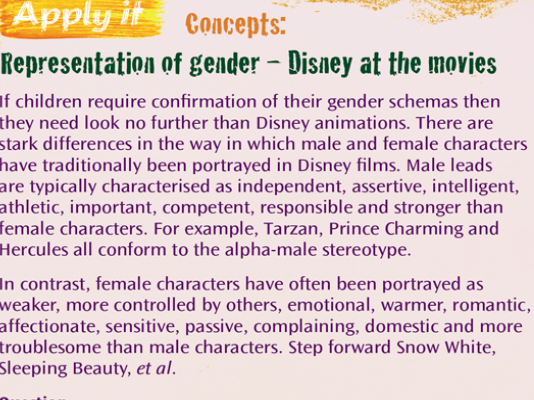
This theory can account for the fact that young children tend to hold very fixed and rigid gender attitudes. Information that conflicts with existing schema, such as the idea of a woman working on a building site, would be discounted or ignored in favour of information that confirms ingroup schema, such as a woman working as a secretary.
Similarly, children display a strong in-group bias in terms of how they process information and this is explained by the fact that children pay more attention to information that is relevant to their own experience.
Thus, Martin and Halverson’s theory can explain many aspects of young children’s thinking about gender.
Complements Kohlberg’s theory
Although many critics have drawn attention to the contradiction that lies at the heart of the two cognitive theories, Charles Stangor and Diane Ruble have suggested that gender schema and gender constancy may actually describe two difference processes..
Gender schema is concerned with how organisation of information affects memory, and this explain why gender-inconsistent information is misremembered or forgotten. Gender constancy is more appropriately linked to motivation. Once children have a firmly established concept of what it means to be a boy or a girl - at gender constancy stage - they are motivated to find out more about this role and engage in gender-appropriate activities.
Extra
Overemphasis on the role of the individual in gender development.
It is likely that the importance of schemas and other cognitive factors in determining behaviour are exaggerated within the theory. As with Kohlberg’s theory, there may not be sufficient attention paid to the role of social factors such as parental influence and the role of rewards and punishments the child receives for their gendered behaviour. For this reason, the theory does not really explain why gender schemas develop and take the form they do.
If a child is rewarded for certain behaviours, it is likely those behaviours will be repeated, so for example, if a girl is playing with dolls and putting on make-up and she is told she is a good girl or looks nice, she will do this again. If a child is punished for certain behaviour, it is likely that this behaviour will stop, so for example if a boy is playing with dolls and he is scolded for it and told dolls are for girls, it is unlikely he will do this in the future. Rewards and punishments shape behaviour and are likely to encourage gender-stereotyped behaviours in children.
Key assumptions of the theory are not supported
It is assumed within gender schema theory that it should be possible to change children’s behaviour by changing their schemas or stereotypes. In fact it is very difficult to change behaviour even if certain beliefs are held. This is reflected in the fact that many married couples have strong view related to equality of the sexes and equal division of labour in the home, but review suggest that this rarely has much effect on their behaviour. (Kane and Sanchez 1994)
It challenges gender schema theory because, even though people hold certain attitudes, this doesn’t seem to affect their behaviour – and the basis of gender schema theory is that attitudes do determine behaviour.