Prevalence of sexual orientations
The Prevalence of Sexual Orientations+
The Prevalence Rates of Sexual Orientations in the USA
Williams & Valentova (2013)
N = 117,717
Exclusive heterosexuals far outnumber non -heterosexuals (Heterosexuality more common)
Men are more likely to report that they are exclusively heterosexual than women
The Prevalence Rates of Sexual Orientation in the West
Prevalence of Heterosexuality
Heterosexuality is the most prevalent within the West
Individuals who are “mostly heterosexual” (Kinsey 1) are much more common than those with stronger same sex feelings (Kinsey 2-6)
More women rate themselves as “mostly heterosexual” compared to men
Kinsey 1 reported more for women tho
Kinsey 1 most common in both men and women
Kinsey 1 (“mostly heterosexual”) reported more for women tho
Exclusive Heterosexuality more common in men
Prevalence of Homosexuality
Prevalence of homosexuality is low, the minority, commonly seen with men, within the West
Individuals with mostly or only homosexual feelings (Kinsey 5 and 6) comprise a small minority
homosexuals in the world = less than 5% (2% - 3%)
Exclusive homosexuality is more common among men than among women
gay men more common than lesbians
Prevalence of Bisexuality
Prevalence of Bisexuality commonly seen with women, within the West
Exclusive homosexuality is more common in men than substantial bisexuality
gay men more common than bisexual men (kinsey 2,3,4s)
Substantial Bisexuality more common in women than is exclusive homosexuality
bisexual women more common than lesbians
Bisexuality is more common among women than among men
Prevalence of Sexual Orientation in Women (the type of curve that can be seen)
Sexual orientation in women appears more continuous than in men
(bisexual sex difference = seen more in women)
this tells us that we are dealing with different natural kinds (different categories for bisexuality)
Shows a Negative exponential curve
(bisexuality in women = Curve is more continuous, going down)
Negative Exponential Curve (for women)
Exponential decay curve, decreases over time
curve = rapid initial decrease, followed by a slower decline that continues indefinitely
differ in degree rather than in time
decreasing proportion of women identify as exclusively heterosexual or exclusively homosexual, while a larger proportion falls somewhere in the middle on the bisexual spectrum.
more women may experience attractions that fall outside the binary categories of exclusively heterosexual or exclusively homosexual
more in the middle bisexual women than exclusively heterosexual or exclusively homosexual
Prevalence of Sexual Orientation in Men (the type of curve that can be seen)
sexual orientation in men appears more bimodal than in women
Bimodal J-Curve (for men)
suggests greater concentration of individuals exclusively heterosexual or exclusively homosexual, with fewer individuals in the middle (bisexual) compared to women
suggests an initial decrease or negative impact followed by a subsequent increase or positive impact, creating the J-shaped pattern
Curve is NOT continuous
relatively higher proportions of individuals identifying as exclusively heterosexual or exclusively homosexual, with fewer individuals identifying as bisexual. (bisexual sex difference = seen more in women)
heterosexuality most common in men
least frequent for men = bisexuality
slight rise to mostly homosexual and entirely homosexual
Sexual Orientation Rates Across Nations
Sexual Orientation rates are relatively stable across nations
Sexual orientation rates are unrelated to various sociocultural variables
Evidence: One study on the prevalence of sexual orientation across 28 nations and its association with Gender Equality, Economic development and individualism
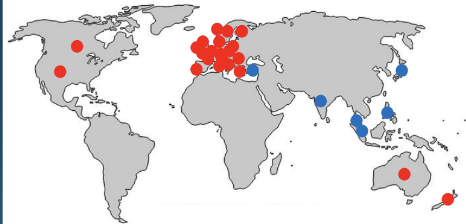
big sample
22 euro nations (marked in red) & also used 6 non euro nations (marked in blue)
asked about patterns of sexual attraction (hetero, homo, or bi)
showed patterns were stable across western and non western countries (shows no patterns that are culturally specific)
The types of unrelated socio cultural variables that are unrelated to sexual orientation across 28 nations
Not supported by data that these variables do anything
Gender equality
Gender empowerment
Economic development
Individualism/collectivism
What about homosexual prevalence rates in the past?
Past Studies
Lucien von Romer
1) In 1901, Lucien von Romer conducted a study on his fellow male university student in Amsterdam in the Netherlands
he found that 1.9% were homosexual
Magnus Hirschfeld
2) In 1903, Magnus Hirschfeld conducted a study in Berlin, Germany = placed the prevalence rate for homosexuality at 1.5%
He conducted a second study in Berlin in 1904 = obtained a prevalence rate for homosexuality of 1.7%
2nd study on steel workers (men) = showed 1.7% were homosexual
Contemporary Studies
3) Contemporary studies
would put homosexuality at 2-3%
so Romer was right although his work was rejected as something offensive and immoral at the time (was not accepted)
All these studies (3) show what same conclusion
No the % has pretty much stayed the same so the idea that: “there are more of us than 100 years ago” because ‘ideological conditions’ have made it easier for people to make the choice to be gay”, is wrong
- shows that its shared human biology, more than socio variables (ideological conditions) that effect sexual orientation (will always be around 3% prevalence of homosexuality within any culture)
Does the population prevalence rate for male androphilia (male homosexuality) differ depending on whether one is transgender or cisgender? — Faafafine and gay men
2013 study (N = 172): 3%
2017 study (N = 382): 2.1%
Rates above show that Faafafine and gay men exhibit similar population prevalence rates
compare fafafine with western data
fafafine results within the normal range for andro males seen in western cultures, still a low amount (shows again thats its not cultural)
Universal results whether in trans or cis form
Intersubjectivity: Different Categories for Homosexual Men
They are the same natural kind (male androphilic)
share common biology BUT have different culturally specific expressions (intersubjective)
different on how they identify, how they act all due to where they grew up in, their environment
trans faafafine way more common than cis in Samoa, but thats due to environment (this is opposite in Western countries)
Objective Reality: Same Category for Homosexual Men
Same natural kind (male androphiles)
share intrinsic qualities of what they like, which is men
all are Androphiles (attracted to adult men)
different culturally-specific expressions
What can we say about the notion that “Homosexuality does NOT exist in all cultures”
social constructionist notion/idea. (since biology says it should)
comes from an ethnological background where social constructionism is prevalent
Is Homosexuality Absent in some Cultures?: Looking at the Aka Men Pygmies Research
researchers inquired about homosexuality among Aka men
found that the men were not aware of the practice, did not have terms for it, and had difficulty understanding the concept and mechanics of same-sex relationships
didn’t view homosexuality negatively but had a hard time conceptualizing it
Aka men in question may not have a cultural framework or linguistic category for understanding or discussing same-sex relationships.
Looking at just the results of this research, it does seem that Homosexuality could be absent in some cultures. BUT this research has some big errors…
It is unlikely that homosexuality is absent among the Aka because the research had…
Insufficient sample size to detect male or female homosexuality
need large samples since we already know that homosexuality is more rare than heterosexuality
this research only had 17 females and 18 males, all from the same band/group
so research encountered sampling error — must use at least 100 males and females for accuracy
Asked about behavior, but not about feelings
this is not good since feelings and behaviour don’t always match up perfectly
Demographic constraints on the expression of homosexual behavior
Absence of a word for homosexuality is not evidence for absence of the phenomenon
absence of word doesn’t prove that homosexual behaviour doesn’t happen
The Sulu Islands Example: Comparing the Tausug to the Bajau
These groups are complete opposites
Tausug (live in land)
Premarital heterosexual sex taboo
Transgender male androphiles accepted and public
Male homosexual behaviour is tolerated and routine
believe you are born that way, so male homosexuality tolerated
southern Philippines
Tausug = ethnic group native to the Sulu Archipelago in the southern Philippines, primarily adheres to Islam
sex taboo before marriage - muslim
Bajau (live in the water - boats)
Premarital heterosexual sex accepted (NOT taboo)
Male homosexual interactions highly taboo and described as “absent” (NOT tolerated)
Bajau = also known as the Sama-Bajau, are an ethnic group traditionally known as sea nomads or sea gypsies
It was explained that The Bajau described homosexuality as being “absent” in their culture, is this true?
NO it is not.
These Bajau men have access to female sexual partners BUT STILL, some Bajau men seek out Tausug males for sex
even though homosexuality taboo for Bajau, they still go to island for these relations
They specifically go where it is very accepted,
the travelling to the Tausug island shows that this is a choice situation, in which when given the choice they would go for more male partners
This shows how some Bajau men are actually intrinsically homosexual. (will only express this behaviour where it is tolerated and the choice is available)
Feminine males exist among the Bajau who are described as resembling Tausug homosexuals
male feminity = big marker for male homosexuality
Is Homosexuality cross culturally universal?
Seen in Small Groups?
For demographic reasons, male androphilia and female gynephilia may really be absent in small groups because both are low frequency traits that are only expressed in larger populations
when studying a small group the amount of data will be insufficient to test something that will already be rare to find in a bigger group
What does the good example, the Aka, tell us?
Male androphiles and female gynephiles may be present, but appear absent, because such individuals never come into contact with others like themselves and thus, they have no sexual outlet, so same-sex sexual behavior is never expressed
What does the Tausug and Bajau tell us?
For cultural reasons, male androphilia and female gynephilia may be present, but appear absent because both are taboo and thus, never expressed behaviorally or in terms of open declarations of identity
So is same-sex sexual orientation context independent or dependent?
The existence of same-sex sexual orientation (feelings) appears to exist in a context independent manner, but its actual expression (behavior, open declarations of identity) is context dependent
existence of homosexuality is NOT affected by context/culture (will always be present, just will always be minority)
homosexual behaviour IS affected by context/culture (whether it is accepted or tolerated influences if someone acts homosexual or not)
context has to be tolerant for homosexuality to be acted upon
True or False: “It’s highly probable that a small group of homosexual people exist in all societies ….” – Frederick L. Whitam (1994)
TRUE around 2% -3%