The Islamic World
Background: The Islamic World
Islam as a religion inherited a number of key ideas from earlier Abrahamic religions:
One God, all-knowing, all-powerful, and all-good
Each individual possesses a unique, immortal soul
God-given laws that provide certain guidance as to what is ethical and what is not ethical
Like Christian philosophers, Muslim scholars absorbed much of the philosophy of Plato and Aristotle
Al-Farabi: Religion and Philosophy
The philosopher Al-Farabi, like Augustine, saw the purpose of philosophy in part to consist in reconciling faith and reason
For Al-Farabi, religion and philosophy serve as means to the same end
There cannot be any contradiction between them
However, Al-Farabi argues, religion should be seen as subordinate to philosophy
Unlike philosophy, religion fails to provide certainty for the truths it conveys
Al-Farabi defines “virtuous religion” as religion that promotes the ultimate happiness of its members
In order to be effective, virtuous religion must be imposed by a ruler
Islam’s “first ruler” was Mohammed, and since Mohammed was a good man who desires the best for his followers, Islam is a virtuous religion
Its rulers since the time of Mohammed are the caliphs and other religious authorities
There are two sides to virtuous religion: theory and law
Theory concerns doctrinal truths: the existence of God and spiritual beings, of an afterlife and a judgment after death, etc.
Law concerns how one should live one’s life, what rules to follow, how to properly worship God and respect other humans
Philosophy is oriented toward knowledge and wisdom
Philosophical truths don’t need to be imposed by a ruler, because they are certainly known by all who study them carefully
because they are certain, philosophical truths do not require faith or trust on the part of those who hold them
This makes philosophical truth superior to the truths of religion, as the truths of religion are not known with certainty but must be imposed or taken on trust
Religion is useful and necessary as a means of convincing those who are too busy or uneducated to understand philosophical truth.
Without religion, the non-philosophers would have no means to gain understanding of truths important for their ultimate welfare (e.g., truths about living a life worthy of heaven)
Avicenna on existence
Building off of Aristotle’s metaphysics, Avicenna analyzes substance as being made up of form and matter
Matter individuates particular objects: what makes something exist as a particular human being is the fact that it has matter
hence why unicorns don’t exist: there is no material that substantiates anything of the form “unicorn”
In another sense, forms exist (or fail to exist) because of their properties
There is no existing form “four-sided triangle,” because no such thing could exist
Avicenna distinguishes between a thing’s essence and its existence
We can think of the essence of “four sided triangle” or “unicorn” whil still acknowledging their non-existence
Avicenna: necessary vs. possible existence
A unicorn is a possibly existing form, that in actuality does not exist
A four-sided triangle is a form that cannot possibly exist
There is a third kind of existence besides possible and impossible: necessary. This is a form that must exist, that does not depend on anything else for its existence
If a necessary form exists, then it must exist in a non-material manner
If it were material, then it would need matter to exist
If it needed matter to exist, then it would depend on matter for existence
If it depends on matter for existence, then clearly, it could not exist necessarily
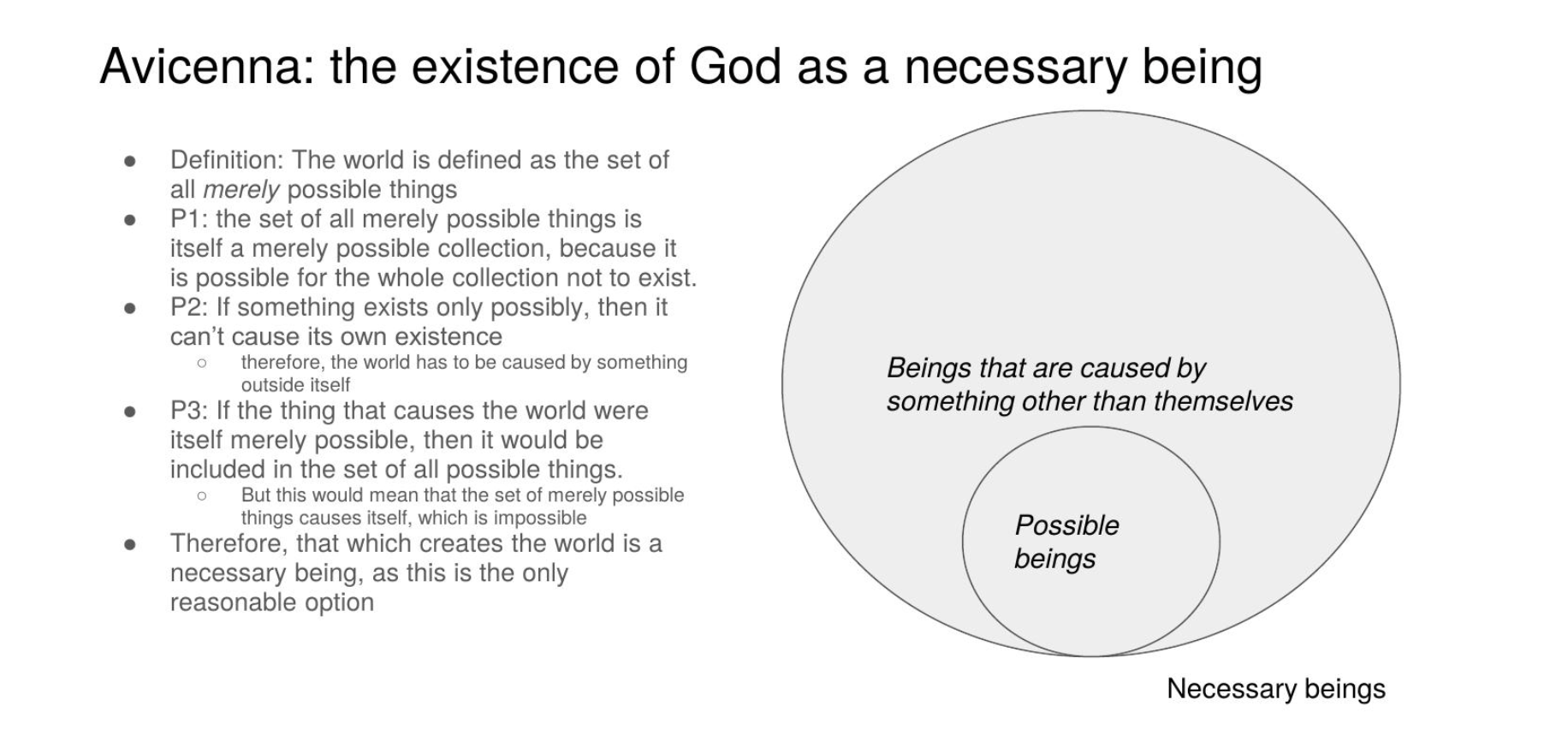
Avicenna: the existence of God as a necessary being
Avicenna defines God as “a necessary being that created the world”
He presents an argument for the existence of such a being:
Defenition: The world is defined as the set of all possible things
P1: the set of all merely possible things is itself a merely possible collection, because it is possible for the whole collection not to exist
P2: If something exists only possibly, then it can’t cause its own existence
therefore, the world has to be caused by something outself itself
P3: If the thing that causes the world were itslefmerely possible, then it would be included in the set of all possible things
But this would mean that the set of merely possible things causes itslef, which is impossible
Therefore, that which creates the world is a necessary being, as this is the only reasonable option