Human Intelligence
Definition (#f7aeae)
Important (#edcae9)
Extra (#fffe9d)
Intelligence:
Refers to intellectual functioning.
Ability to solve problems or create products that are valued witthin 1 or more cultural settings.
Ability to adapt to the environment. Either by making a change in oneself, changing the environment or finding a new one.
Intelligence is not a single mental process, but rather a combination of many mental processes directed towards effective adaptation to the environment.
Measures and strutures of intelligence:
Francis Galton: Intelligence is a function of psychophysical activities, and hereditary.
Alfred Binet: Distinguished normal learners from those who belonged to mental retardation category.
Measured intelligence as a function of the ability to learn within academic setting.
3 elements:
Direction: Knowing what has to be done and how to do it.
Adaptation: Customizing strategy.
Criticism: Ability to critique your own thoughts.
William Stern: Used Intelligent Quotient (IQ), a ratio of mental age divided by the chronological age, multiplied by 100.
Ex: f Alan’s mental age of 20 equals his chronological age of 20, then his intelligence is average and his IQ is 100.
20/20)100 = 100
IQ above 100 = mental age > chronological age
IQ below 100 = mental age < chronological age
IQ test:
Lewis Terman: Developed Stanford-Binet intelligence scale, a widely used IQ test.
Competitor: Wechsler scales by David Weschler.
Wechsler Adult Intelligence Scale (WAIS-IV, 2008)
Wechsler Intelligence Scale for Children (WISC-IV, 2003)
Wechsler Preschool and Primary Scale of Intelligence (WPPSI-III)

Developing scales:
Scales are developed using factor analysis.
Factor analysis: Statistical method for separating a construct into number of hypothetical factors that the researchers believe form the basis of intelligence.
FA is based on correlation studies, if more highly 2 tests are correlated, then more likely they are to measure the same thing.
Spearman: The ‘G’ Factor
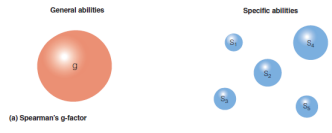
Spearman who invented FA concluded that intelligence can be understood in terms of 2 kinds of factors:
General (g) factor: All mental ability.
Specific factor: Only a single type of mental ability.
g factor provides the key to understand intelligence.
Louis Thurstone:
Intelligence resides on multiple factors (primary mental abilities).
Such as:
Verbal comprehension: Measured by vocabulary tests.
Verbal fluency: Measured by time-limited tests requiring the test-taker to think of as many words as possible that begin with a given letter.
Inductive reasoning: Measured by tests such as analogies and number-series completion tasks.
Spatial visualization: Measured by tests requiring mental rotation of pictures of objects.
Number: Measured by computation and simple mathematical problem-solving tests.
Memory: Measured by picture and word-recall tests.
Perceptual speed: Measured by tests that require the test-taker to recognize small differences in pictures or to cross out the differences in strings of varied letters.
Intelligence and information processing:
Speed and accuracy are important factors of intelligence.
Inspection time: Time taken to inspect items and make a decision about them.
Choice reaction time: Time taken to select one answer among several possibilities.
Lexical-access speed: Speed in which we can retrieve information about words from LTM.
Working memory:
Critical component of intelligence.
Ex:
Task: Participants performed a set of arithmetic problems, each of which then followed by a word or digit. “(7 x 5) -3 = 8? CHAIR”.
They performed several sets.
The task was to recall the words that followed the problem.
The number of words was highly correlated with measured intelligence.
WM predicts scores on tests of general ability.
Biological basis of intelligence:
There is a significant statistical association between brain size and intelligence.
Alternative approaches to intelligence:
Cultural context:
Culture is the set of attitudes, values, behaviors and beliefs shared by a group of people.
Different cultures have different ideas of what it measn to be smart.
Cole et al., (1972) did a sorting task.
Can be arranged hierarchically or functionally.
More intelligent → hierarchically
Less intelligent → functionally
Howard Gardner:
Multiple intelligence theory:
Intelligence include multiple independent constructs, and there are 8 separate intelligences that are distinct from each other.
Used 8 signs as criteria to develop the theory.
Potential isolation by brain damage.
Existence of exceptional individuals.
Identifying core operations.
A distinct developmental history.
A distinct evolutionary history.
Evidence from cognitive-experimental research.
Evidence from psychometric testing.
Susceptibility to encoding in a symbol system.

Sternberg: The triangle theory
3 factors:
The internal world of perception (analytical).
To experience (creative).
To the external world (practical)

Components:
Componential intelligence (analytical): Involves mental processes used to solve problems and decision-making. Typically associated with the traditional measures of IQ tests.
Experiential intelligence (creative): Involves the ability to think creatively, and use insights in novel situations.
Practical intelligence: Involves adapting to the environment and applying knowledge and skills in everyday real world situations.
Can computers be intelligent:
Can solve highly complexed instructions.
Turing test developed Alan Turing (1963) was the first attempt to determine whether computers can be intelligent.
He devised a test by which a human could assess the intelligence of a respondent to see whether an observer can distinguish the performance of a computer from of a human.
Alan Turing had introduced the concept (imitation game) in his landmark 1950 paper, " Computing Machinery and Intelligence".
By 1963, his paper was influential and widely discussed among AI pioneers.
The field of AI was still in its early stages following the foundational 1956 Dartmouth Workshop. Researchers were developing basic programs, such as Joseph Weizenbaum's ELIZA, created a few years later in the mid1960s, which mimicked a psychotherapist using simple pattern matching. No computer program in 1963 was close to passing the full, unrestricted Turing Test.
The technology and computational power required for the nuanced, natural language conversation necessary to fool a human interrogator over a reasonable amount of time did not yet exist.
Alan Turing himself had died in 1954. His work in computer science and his proposed test continued to inspire research into the possibility of creating machines that could think.
The Turing Test remained a thought-provoking philosophical exercise and a long-term goal, rather than a practical, regularly administered experiment, during that era.
Intelligence vs appearance of intelligence:


According to Searle, programs that seem to understand various kinds of inputs and to respond in a seemingly intelligent way are like Searle in the Chinese room.
They are simply operating according to a set of preprogrammed rules.
Searle’s notion is that the computer does not really see and understand the connections between input and output.
Rather, it uses preestablished connections that make it seem intelligent on the surface.
To Searle, these programs do not demonstrate AI.
They only appear to show intelligence.