Amendments 11 to 18
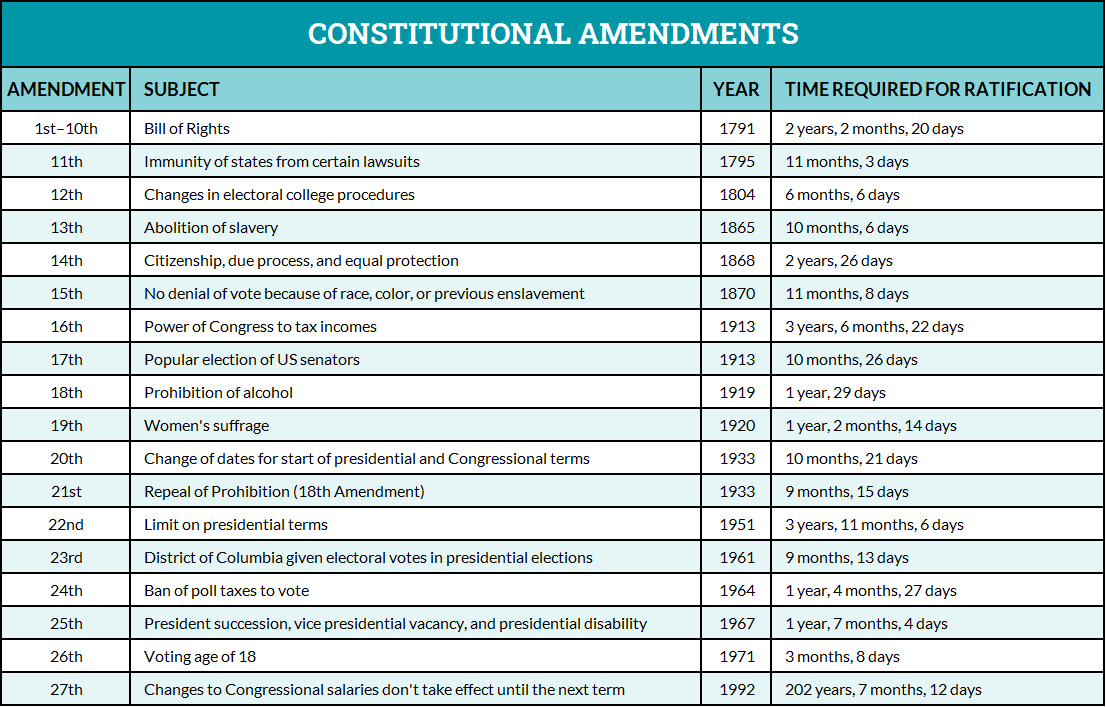
The first ten amendments of the Constitution are collectively known as the Bill of Rights, but these are not the only amendments that have been made to the document. In total, there have been twenty-seven amendments to the Constitution. You can view the chart below for a brief overview of these amendments. In this lesson, you'll learn more about the Eleventh Amendment through the Eighteenth Amendment, and in the next lesson, we'll cover the Nineteenth through the Twenty-Seventh.
Eleventh Amendment (1795)
TEXTEXPLANATION
The Judicial power of the United States shall not be construed to extend to any suit in law or equity, commenced or prosecuted against one of the United States by Citizens of another State, or by Citizens or Subjects of any Foreign State.
 This amendment adjusted a portion of Article II. It says that states cannot be sued in federal court by a citizen of another state or by someone from another country.
Twelfth Amendment (1804)
TEXTEXPLANATION
The Electors shall meet in their respective states and vote by ballot for President and Vice-President, one of whom, at least, shall not be an inhabitant of the same state with themselves; they shall name in their ballots the person voted for as President, and in distinct ballots the person voted for as Vice-President, and they shall make distinct lists of all persons voted for as President, and of all persons voted for as Vice-President, and of the number of votes for each, which lists they shall sign and certify, and transmit sealed to the seat of the government of the United States, directed to the President of the Senate;—the President of the Senate shall, in the presence of the Senate and House of Representatives, open all the certificates and the votes shall then be counted;—The person having the greatest number of votes for President, shall be the President, if such number be a majority of the whole number of Electors appointed; and if no person have such majority, then from the persons having the highest numbers not exceeding three on the list of those voted for as President, the House of Representatives shall choose immediately, by ballot, the President. But in choosing the President, the votes shall be taken by states, the representation from each state having one vote; a quorum for this purpose shall consist of a member or members from two-thirds of the states, and a majority of all the states shall be necessary to a choice. [And if the House of Representatives shall not choose a President whenever the right of choice shall devolve upon them, before the fourth day of March next following, then the Vice-President shall act as President, as in case of the death or other constitutional disability of the President.—]* The person having the greatest number of votes as Vice-President, shall be the Vice-President, if such number be a majority of the whole number of Electors appointed, and if no person have a majority, then from the two highest numbers on the list, the Senate shall choose the Vice-President; a quorum for the purpose shall consist of two-thirds of the whole number of Senators, and a majority of the whole number shall be necessary to a choice. But no person constitutionally ineligible to the office of President shall be eligible to that of Vice-President of the United States.
*The part included in brackets has been superseded by Section 3 of the Twentieth Amendment.
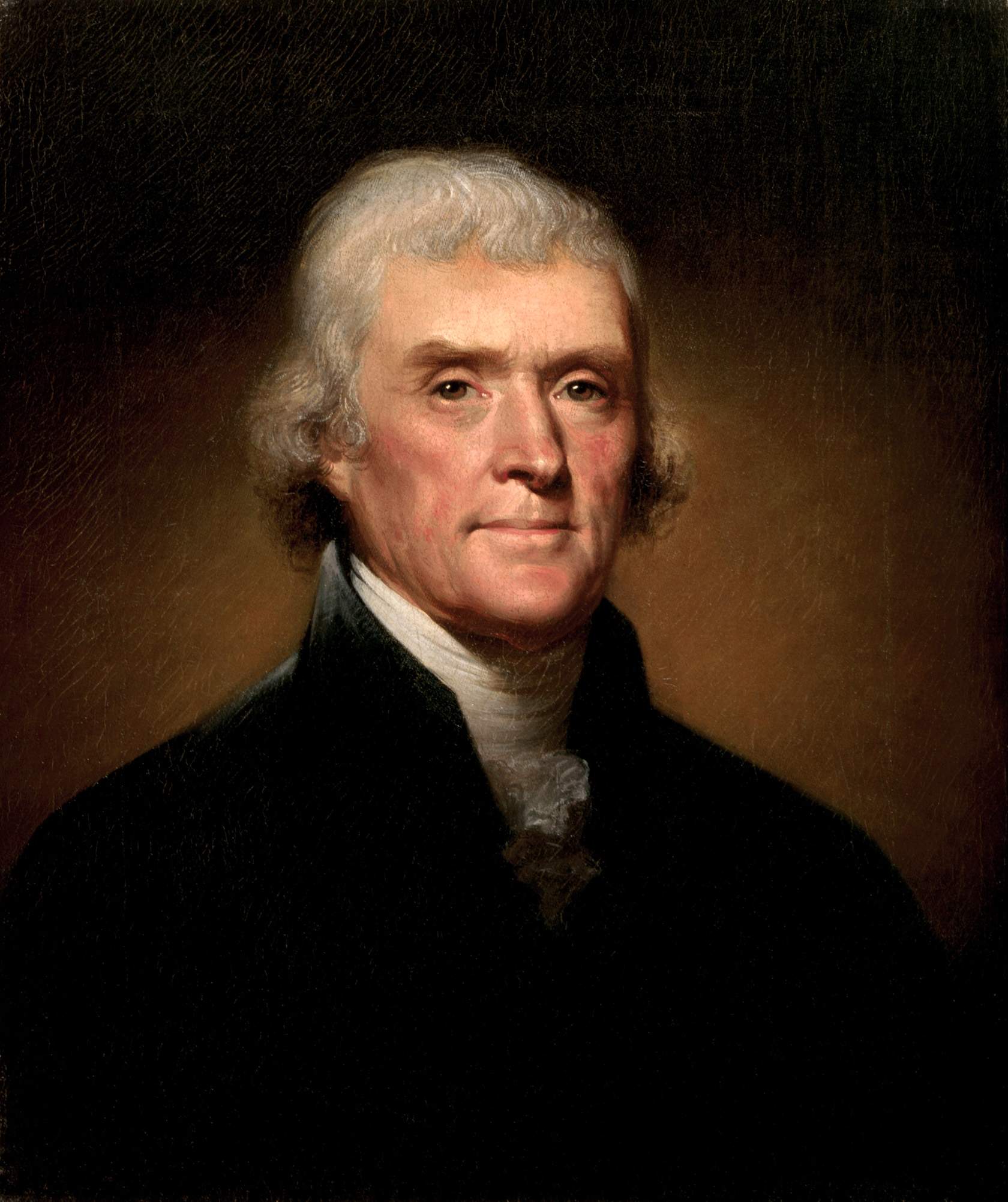
Image: Thomas Jefferson
 This amendment changes the scope and procedure of the Electoral College described in Article II. It details the procedure for the electors that vote for the president and the vice president.
In today's political arena, the political parties choose the candidates that they want to run for both the office of the president and the vice president. The candidates are nominated at conventions that are held the summer before the election in November. When the election occurs, the people go to the polls and cast their votes. This is known as the popular vote. The popular vote in each state determines who shall serve as the electors in each state. The electors then cast a separate vote for president and vice president. The number of electors in each state equals the number of representatives of the state, which is determined by population, combined with the number of senators of the state, which is always two per state. Each state sends a list of the candidates with the number of votes cast for each. Then, the votes are counted in a joint session of Congress. If no candidate for the presidency receives a majority of the electoral vote, the House of Representatives must choose a winner from the top three candidates. This is referred to as throwing the election to the House. The election has been thrown to the House twice in American history: in 1800 and in 1824. If no candidate for the vice presidency receives a majority of the vote, the Senate must choose a winner from the top two candidates. In both cases, each state receives one vote.
Before the Twelfth Amendment, the way electors voted was different. Instead of casting two separate votes for president and vice president, electors would cast two votes for president. Then, whoever had the most votes would become president, and whoever had the second-most votes would become vice president.
This caused two major issues. First, it could result in a president and vice president from different parties—this happened in 1796 when the Federalist John Adams was president, and the Democratic-Republican Thomas Jefferson was vice president. Second, it could lead to a tie for the presidency if all electors in a political party gave both their votes to their party's presidential and vice presidential candidates. This happened in 1800, when Jefferson (the presidential candidate) and Aaron Burr (the vice presidential candidate) tied for the most electoral votes. It took thirty-six votes in the House to resolve the issue and finally grant Jefferson the presidency. The creators of the Constitution had failed to take into account the effect of political parties when drafting the original document, and the Twelfth Amendment was designed to fix these issues.
Image: Aaron Burr
Thirteenth Amendment (1865)
TEXTEXPLANATION
1: Neither slavery nor involuntary servitude, except as a punishment for crime whereof the party shall have been duly convicted, shall exist within the United States, or any place subject to their jurisdiction.
2: Congress shall have power to enforce this article by appropriate legislation.
 This amendment freed all the slaves.
Fourteenth Amendment (1868)
TEXTEXPLANATION
1: All persons born or naturalized in the United States, and subject to the jurisdiction thereof, are citizens of the United States and of the State wherein they reside. No State shall make or enforce any law which shall abridge the privileges or immunities of citizens of the United States; nor shall any State deprive any person of life, liberty, or property, without due process of law; nor deny to any person within its jurisdiction the equal protection of the laws.
2: Representatives shall be apportioned among the several States according to their respective numbers, counting the whole number of persons in each State, excluding Indians not taxed. But when the right to vote at any election for the choice of electors for President and Vice-President of the United States, Representatives in Congress, the Executive and Judicial officers of a State, or the members of the Legislature thereof, is denied to any of the male inhabitants of such State, being twenty-one years of age,* and citizens of the United States, or in any way abridged, except for participation in rebellion, or other crime, the basis of representation therein shall be reduced in the proportion which the number of such male citizens shall bear to the whole number of male citizens twenty-one years of age in such State.
3: No person shall be a Senator or Representative in Congress, or elector of President and Vice-President, or hold any office, civil or military, under the United States, or under any State, who, having previously taken an oath, as a member of Congress, or as an officer of the United States, or as a member of any State legislature, or as an executive or judicial officer of any State, to support the Constitution of the United States, shall have engaged in insurrection or rebellion against the same, or given aid or comfort to the enemies thereof. But Congress may by a vote of two-thirds of each House, remove such disability.
4: The validity of the public debt of the United States, authorized by law, including debts incurred for payment of pensions and bounties for services in suppressing insurrection or rebellion, shall not be questioned. But neither the United States nor any State shall assume or pay any debt or obligation incurred in aid of insurrection or rebellion against the United States, or any claim for the loss or emancipation of any slave; but all such debts, obligations and claims shall be held illegal and void.
5: The Congress shall have the power to enforce, by appropriate legislation, the provisions of this article.
*Changed by Section 1 of the 26th Amendment.
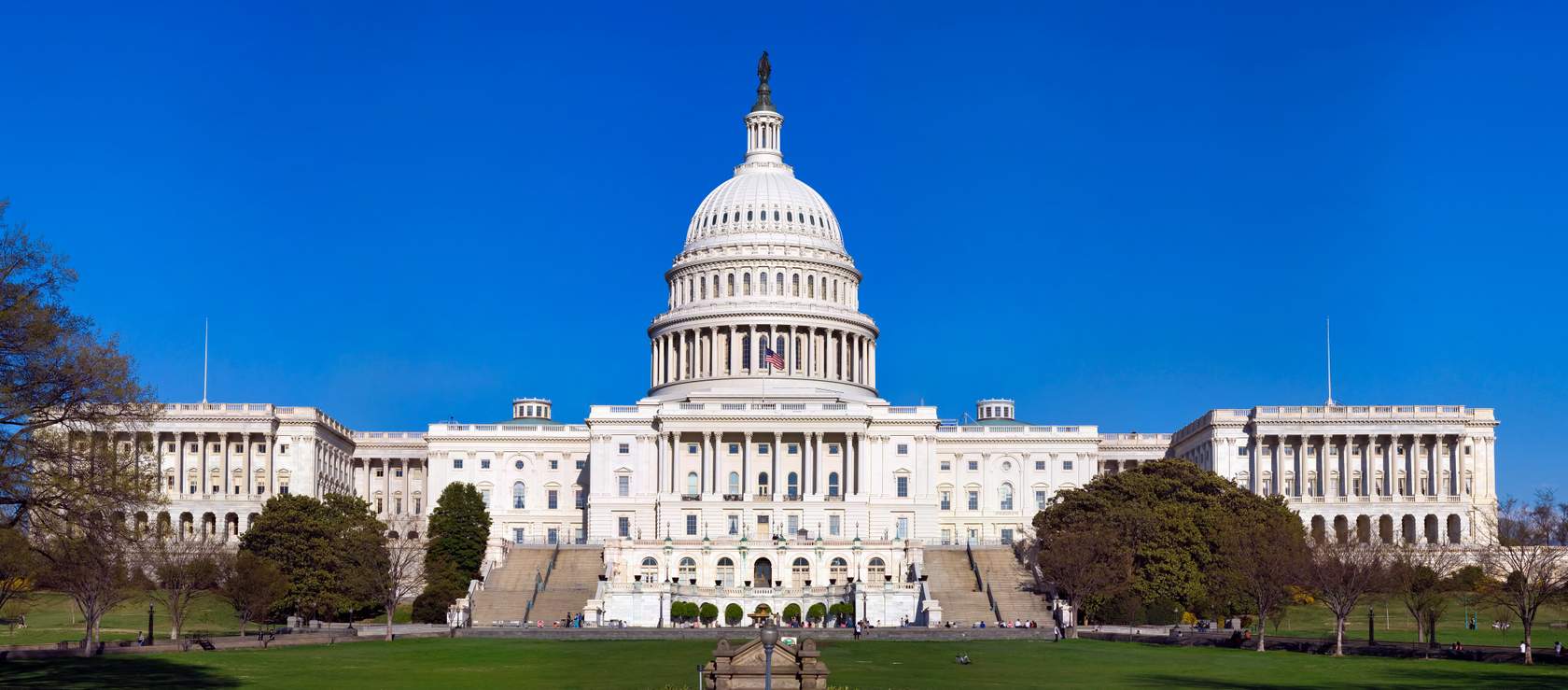
The Fourteenth Amendment is important because it has been used by the Supreme Court to prohibit state and local governments from acting unfairly in the same way that the Bill of Rights prohibits the federal government from acting unfairly. The Fifth and Fourteenth Amendments work together to guarantee due process of law for all citizens. This includes two different types of due process: procedural due process, which says that the government must use fair proceedings, and substantive due process, which says that the laws created by the government must be constitutional.
Section 1: A citizen of the United States is defined as someone who is born in the United States or naturalized. Naturalization is the legal process through which a non-citizen can become a citizen. So, an immigrant who moves to America can become a US citizen by being naturalized. This section also says that no state in the Union can take away a person's freedom without due process of law (legal proceedings—e.g., a trial). State laws should apply to each citizen in the same manner.
Section 2: The state shall count all of its citizens for the purpose of representation (local, state, and federal representatives). If the state does not allow its citizens to participate in voting, however, the representation for the state will be cut.
Section 3: Anyone who has taken an oath to defend the Constitution but then has rebelled against it can no longer serve as a senator, representative, elector, or in any other federal office. This section was targeted toward people who served the Confederacy. It meant that if someone had served in the United States federal government or a state government before the Civil War, but then supported the Confederacy, that person could not return to the federal or state government after the war.
Section 4: The national debt incurred by the United States is upheld, but the debt incurred by the Confederacy was not to be repaid. Owners of slaves were not to be compensated for the loss of slaves.
Section 5: Congress was given the power to enforce this article with legislation.
Image: Confederate National Flag (The Fourteenth Amendment addressed several items related to the Confederacy. It said that no state can take away people's freedom without due process, that former members of the government who'd broken their oaths by joining the Confederacy could not rejoin the government, and that the US would not be responsible for debts incurred by the Confederacy.)
Fifteenth Amendment (1870)
TEXTEXPLANATION
1: The right of citizens of the United States to vote shall not be denied or abridged by the United States or by any State on account of race, color, or previous condition of servitude—
2: The Congress shall have the power to enforce this article by appropriate legislation.
 The states cannot prohibit someone from voting based on race, color, or having previously been a slave.
Sixteenth Amendment (1913)
TEXTEXPLANATION
The Congress shall have power to lay and collect taxes on incomes, from whatever source derived, without apportionment among the several States, and without regard to any census or enumeration.
 Congress has the power to lay and collect income taxes.
Seventeenth Amendment (1913)
TEXTEXPLANATION
The Senate of the United States shall be composed of two Senators from each State, elected by the people thereof, for six years; and each Senator shall have one vote. The electors in each State shall have the qualifications requisite for electors of the most numerous branch of the State legislatures.
When vacancies happen in the representation of any State in the Senate, the executive authority of such State shall issue writs of election to fill such vacancies: Provided, That the legislature of any State may empower the executive thereof to make temporary appointments until the people fill the vacancies by election as the legislature may direct.
This amendment shall not be so construed as to affect the election or term of any Senator chosen before it becomes valid as part of the Constitution.
 This amendment provides for the direct election of senators by popular vote. This changes Article I, which states that senators were to be elected by the state legislatures. If there is a vacancy in the Senate, the voters may fill the vacancy with a special election, or with permission from the state legislature, the governor may fill the vacancy until the next regular election. This amendment was not retroactive, as it only applied to elections moving forward.
Eighteenth Amendment (1919)
TEXTEXPLANATION
1: After one year from the ratification of this article the manufacture, sale, or transportation of intoxicating liquors within, the importation thereof into, or the exportation thereof from the United States and all territory subject to the jurisdiction thereof for beverage purposes is hereby prohibited.
2: The Congress and the several States shall have concurrent power to enforce this article by appropriate legislation.
3: This article shall be inoperative unless it shall have been ratified as an amendment to the Constitution by the legislatures of the several States, as provided in the Constitution, within seven years from the date of the submission hereof to the States by the Congress.

This amendment is known as Prohibition. The manufacture, sale, and transportation of alcohol was deemed illegal.