Political Science
Political Science Notes
Definition
Political Science: The systematic study of politics, government systems, and political behavior.
Key Subfields
Comparative Politics
Examines different political systems and governments.
Analyzes political institutions, processes, and policies across countries.
International Relations
Focuses on relationships between countries.
Studies issues like war, diplomacy, trade, and international organizations.
Political Theory
Explores ideas and philosophies behind political systems.
Key thinkers: Plato, Aristotle, Machiavelli, Hobbes, Locke, Rousseau, Marx.
Public Administration
Examines the implementation of government policy.
Focuses on the organization, management, and behavior of public sector organizations.
Public Policy
Analyzes the creation and effects of policies.
Involves policy formulation, implementation, and evaluation.
Key Concepts
Power: The ability to influence or control the behavior of people and institutions.
Authority: The recognized right to make decisions and enforce rules.
Legitimacy: The acceptance of an authority, often a governing law or regime.
Sovereignty: The authority of a state to govern itself without external interference.
Political Ideologies: Sets of beliefs about politics and society (e.g., liberalism, conservatism, socialism).
Political Systems
Democracy: Government by the people, typically through elected representatives.
Authoritarianism: Concentration of power in a leader or an elite not accountable to the public.
Totalitarianism: An extreme form of authoritarianism where the state seeks to control all aspects of public and private life.
Research Methods
Qualitative Methods: Interviews, case studies, and content analysis.
Quantitative Methods: Surveys, statistical analysis, and experiments.
Important Theories
Realism: Focuses on power and national interest in international relations.
Liberalism: Emphasizes cooperation, democracy, and international institutions.
Constructivism: Highlights the role of social constructs and identities in politics.
Current Issues in Political Science
Globalization and its impact on sovereignty.
Climate change and environmental policy.
Human rights and humanitarian interventions.
Populism and its
Federalism
Federalism is a system of government where power is divided between a central authority and smaller political units, like states or provinces. Each level has its own responsibilities and powers.
Presidential
Presidential refers to a system of government where a president serves as the head of state and government, often elected separately from the legislative branch. The president has significant powers, including enforcing laws and overseeing the executive branch.
1987 Constitution of the Philippines
Overview
Ratified on February 2, 1987.
Established after the People Power Revolution, which ousted President Ferdinand Marcos.
Aimed to restore democracy and promote human rights.
Structure
Preamble
Expresses the aspirations of the Filipino people.
Emphasizes sovereignty, democracy, and social justice.
Articles
Article I: National Territory
Defines the territory of the Philippines.
Article II: Declaration of Principles and State Policies
Establishes the fundamental principles guiding the government.
Emphasizes nationalism, social justice, and human rights.
Article III: Bill of Rights
Guarantees individual rights and freedoms (e.g., freedom of speech, religion, assembly).
Article IV: Citizenship
Defines who are citizens of the Philippines.
Article V: Suffrage
Establishes the right to vote and the electoral process.
Article VI: Legislative Department
Outlines the structure and powers of Congress (Senate and House of Representatives).
Article VII: Executive Department
Defines the powers and responsibilities of the President.
Article VIII: Judicial Department
Establishes the judiciary's role and the Supreme Court.
Article IX: Constitutional Commissions
Creates independent bodies (e.g., Commission on Elections, Commission on Human Rights).
Article X: Local Government
Provides for the autonomy of local government units.
Article XI: Accountability of Public Officers
Establishes mechanisms for the accountability of government officials.
Article XII: National Economy and Patrimony
Regulates the economy and natural resources.
Article XIII: Social Justice and Human Rights
Promotes social justice and the protection of human rights.
Article XIV: Education, Science and Technology, Arts, Culture, and Sports
Emphasizes the importance of education and cultural heritage.
Article XV: The Family
Recognizes the family as the basic social unit.
Article XVI: General Provisions
Contains miscellaneous provisions.
Article XVII: Amendments or Revisions
Outlines the process for amending the Constitution.
Constitution Notes
Definition
A constitution is a set of fundamental principles or established precedents according to which a state or other organization is governed.
Purpose
Establishes the framework of government.
Defines the distribution of powers among different branches.
Protects individual rights and liberties.
Provides a mechanism for amendments and changes.
Types of Constitutions
Written Constitution
Codified in a single document (e.g., U.S. Constitution).
Clear and accessible.
Unwritten Constitution
Based on statutes, conventions, judicial decisions (e.g., UK Constitution).
Flexible and adaptable.
Rigid Constitution
Difficult to amend (e.g., U.S. Constitution).
Requires special procedures.
Flexible Constitution
Can be amended easily (e.g., UK Constitution).
Changes can be made through ordinary legislation.
Key Components
Preamble: Introduction stating the purpose and guiding principles.
Articles: Main body detailing the structure of government, powers, and responsibilities.
Amendments: Provisions for changes to the constitution.
Bill of Rights: List of individual rights and freedoms.
Constitution Notes
MEANING
derive from the word “constitutuo” which means fixed, established or settled
define as the body rules and principles
Forms of Government
Definition
A system by which a state or community is governed.
Determines how power is distributed and exercised.
Monarchy, Aristocracy, and Democracy
Monarchy
Definition: A form of government where a single person (the monarch) rules the state.
Types:
Absolute Monarchy: The monarch has unrestricted power (e.g., Saudi Arabia).
Constitutional Monarchy: The monarch's powers are limited by a constitution or laws (e.g., United Kingdom).
Pros:
Stability and continuity in leadership.
Can be efficient in decision-making.
Cons:
Potential for abuse of power.
Limited political participation for citizens.
Aristocracy
Definition: A government system where power is held by a small, privileged ruling class (aristocrats).
Characteristics:
Often based on noble lineage, wealth, or education.
Can coexist with other forms of government (e.g., aristocratic elements in democracies).
Pros:
Can lead to informed governance by educated elites.
Stability through established social structures.
Cons:
Can lead to inequality and social stratification.
Limited representation of the general populace.
Democracy
Definition: A system of government in which power is vested in the people, who exercise it directly or through elected representatives.
Types:
Direct Democracy: Citizens directly participate in decision-making (e.g., ancient Athens).
Representative Democracy: Citizens elect representatives to make decisions on their behalf (e.g., United States).
Pros:
Promotes political equality and citizen participation.
Encourages accountability and transparency in governance.
Cons:
Can lead to populism and mob rule.
Decision-making can be slow and inefficient.
Comparative Overview
Power Distribution:
Monarchy: Centralized in one individual or family.
Aristocracy: Concentrated among a small elite.
Democracy: Distributed among the populace.
Citizen Participation:
Monarchy: Limited.
Aristocracy: Limited, often based on class.
Democracy: High, with mechanisms for public input.
Stability vs. Change:
Monarchy: Generally stable but can resist change.
Aristocracy: Stable but may face challenges from lower classes.
Democracy: Dynamic, allowing for
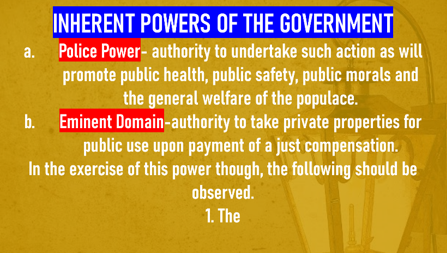
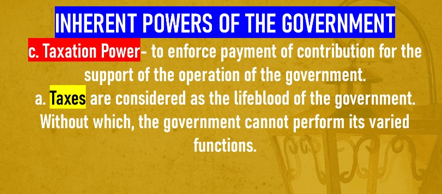
Inherent Powers of the Government
Definition
Inherent powers are those powers that are not explicitly stated in the Constitution but are essential for the government to function effectively and fulfill its duties.
Police Power
individual freedoms while ensuring public welfare.
Notes on State
Definition
A state is a political entity with a defined territory, a permanent population, a government, and the capacity to enter into relations with other states.
Characteristics of a State
Territory:
Defined geographical area with recognized borders.
Population:
A group of people residing within the territory.
Government:
An organized political authority that makes and enforces laws.
Sovereignty:
The supreme authority within its territory; independence from external control.
Three Branches of Government
The government of the United States is divided into three branches to ensure a separation of powers and prevent any one branch from becoming too powerful. Each branch has its own distinct functions and responsibilities.
1. Legislative Branch
Primary Function: Makes laws.
Components:
Congress: Bicameral legislature consisting of:
House of Representatives:
Members serve 2-year terms.
Representation based on state population.
Senate:
Members serve 6-year terms.
Each state has 2 senators.
Powers:
Draft and pass legislation.
Control federal budget and taxation.
Declare war.
Confirm presidential appointments (Senate).
Ratify treaties (Senate).
2. Executive Branch
Primary Function: Enforces laws.
Components:
President: Head of state and government.
Serves a 4-year term; can be re-elected once.
Vice President: Assists the President and assumes office if the President is unable to serve.
Cabinet: Composed of heads of federal departments (e.g., Defense, Education).
Powers:
Veto legislation passed by Congress.
Issue executive orders.
Conduct foreign policy and negotiate treaties.
Appoint federal judges and other officials.
3. Judicial Branch
Primary Function: Interprets laws.
Components:
Supreme Court: Highest court in the land.
Composed of 9 justices appointed for life.
Lower Federal Courts: Includes Courts of Appeals and District Courts.
Powers:
Review laws and executive actions for constitutionality (Judicial Review).
Resolve disputes under federal law.
Interpret the meaning of laws and the Constitution.
Checks and Balances
Each branch has the ability to limit the powers of the others:
Legislative can override vetoes and confirm appointments.
Executive can veto legislation and appoint judges.
Judicial can declare laws or executive actions unconstitutional.
Conclusion
The separation of powers among the three branches of government is fundamental to the functioning of democracy in the United
Sovereignty
Definition
Sovereignty: The authority of a state to govern itself or another state. It encompasses the full right and power of a governing body to govern its territory without interference from external bodies.
Types of Sovereignty
Internal Sovereignty:
The power of a state to exercise authority over its own territory and population.
Involves law-making, enforcement, and administration.
External Sovereignty:
Recognition by other states and international organizations.
Involves the ability to enter into relations with other states.
Key Concepts
State Sovereignty: The principle that a state has the ultimate authority over its territory and domestic affairs.
Popular Sovereignty: The idea that the authority of a state is created and sustained by the consent of its people, through their elected representatives.
National Sovereignty: The concept that a nation has the right to self-determination and governance.
Historical Context
Westphalian Sovereignty: Established in 1648, it marked the end of the Thirty Years' War and laid the foundation for modern international relations, emphasizing territorial integrity and non-interference.
Colonialism and Sovereignty: Many nations lost sovereignty during colonial periods, leading to struggles for independence and self-governance.
Challenges to Sovereignty
Globalization: Increased interdependence among states can dilute sovereignty as decisions are influenced by international organizations and treaties.
Supranational Entities: Organizations like the EU may require member states to cede some aspects of sovereignty for collective decision-making.
Human Rights: The principle of humanitarian intervention can challenge state sovereignty when human rights abuses occur.
Legal Aspects
International Law: Sovereignty is a fundamental principle in international law, governing relations between states.
Recognition: A state’s sovereignty is often contingent upon recognition by other states and international bodies.
Contemporary Issues
Sovereignty vs. Global Governance: The tension between national interests and global challenges (e.g., climate change, terrorism).
Cyber Sovereignty: The concept of controlling internet governance and data within a state's borders.
Indigenous Sovereignty: The rights of indigenous peoples to govern themselves and maintain their cultural identity.
Conclusion
Sovereignty remains a crucial concept in understanding state power, international
Nation and State
NATION
A nation is a group of people who share a common identity and often live within a defined territory. This shared identity can be based on various factors such as culture, language, history, or ethnicity.
STATE
A state is a structured and organized political unit with sovereignty over a defined geographic area. It is responsible for governing its territory and population and has the authority to enter into relations with other states.
To take into consideration
There can be a nation without there being a state. However, when a state exist, there must be at least one nation
Examples of Stateless Nations
Kurds: The Kurds are an ethnic group with a distinct language, culture, and history. They live in regions spanning across Turkey, Iraq, Iran, and Syria. Despite their strong sense of national identity and aspirations for greater autonomy or independence, they do not have a recognized independent state.
Basques: The Basques are another example. They have a unique language and culture and inhabit parts of Spain and France. They have sought greater autonomy within Spain and France but do not have a separate sovereign state.
Tibetans: Tibetans have a distinct cultural and religious identity. They are primarily located in the Tibetan Plateau region, which is now part of China. Although there is a strong sense of Tibetan national identity, Tibet does not have an independent state.