Period 3
Trends:
as you move along the period the ionisation energy increases until a new energy level is reached
sodium requires less energy to ionise than magnesium as magnesium has to lose two electrons to form a full outer shell (Mg2+) and has more protons in its nucleus
2Na + 2H2O → 2NaOH + H2 is faster than
Mg(s) + 2H2O(l) → Mg(OH)2(aq) + H2(g) where bubbles form slowly on the surface
but Mg(s) + H2O(g - steam) → MgO(s) + H2(g) happens quickly with bright white flame to form a white solid
Oxides:
form oxides in their highest oxidation state (same as their group number)
Al → 3+ therefore Al2O3
P → 5+ therefore P4O10 NOT P2O5
sulphur can form either SO2 (sulphur dioxide) or SO3(sulphur trioxide) but SO3 requires a catalyst + higher temperature
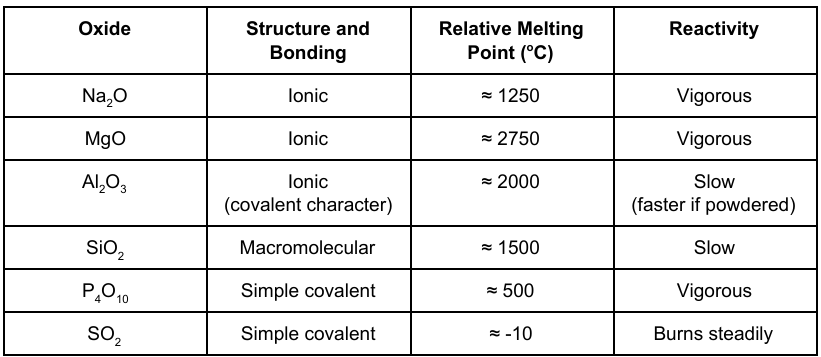
all the ionic oxides dissolve in water to form alkaline solutions
Na2O + H2O → 2NaOH
MgO + H2O → Mg(OH)2
simple covalents dissolve to form acidic solutions
P4O10 + 6H2O → 4H3PO4 (phosphoric acid)
SO2 + H2O → H2SO3 (sulfurous acid)
SO3 + H2O → H2SO4 (sulfuric acid)
When ionic oxides are mixed with an acid, neutralisation occurs
forms a salt + water
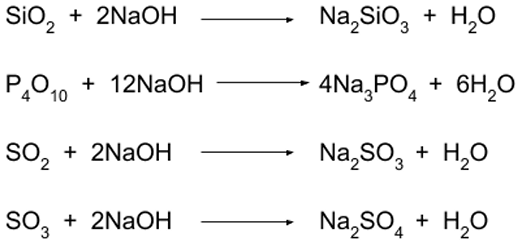
Aluminium oxide is partially covalent + ionic and so it is insoluble in water
therefore acts as both acid and a base - it is amphoteric
