Democratisation, the 'End of History' and Democratic Indicators
Models of Democracy
These models below are by British political scientist, David Held.
Democracy encompasses many different modes and definitions that states all over the world participate in. This is because there is no one correct definition of democracy, making it ‘essentially contested’.
These are as follow:
→ Minimalist
On behalf of the public, representatives are elected to vote on laws to pass.
→ Representative / Indirect
Debate whether this is still considered ‘liberal’ or not
→ Direct
→ Participatory
All members (or as many can be) of the public are to participate to as much and as deep as possible in every decision-making scenario
→ Deliberative
Members of the public come together to debate on issues that are concerning their society and choose an outcome together
→ E-Democracy
The Triumph of Liberal Democracy
The Third Wave
The third wave of democracy had a large number / majority of states fully consolidating themselves as a democracy from other regimes that they followed. By the end of 2016, 58% of countries were considered a democracy and were following that regime type.
The minimalist definition of democracy is:
→ A process of moving from a government that isn’t democratically elected to one that is selected in open, free and fair elections. (Sunman, 2026)
→ …democratisation is the replacement of a government that was not chosen [democratically] by one that is selected in open, free and fair election. (Huntington, 1991, p. 9).
The End of History
During the Third Wave of democratisation, it was believed by many that democracy is the final evolution stage of government politics for state, but also a stage of human development that was always inherent. The democratisation promoted took the modernity approach, and exhausted any other type of political regime because of the large Western influence globally.
The Democratic Recession
However, despite all the belief that democratisation was the final form of political evolution and all states that were democratic would stay as such, there came a recession. There had been no new states established as a democracy since 2006 and this democratic recession happened in four trends:
→ Democratic Breakdown of States
→ Declination of Stability and Quality of Democracies
This was majorly found in states that were “…strategically important emerging-market countries…” (Diamond, 2015)
→ Rise of Authoritarian Rule
→ Lack of Effectiveness and Performance in Promoting Democracy from States
It is found that now most (71%) of the world’s population tends to live in more autocratic and authoritarian countries currently due to the democratic recession. Those who do follow democratic rule are also only getting worse, with characteristics weakening or simply disappearing with the highest affected trait being freedom of expression, especially political expression.
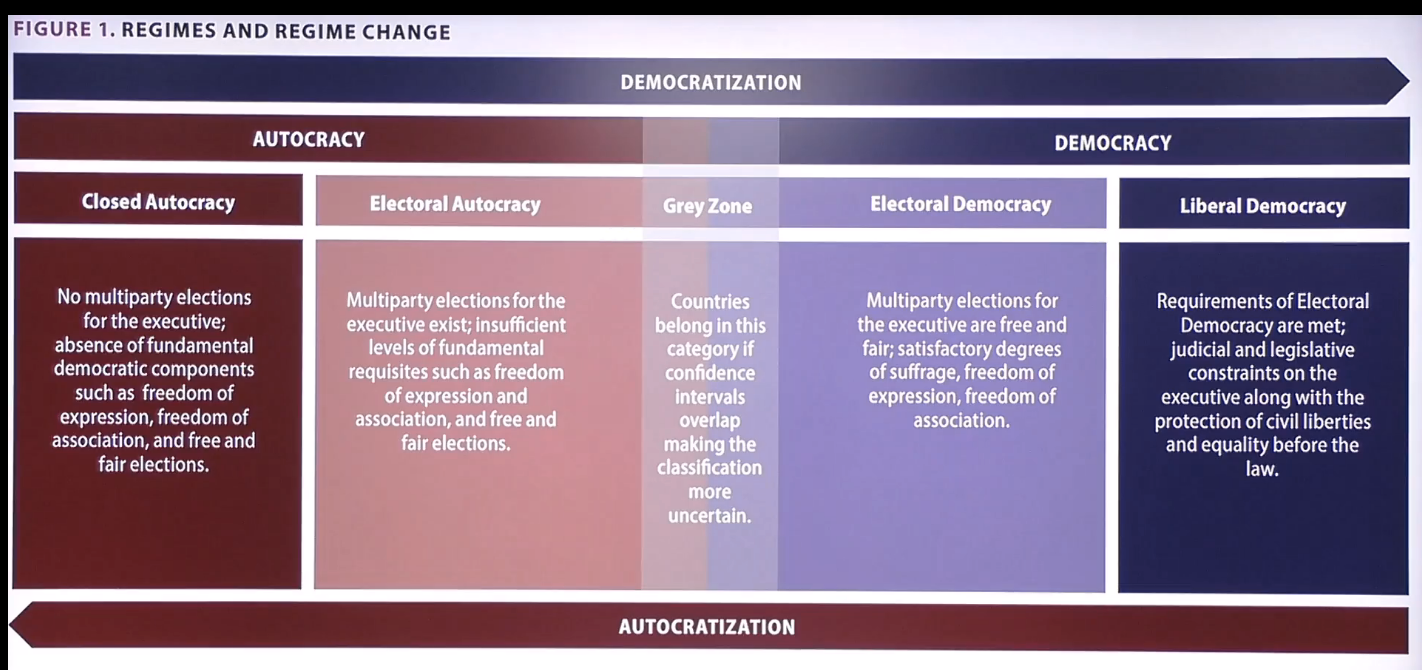
As of 2020, the number of democracies that are contracting has increased up to around 50 of the world’s total democracies, with around 10 of those in severe decline, and around 90 still stable (yet dropping). Plus, other graphs have shown that there had been around a 30% decline (as of 2018) in trust of the political institutions that follow democracy in Australia alone, down from around 71% in 2013. However, it is important to recognise that these graphs and statistics are all based on their own version of what democracy is meant to them, therefore, they may not be accurate and actually representative of how society feels or how democratisation is proceeding on.
→ Sources that measure this is VDM and Freedom World