unit 6
lesson 1
discrete random variable → takes a fixed number of values with gaps between values
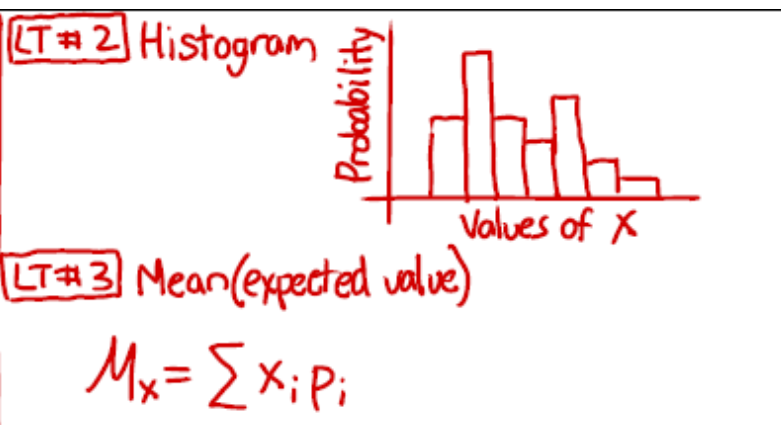
lesson 2
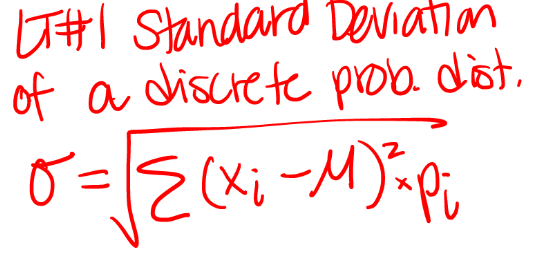
SD2 = variance
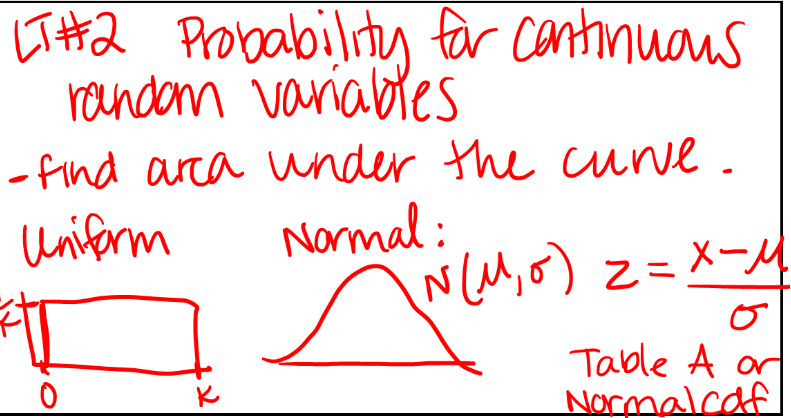
use normalcdf to find area under the curve
lesson 3
addition and subtraction to a distribution → mean changes, SD stays the same
multiplication and division to a distribution → both mean and SD change
lesson 4
combining random variables
MX+Y = MX + MY, SDX+Y = sqrt(SDX2 + SDY2)
MX-Y = MX - MY, SDX-Y = sqrt(SDX2 + SDY2)
you can’t just add standard deviations
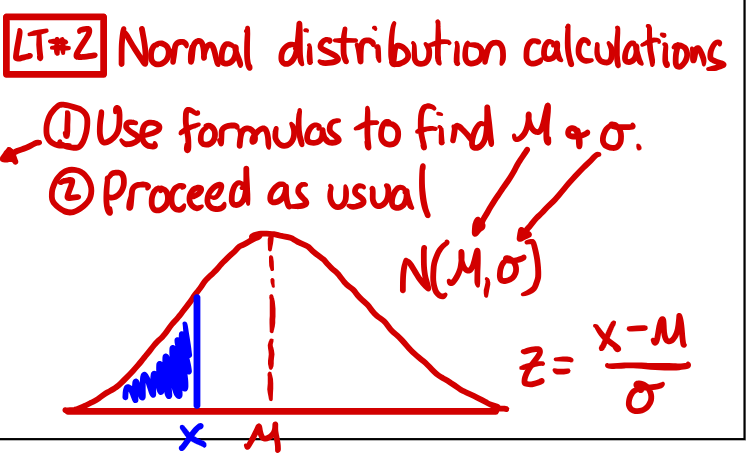
lesson 5
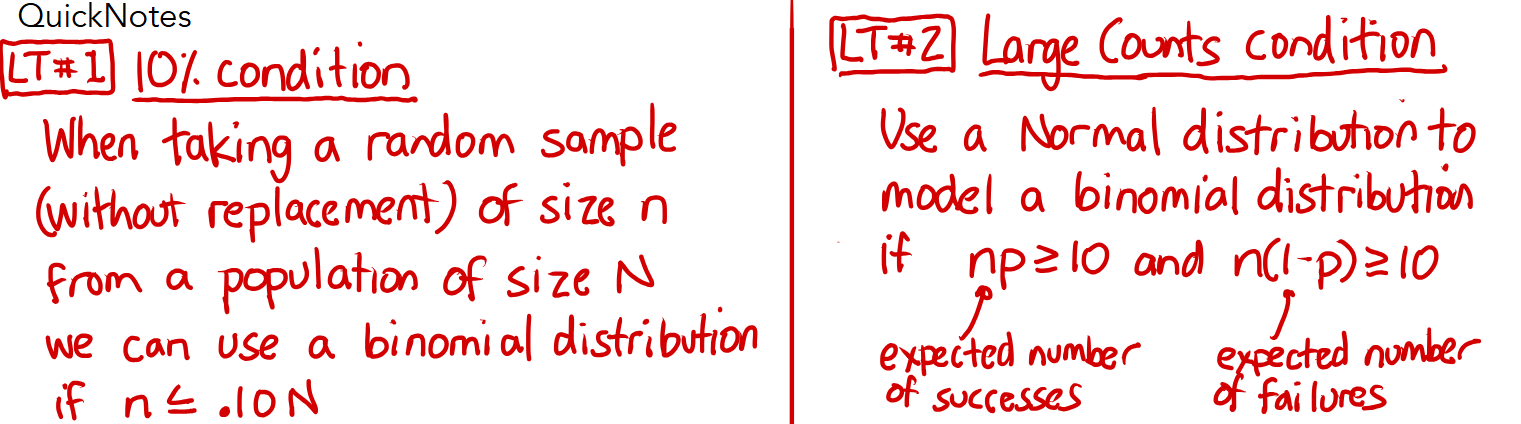
binomial distribution ( x → number of successes)
BINS
B → binary (success or failure)
I → independent trials
N → number of trials is fixed (n)
S → same probability of success
binomial formula
P (x = k) = nCk*pk(1-p)n-k
nCk → number of ways to get k successes
p → probability of success
k → # of successes
(1-p) → probability of failure
n-k → number of failures
lesson 6
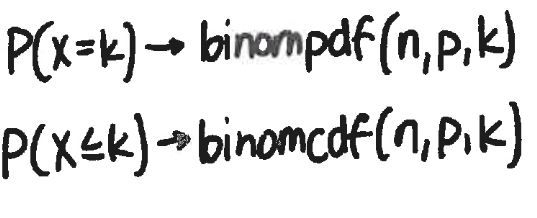
mean for binomial distribution → M = np
“after many, many groups of [n] trials, the average number of successes is [M].”
standard deviation for binomial distribution → SD = sqrt(np(1-p))
“the number of successes typically varies by [SD] trials from the mean of [M].”
lesson 7
lesson 8
geometric distribution
BITS
B → binary (success or failure)
I → independent trials
T → trials until success
S → same probability of success
P(x=k) = (1-p)k-1 * p
(1-p) → probability of failure
k → # of failures
p → probability of success
geometric distribution description
shape → skewed right
center → M = 1/p
variability → SD = sqrt(1-p)/p