WEEK 8
PRE - RECORDED LECTURE 1
Transcription occurs in the nucleus
DNA makes an RNA copy

RNA replaces T with U in transcription
in transcription the top strand of DNA is the template strand
the purple are bible nucleotides and its a single stranded nucleic acid strand made of ribose nucleotides (they’ll be translated into protein)
promoters
are responsible for starting transcription they extend several dozen or thousand nucleotide pairs upstream
attract the transcription machinery
transcription factors
the completed assembly of transcription factors and RNA polymerase II bound to a promoter is called transcription initiation complex
a promoter element called TATA box may be part of the initiation complex in eukaryotes
specific proteins that help attract RNA polymerase to a specific promoter and thats what starts transcription
mediate the binding of RNA polymerase and the initiation of transcription

steps in transcription
transcription factors
they bind to DNA when a certain number of them land on promoter then they attract RNA polymerase to transcribe the gene
RNA polymerase binds to the promoter and will start transcription at a designated spot
once RNA polymerase is bound it synthesis DNA from 5’-3’ direction (in the example above it is using the bottom strand to make an exact copy of the non template strand (the top strand))
there will be uracil instead of thymine in the RNA polymerase strand
RNA Polymerase
as RNA polymerase moves along DNA it untwists through double helix and separates the DNA (10-20 bases at a time)
RNA polymerase kinda acts like helicase at times (it locally unwinds the DNA just enough for it to get in between the strand to do its job of transcription)
RNA polymerase uses the template strand to create base pairing with the template strand (making a copy of the non template strand)
after transcription is done it rewinds

the two blue strands are complimentary and the orange is the new non template strand that got built and is a copy of the top blue strand (except it has U instead of T bc its RNA)
direction of transcription is 5’-3’
Transcription
transcription progresses at a rate of 40 nucleotides per second in eukaryotes (pretty fast)
a gene can be transcribed simultaneously by several RNA polymerases
nucleotides are added to the 3’ end of the growing RNA molecule
ribonucliotides are used to make mRNA are added to the 3’ end (bc synthesis is 5’-3’)
Termination in Eukaryotes vs Bacteria
the mechanisms of termination are different in bacteria and eukaryotes
Eukaryotes
in eukaryotes RNA polymerase works in the nucleus to transcribe the DNA and then translation occurs in cytoplasm
in eukaryotes RNA polymerase II transcribes a polyadenylation signal sequence
- this signal sequence sequences AUAA
-somewhere at the end of the coding part of the gene (the part that going to eventually code for a protein), beyond that is the sequence AAUAAA (more or less)
-the AAUAAA results in the RNA transcribing around 10 - 35 nucleotides past this sequence
the AAUAAA is the signal to end transcription
Bacteria
in bacteria the polymerase stops at a terminator and mRNA can be translated right away
transcription and translation are tightly linked in bacteria because they are in the same component compartment
in bacteria the polymerase stops transcription at the end of a terminator
the mRNA can be translated without further modification

each end of a pre-mRNA molecule is modified
-the 5’ end receives a modified nucleotide 5’ cap
-the 3’ end gets a poly - A tail
you start with a pre mRNA that needs processing
steps of processing
5’ end gets a modified nucleotide added to it called “5’ cap” (modified guanine nucleotide)
it provides protection for the 5’ against enzymes or other things that could try to degrade the RNA (it slows down that process)
at the 3’ end we get a polyadenialtion signal (see diagram)
beyond the 10 - 35 nucleotides transcription stops
then a poly A polymerase comes along and it synthesizes a poly A tail (see diagram) on the end of the mRNA

signal sequence for the RNA polymerase is there so that it knows that its going to stop making mRNA soon
poly A polymerase takes the mRNA that is present and it adds a string of As
-length of the As is highly regulated
-the determining factor of the length of the As is the lifespan of the mRNA
-if it needs to be around a long time (to make lots of proteins) the A train is long
-if it only needs to be around for a short time the A train is shorter
overview
you get a 5’ end cap
and a poly A tail
these are both ways of protecting mRNA against degrading
Modifications Share Functions
they facilitate the export of mRNA to cytoplasm
protect mRNA from hydrolytic enzymes
5’ end cap helps ribosomes attach to the 5’ end
most eukaryotic genes have long noncoding stretches of nucleotides that lie between coding regions
-these noncoding (don’t code for the protein) regions are called intervening sequences (aka introns)
the other regions (coding regions) are called exons
-called this because they are eventually expressed, usually translated into amino acid sequences
-called exons bc they are eventually expressed

5’ end cap on the left
bright orange section that has exons and the introns in light orange
introns are areas that are not needed for the final mRNA bc the aren’t coding for the protein
RNA splicing is a process that removes introns and bringing exons together
it shows the codons (part of the mRNA that is eventually gonna code for a protein)
-for example in the first section we have codons 1-30 and 30-104 and lastly 105-146 (all on extrons)
-once we splice out the introns you get just exons made up of the central core (coding sequence of the gene)
in some cases RNA splicing is carried out by spliceosomes
-spliceosomes consist of varitiy of proteins and several smaller nuclear ribonucleopritoens (snRNPs)
-together they decide where splicing occurs for every mRNA in the cell
-snRNPs recognize splice sites
spliceosomes have to be able to identify which areas of a gene are not needed for a protein

RNAs of the spliceosome also catalyze the splicing reaction
there are small RNAs that recognize specific sequences in the mRNA that will be spliced
there are thousands of these in a cell that preform this job and each one is distinct for different mRNAs
Process
exon one on the left there is a large looped intron and then exon two on the right
it brings those exons together and cuts the intron out
spliceosome brings the two exons together by forming the little arch thing
the thing at the top with the arch shape is a pre mRNA and the thing at the bottom (straight line) is a mature mRNA
Ribozymes are catalytic RNA molecules that function as enzymes
-they self splice RNAs to remove their own introns
most splicing is done by a splicisome (but there are enzymes that have the ability to do that themselves and they are called riobenzymes)
discovery of ribozymes disproved the belief that all biological catalysts were proteins
some introns contain sequences that may regulate gene expression
-promoter elements can be inside an intron
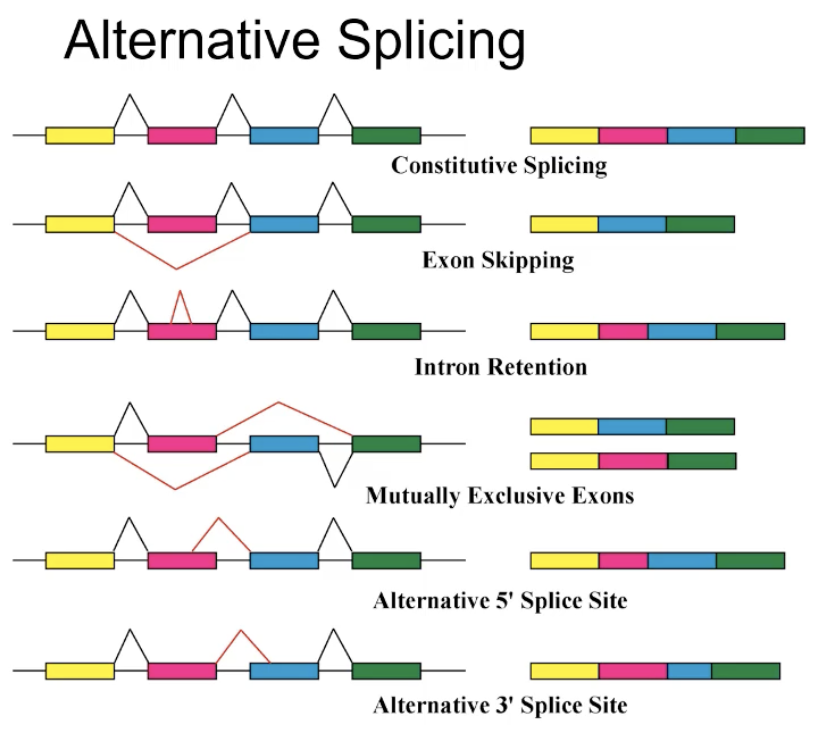
genes can encode more than one polypeptide, depending on which segments are treated as exons during splicing
RNA splicing is when different introns are spliced in resulting in different final mRNAs
Consequently the number of different proteins an organism can produce is much greater than its number of genes
proteins often have modular architecture consisting of discrete regions called domains
in many cases, individual exons code for the different domains in a protein
exon shuffling may result in
THREE MAIN STEPS OF RNA PROCESSING
5’ cap
splicing (after splicing you get mature mRNA)
poly A tail

two exons in pre mRNA and intron
not always but most of the time the sequence of the intron has a GU at the 5’ end and an AG at the 3’ end of the intron
the 5’ GU is connected to the internal A and then the whole entire thing is spliced out
this results in exon 1 and 2 brought together and spliced and your intron released

red, yellow, green and blue are exons and the lines are introns
after splicing you can see that two different mRNAs are made
in one case green exon is spliced out and in another case the yellow exon is spliced out
from the same pre mRNA we get two different mature mRNAs that lead to two different proteins
these are called isoformers

this diagram is to remind you that if the top line has your mRNA and modified guanine
m7Gppp = the modified five prime cap of the mRNA
start codon = AUG and the stop codon = UAA
the part that is translated is between the AUG and UAA
in this example to the left of that there is a new five prime untranslated region
beyond that on the 3’ end is the poly A tail and in this case it is 70 nucleotides long