(Module 59) Sustainable Development
Sustainable Development: Development that meets present consumption needs without compromising the ability of future generations to meet their consumption needs.
Resource Depletion: The consumption of natural resources faster than they can be replenished.
Mining for fossil fuels & minerals
Deforestation
Soil Erosion
Aquifer Depletion
Overfishing
Environmental Pollution: The contamination of the physical (air, water, earth) and biological components of the environment to the point that normal functions are negatively affected.
Point Source Pollution: Any single identifiable source from which contaminants are discharged such as a pipe or smokestack.
Non-Point Source Pollution: Contamination originating from multiple diffuse sources.
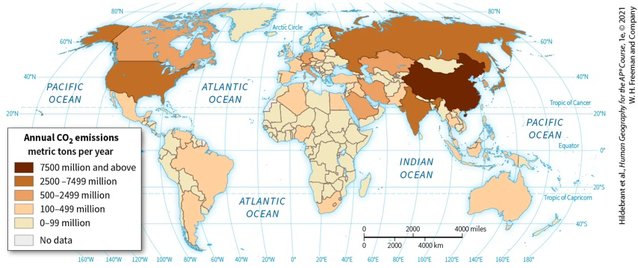
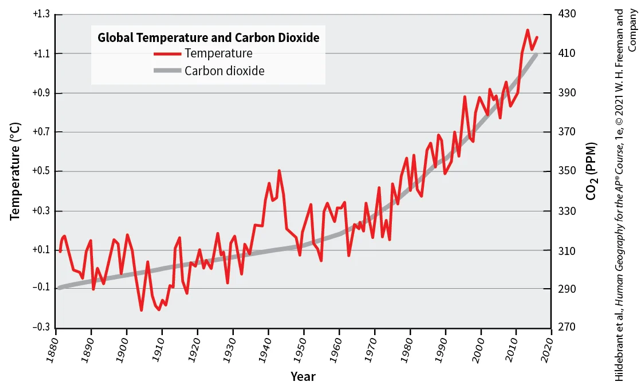
Climate Change: A long-term shift in global or regional climate patterns.
The most significant of human-influenced change is the steady rise in average global temperatures from the mid-twentieth century to the present.
Conserving Natural Resources:
One way to think about slowing natural resource depletion is to follow the 4 R’s: Reduce, Reuse, Recycle, and Rethink.
Cogeneration: Producing two forms of energy from one fuel.
When one fuel is combusted, some of the energy is released into the environment as heat.
Cogeneration facilities capture that heat and use it to warm building or to power machinery.
Reducing Pollution:
In the United States, the most important regulations were the Clean Air Act (1963) and the Clean Water Act (1973).
Industrialization does not necessarily lead to environmental harm. However, some rapidly developing countries have not adopted and enforced the necessary regulations and continue to harm the environment.
Carbon Neutrality: Achieving zero CO2 releases through a combination of emissions reduction and carbon removal.
Carbon Offsets: Processes that remove or sequester (store) carbon from the atmosphere to make up for CO2 emissions elsewhere.
Ecotourism: Travel to natural areas of ecological values in support of conservation efforts and socially just economic development.
Natural landscapes, such as tropical forests and coastal marine ecosystems, can bring sustained economic growth if they are protected rather than exploited.
Tourists should come away enriched by a better understanding of the people, the place, and its environmental.
UN Sustainable Development Goals:
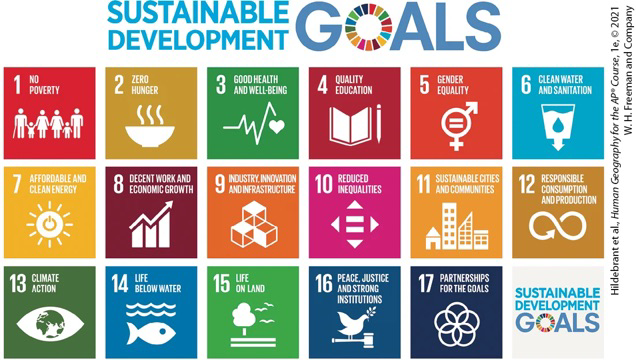
In 2000, the United Nations established eight Millennium Development Goals (MGDs), specifying targets for all countries to achieve by 2015 in areas such as environmental sustainability, gender equality, and poverty reduction.
The 2015 Sustainable Development Summit resulted in the 2030 agenda for sustainable development. 17 Sustainable Development Goals (SDGs) were created.