Vascular system
Sure, here are some detailed notes based on the slides:
Vascular System
Lecture Outline
Blood Vessels and Arteries
Arterioles, Resistance, and Blood Pressure
Veins and Capacitance
Pulmonary Blood Pressure
Aims I
Define vaso and veno constriction.
Describe how elastic arteries maintain blood flow during diastole.
Define resistance and total peripheral resistance.
Describe the role of arterioles in the regulation of total peripheral resistance.
Describe how changes in cardiac output and total peripheral resistance alter mean arterial pressure.
Describe the actions of sympathetic tone on arterioles.
Aims II
Define capacitance.
Describe the role of veins as capacitance vessels.
Describe the function of the venous valves.
Describe how the sympathetic tone alters venous capacitance and venous return.
Know typical values for venous pressure and pulmonary arterial pressure.
Outline of the Circulation
Vessel Size and Composition
Blood Vessels:
Lined with endothelium.
Elastic and connective tissue contains the pressure.
Smooth muscle contraction changes vessel size.
Sympathetic nerves to most blood vessels.
Adrenaline/noradrenaline contract blood vessels via α-receptors.
Arterial Elasticity
Stores Pressure and Maintains Flow:
Thick walls with lots of elastic and connective tissue.
Stretch during systole and store pressure (and energy).
Maintain arterial pressure and blood flow during diastole.
Resistance to Flow
Flow (Q) depends on a pressure difference and the resistance of the vessel.
High resistance leads to low flow.
Small vessels have more resistance than large vessels.
Equation: $Q = (Pa - Pv) / R
Mean Arterial Pressure
Equation: MAP = Cardiac Output x Total Peripheral Resistance
Factors:
Heart rate.
Stroke volume.
Total peripheral resistance.
Arterioles
Characteristics:
Thick walls with lots of smooth muscle.
Most resistance to blood flow.
Control total peripheral resistance and distribution of cardiac output.
Active control of diameter through vaso-constriction.
Vaso-constriction
Sympathetic Tone:
At rest, sympathetic tone increases resistance.
Global sympathetic tone increases total peripheral resistance and mean arterial blood pressure.
Local sympathetic tone alters resistance and blood flow.
Capacitance (Compliance)
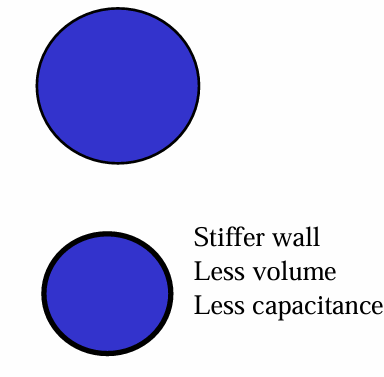
Blood vessels are not rigid.
Volume of a vessel depends on the pressure in the vessel and the vessel's stiffness.
Stiff vessels have low capacitance (e.g., arteries).
Veins are not stiff, contain a large volume of blood, and are capacitance vessels.
Veno-constriction reduces capacitance, increases venous return, and cardiac output.
Venous Valves
Function:
Create one-way flow.
Prevent blood flow away from the heart.
Combine with skeletal muscle to assist pumping of venous blood.
Systemic vs. Pulmonary Pressure
Systemic Blood Pressure: 120/80 mmHg.
Pulmonary Blood Pressure: 22/8 mmHg.
Lower total resistance in the pulmonary circuit.
Pa ≈ Q∙R
Summary
Arteries are elastic vessels that store energy (pressure) during systole and maintain flow during diastole.
Mean arterial pressure is controlled by cardiac output and total peripheral resistance.
Arterioles are high resistance vessels that control total peripheral resistance and the distribution of cardiac output.
Sympathetic stimulation constricts arterioles, increasing blood pressure by restricting blood flow.
Veins are high volume (compliance/capacitance) vessels that can act as a blood store.
Sympathetic stimulation constricts veins, reducing the volume of blood they hold, increasing venous return and cardiac output.
Feel free to ask if you need more details or have any specific questions!