Periodontal Considerations in Restorative Dentistry
Aims of Periodontal Therapy
To arrest the disease process
Ideally, to regenerate lost tissues
To maintain periodontal health long-term
Result = Prevention of tooth loss
Periodontal Therapy as an Aid to Restorative Dentistry
Improves soft tissue management
Establishes stable gingival margin position
Contributes to aesthetics
Reduces tooth mobility
Compliance and response to treatment help establish prognosis
Inflamed Gingival Margin
Bleeds during operative procedures
Is unstable in its apico-coronal location
Gingival recession following non-surgical periodontal therapy
Gingival inflammation and papilla loss associated with a poorly fitting veneer and excess luting cement
Two weeks after the removal of veneer and debridement there has been further gingival recession
Periodontitis
Following non-surgical and surgical treatment there has been significant gingival recession
When planning restorations in the aesthetic zone, the position of the gingival margin is crucial.
The position of the gingival margin will be stable only if it is healthy.
Determinants of Gingival Margin Location
Presence or absence of inflammation
Biological width (2mm) – connective tissue of 1mm and junctional epithelium of 1mm (alveolar crest to gingival sulcus – supracrestial attachment)
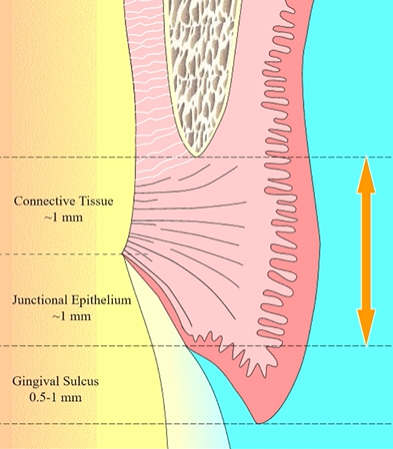
The dimension of connective tissue to the gingival sulcus (3mm) cannot be reduced, it can be moved apically in its entirety.
Surgical Crown Lengthening is a Procedure in Which:
The biological width is relocated in an apical direction
To make the clinical crown longer
For instance, to improve aesthetics
Soft Tissue Harmony
Gingival display (1-4mm)
General gingival inclination (zenith from canines are parallel horizontal with interpapillary line and incisal plane)
Gingival outline and symmetry (upper gingiva in-line and lower gingiva below the line)
Increased gingival display = gingivectomy
Removing Gingival Tissue
Excision of soft tissue and bone
Move biological width apically
Restoration Margins
Should sit above the gingival margin
Anywhere within JE or connective tissue, will cause problems
Case: Through bone removal and manipulation of the mucoperiosteal flap the biological width has been relocated apically, allowing access to the crown margins and facilitating a return to tissue health
Crown Margins
Ensure the margins follow the shape of the tooth/gingiva to avoid going subgingivally in the approximal areas – DON’T CUT STRAIGHT ACROSS
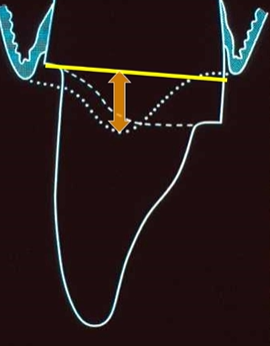
Due to inflammation, we have lost some alveolar bone (to 3mm) so now we need the soft tissue to conform to that dimension by reducing the inflammation
The biological width can be accommodated between the crown margin and the bone
If the inflammation can be resolved, the crown margins will become accessible
“Well-fitting Provisional Restorations”
Problem – apical relocation of the gingival margin through the resolution of inflammation between the teeth can cause a ‘black triangle’
Healthy tissue + carefully located preparation margins = easy impression + reduced risk of disease
Overhanging Restorations
Jansson et al 1994 – periodontal pockets at proximal sites with marginal overhangs were significantly deeper compared to sites with metal restorations without overhangs
Prevented through the proper application of matrix bands
Keys to Periodontally Successful Restorations
Start with healthy tissue
Care with margin location and contour
Excellent provisional restorations
Facilitate plaque control
Patient with Missing Teeth
Is there a need to replace missing teeth?
With what should they be replaced with?
What are the problems in replacing missing teeth in patients with periodontitis?
Prognosis
How long do we expect these teeth to last?
Will more teeth be lost in the near future?
What will be the effect of any prosthesis on the prognosis for the teeth?
Support
Can we rely on the teeth for support for a restoration? (bridges/dentures, etc)
What are We Afraid of?
Abutments which are periodontally compromised will be “overloaded”
Periodontitis will be made worseControl the plaque
The teeth will be “loosened”
What’s Important?
Inflammation is controlled
Plaque control is not hindered
Forces on the teeth are controlled
Partial Dentures
Mucosa supported
Inflammation of the mucosa
Can be supported by teeth down the long axis with rest-seat preparations in crowns
RPDs
Effective tooth support
Clearance of gingival margins
Rigid connectors
Case:
Reduced but healthy periodontium
Extensive fixed bridge
Transmits forces down the long axis of the tooth
Cross-arch splinting
What about Implants?
Good implant survival in periodontitis patients can be achieved, but
Periodontitis patients are more likely to develop complications such as peri-implant mucositis and peri-implantitis
Warn patients of the risk
Conclusion
Effective treatment planning requires consideration of the role of the periodontal tissues
Healthy periodontal tissues make restorative dentistry easier and more predictable
Poorly designed restorations can adversely affect the health of the periodontium