Early Terrestrial Plants and Bryophytes
- Life cycles
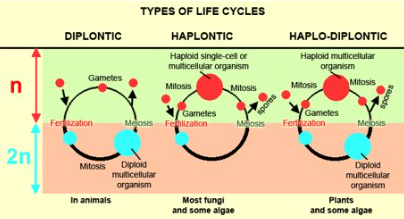
- Earlier terrestrial environments were inhospitable to plants due to the high levels of UV radiation and a lack of water.
- The development of these structures led to the evolution of land plants
- Structural support
- Protection from desiccation
- Protection from UV radiation
- Ability to take in CO2
- Ability to get water from the soil
- Ability to transport water to all parts of body
- Ability to get sperm to egg
- Colonization of land by plants was an important biological event
- Altered atmospheric and soil conditions
- Allowed for other life forms to emerge on land
- Allowed human civilization to develop and advance through agriculture and fossil fuels
- Bryophytes
- Gametophyte generation is dominant and photosynthetic
- Diverse habitats, but mostly moist environments
- Small
- Lack vascular structures, but have simple water conducting cells
- Motile sperm that needs water as a transport medium to meet a non motile egg
- Sporophyte develops out of the gametophyte which provides nourishment and support
- Disperses spores
- Liverworts (hepatophyta):
- Can be flat or leafy
- Flat liverworts have rhizoids
- Lack stomata but have open air chambers
- Dioecious and homosporous
- Very small sporophytes
- Asexual reproduction of spores using gemma cups
- Mosses (Bryophyta):
- Have rhizoids
- Only the sporophyte capsule has stomata
- Most are dioecious and homosporous
- Most abundant plant in arctic and Antarctic climates
- Many species are drought resistant
- Hornworts (Anthropocentriste):
- Dominant sporophyte generation
- Sporophytes have stomata and are photosynthetic
- May be among the first land plants