Macro+Topic+6.1+Balance+of+Payments+Accounts+S25
Page 1: Overview of Economic Indicators
Unit Information
Topic: Open Economy
Units involved: QMXRGI OWA RIGA
Number values indicating various economic metrics (suggestive of trade, finance, etc.)
Page 2: Balance of Payments (BOP) Accounts
Defining BOP
Measures the flow of goods, services, and financial capital between countries.
Learning Objectives
Understand Current Account (CA) and Capital and Financial Account (CFA).
Current Account (CA)
Records: net exports, net income from abroad, and net unilateral transfers.
CA may show surpluses or deficits.
Capital and Financial Account (CFA)
Records capital transfers and asset purchases/sales.
May also show surpluses or deficits.
BOP as an Accounting System
Records international transactions over a set period.
Transactions flowing in = credits, flowing out = debits.
Equation: CA + CFA = 0.
Page 3: Components of BOP
Balance of Payments (BOP): tracks financial transactions between countries.
Components
Current Account (CA): Records trades, money transfers, investment income.
Capital and Financial Account (CFA): Records balance for asset transactions.
Page 4: Balance of Trade
Net Exports (XN)
Formula: XN = Exports − Imports.
Trade Surplus
Condition: Exports > Imports.
Trade Deficit
Condition: Exports < Imports (also known as trade gap).
Page 5: U.S. Exports in 2020
Total Value of Exports
Total Exports: $2.84T
Important categories:
Services: $495.2B
Goods (various types) totaling $1.82T
Source: Bureau of Economic Analysis.
Page 6: U.S. Imports in 2020
Total Value of Imports
Total Imports: $2.55T
Major categories:
Goods: $1.32T
Services and other types contributing to the total.
Source: Bureau of Economic Analysis.
Page 7: Summary of BOP
BOP incorporates all international transactions, not just goods and services unlike balance of trade.
Summary presented in domestic currency (e.g., US Dollar for the U.S.).
Page 8: Current Account Details
Components of the Current Account
Trade in Goods and Services: (Net exports) Difference
between a nation’s exports of goods and services and its
imports of goods and services.
Investment Income: Income form factors of production including payments to foreign investors.
Net Transfers: Private/public sector money flows.
Page 9: (Captial) Financial Account (FA)
Purpose of FA
Measures purchase/sale of financial assets abroad. (Purchase of things that continue to earn money)
Examples
Foreign Direct Investment: foreign companies buying domestic assets.
Net Capital Outflow
Measure of foreign vs domestic asset transactions or the difference
between the purchase of foreign
assets and domestic assets purchased
by foreigners.
Financial Account Surplus = Inflow >
Outflow
Financial Account Deficit = Inflow <
Outflow
Page 10: Balancing BOP Accounts
BOP consists of CA and FA, both must equal out (CA + FA = 0).
Deficits in one account lead to surpluses in the other.
Money that leaves a country must come back as
either foreign purchases of goods/services (exports) or
foreign purchases of financial assets.
Page 11: Diagram of BOP Transactions
Payments for goods/services and asset transactions between the U.S. and the rest of the world.
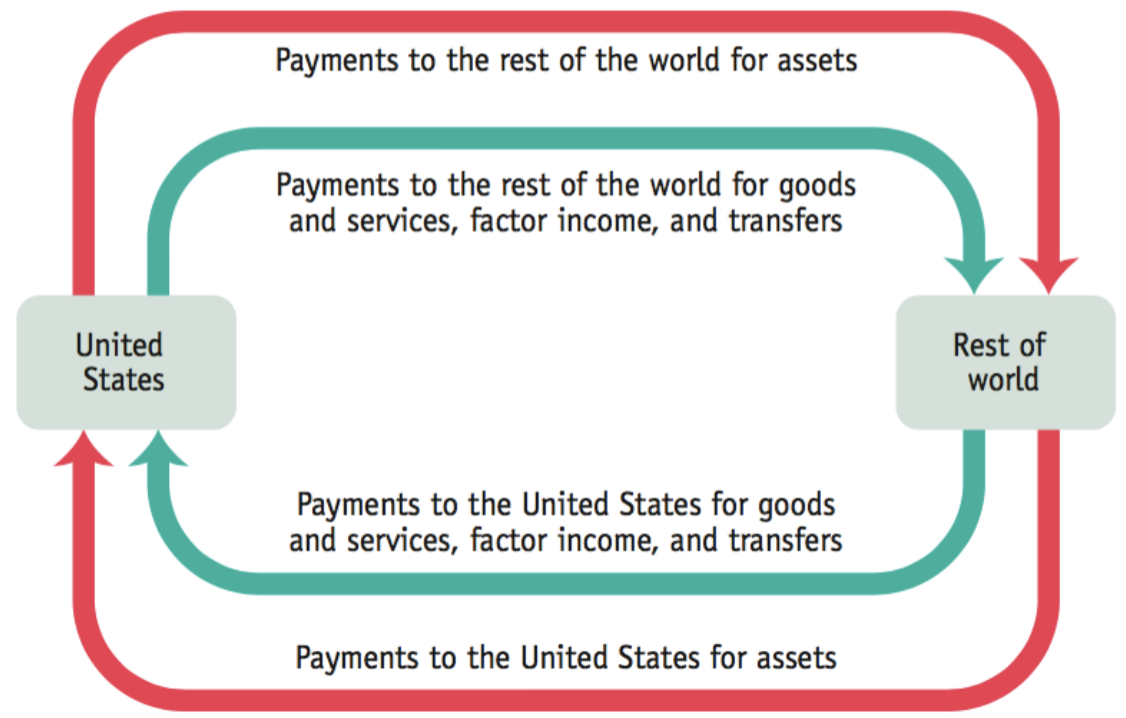
Page 12: Current vs Financial Account
Relationship: Deficit in CA typically leads to surplus in FA due to increased foreign financial purchases.
Page 13: AD/AS and Loanable Funds Markets Comparison
Visuals comparing economic metrics between the US and China.
Page 14: Detailed AD/AS and Loanable Funds
Further illustrations comparing economic activities across both nations.
Page 15: Effects of Increased U.S. Imports from China
Discussion on graph behavior under this economic change.
Page 16-20: Economic Flows and Graph Changes
Analysis of graphs related to capital flows and export/import dynamics between China and the USA.
Page 21: Current or Financial Account Identifying
Example transactions categorized as either current or financial account entries.
Page 22: Practice Questions on BOP Movement
Examining conditions that result in movements toward surplus or deficit in the BOP.
Page 23: Trade Surplus Factors
Factors leading to surplus in balance of trade, with multiple-choice options.
Page 24: Current Account Transactions
Identification of transactions as current account activities with relevant examples.