Regulation in the Media
7.1 Regulation
What is media regulation?
Regulation of the media means monitoring and controlling media output to ensure audiences are protected and standards are upheld. Media producers must operate within legal and ethical frameworks:
Legal frameworks are in place to prevent media producers from creating content that could harm individuals, groups, or organizations. Different countries have different regulatory media bodies.
Ethical frameworks are intended to outline good working practices when there is no legal framework. Producers are encouraged to self-regulate their content to ensure it is ethically and morally sound.
Activity 7.1
Discuss what you have learned so far about media regulation with a partner. Copy and complete this table:
Reasons why the media should be regulated
Protection of vulnerable populations, such as children, from harmful content
Prevent disinformation which can lead to public harm.
Maintain diversity of opinions and reduce monopolistic practices.
Reasons why the media shouldn't be regulated
Risk of infringing on freedom of speech and expression
Potential for government overreach and censorship.
Self-regulation may suffice without the need for external control.
Why is the Media Regulated?
There are two main reasons for regulating media industries:
Political and Economic Factors:
Media industries are dominated by large multinational media conglomerates aiming to generate profits and gain power, which allows them to push their agenda and gain political influence.
Achieving such goals can be done through:
Horizontal integration: where conglomerates acquire or merge with smaller companies to increase revenue streams and reduce competition leading to diminished diversity in media. (e.g., Disney owns various production companies like Disney Pictures, Lucas Films, and Marvel).
Vertical integration: enabling conglomerates to control multiple stages of production, distribution and exhibition, which minimizes overhead costs and maximizes profit. (e.g., Disney manages production, distribution, and exhibition through Disney Plus).
Regulation is necessary to prevent these conglomerates from monopolizing the industry.
Social and Cultural Factors:
Media is accessible to diverse audiences, including children, who may consume content that is not appropriate for them.
The potential effects of media have long been debated, necessitating regulation to ensure audiences are protected from harmful content.
Regulating Power
The increasing conglomeration of media ownership has led to:
Monopolies: A situation where one company dominates an industry; these are rare and illegal in some countries.
Oligopolies: Where a small number of companies dominate the industry, which can result in limited perspectives and voices in media (e.g., the video game industry dominated by Sony, Nintendo, and Microsoft).
Theory Focus
Curran and Seaton (2010) argue that extensive media conglomeration results in a restricted range of ideas and opinions available to audiences, reducing the diversity of discourse and public debate.
Activity 7.3
Discuss with a partner the ideas from Curran and Seaton:
What effects could a narrowing of media ownership have on audiences?
Limited Viewpoints: audiences are exposed to a narrower range of ideas, opinions and ideologies, often reflecting the values of powerful elites rather than the public.
Reinforcement of dominant ideologies: media content tends to support the political and economic status quo, discouraging radical or alternative perspectives.
Manipulation and agenda-setting: large corporations can shape what audiences think is important prioritising certain stories and ignoring others, often prioritising profit over the publics’ interest.
Can you cite examples where limited viewpoints are presented to audiences?
Rupert Murdoch’s media empire (e.g. The Sun, Fox News): these outlets often promote right-wing, pro-capitalist viewpoints, with limited representation of left-wing or progressive stances.
UK national newspapers: the majority are owned by a small number of corporations and tend to share similar political stances, particularly during elections, limiting ideological diversity.
Disney’s dominance in film and entertainment: As a major conglomerate, it gives Disney huge control over global entertainment content reducing diversity and encourages formulaic content and prioritises profit over creativity.
The Effect of Media on Individuals and Society
The necessity for media regulation to protect audiences is evident. The effects of media on individuals and society have been a topic of significant debate, leading to the establishment of regulatory bodies. Considerations regarding media influence include:
Socialization: media shapes societal values and norms, influencing public opinions and behaviors across different demographics.
Public Safety: content that glamorizes violence or risky behaviors may contribute to real-world consequences, such as increased aggression or acceptance of violence in society.
Theory Focus
Table 7.1: Theoretical Perspectives on the Influence of Media on the Audience
Theoretical Perspective | Explanation |
|---|---|
Hypodermic Needle / Silver Bullet Theory | Suggests that audiences are passive and directly influenced by media messages. |
Uses and Gratification Theory | Focuses on why and how individuals use media for various reasons such as entertainment, information, personal identity formation, and social interaction. |
Cultivation Theory | Posits that views and opinions develop over time with repeated media exposure, leading to the normalization of stereotypes. |
Copycat Theory | Audiences may imitate behaviors portrayed in the media consumed by them. |
Reception Theory | The audience has three potential interpretations of a media text: |
Dominant/Preferred Reading: Acceptance of the producer's intention and message.
Oppositional Reading: Rejection of the intended meaning, leading to personal interpretation.
Negotiated Reading: A mix of acceptance and rejection of the producer’s bias, where audiences adapt the message to their contexts and beliefs.
/
Applying Theory to First-Person Shooter Games
For a concrete application, consider first-person shooter games:
These often involve graphic violence, coarse language, and harmful content.
Analyzing using theoretical perspectives:
Hypodermic Needle Theory: Users may believe that war is the only resolution to problems and that killing is justified.
Cultivation Theory: Sustained exposure normalizes brutality in warfare.
Copycat Theory: Users may mimic the violence observed in these games in real life.
Uses and Gratifications:
Entertainment: As a form of escapism.
Social Interaction: Engaging with others in multiplayer formats.
Information: Gaining insight into warfare may provide an educational component.
Personal Identity: Users identify as gamers or soldiers.
Regulatory Bodies
Different media forms have specific regulatory bodies overseeing their content. Globally, the aim is to protect the public.
Regulations may operate post-publication, as seen in democratic societies where media is subject to self-regulation and voluntary membership in bodies like IPSO in the UK.
Table 7.3: Regulatory Bodies in Global Gaming Industry
Country/Region | Regulatory Body for Video Games |
|---|---|
United Kingdom and European Union | PEGI (Pan European Game Information) |
USA and Canada | ESRB (Entertainment Software Rating Board) |
China | SAPP (State Administration of Press and Publications) |
Australia | ACB (Australian Classification Board) |
Age Ratings and Classifications
One of the primary methods for regulating media content is through age ratings. Different countries may have varying ratings for the same media due to their distinct regulatory frameworks.
Media products are assessed for suitability, with independent assessors providing feedback and age ratings.
A case study example is The Hunger Games (2012):
Initially aimed for a 12A rating, multiple edits were made to reduce violence and gore to meet guidelines, balancing the need for audience protection with creative content.
Regulating Broadcast Media
Independent regulators like ofcom work to ensure programming reflects diverse societal needs while protecting audiences from harmful content.
Ofcom's Role:
Guarantees fairness and transparency in media practices.
Protects the privacy rights of audiences and ensures that broadcasters operate equitably.
Changes to Regulation Reflecting Social and Cultural Change
As societal attitudes evolve, regulatory content requirements also adapt, often as a response to audience desensitization towards previously regulated content types.
Example: The transformation from Disney’s Sleeping Beauty (1959) to Maleficent (2014) represents a shift in thematic presentation and audience reception.
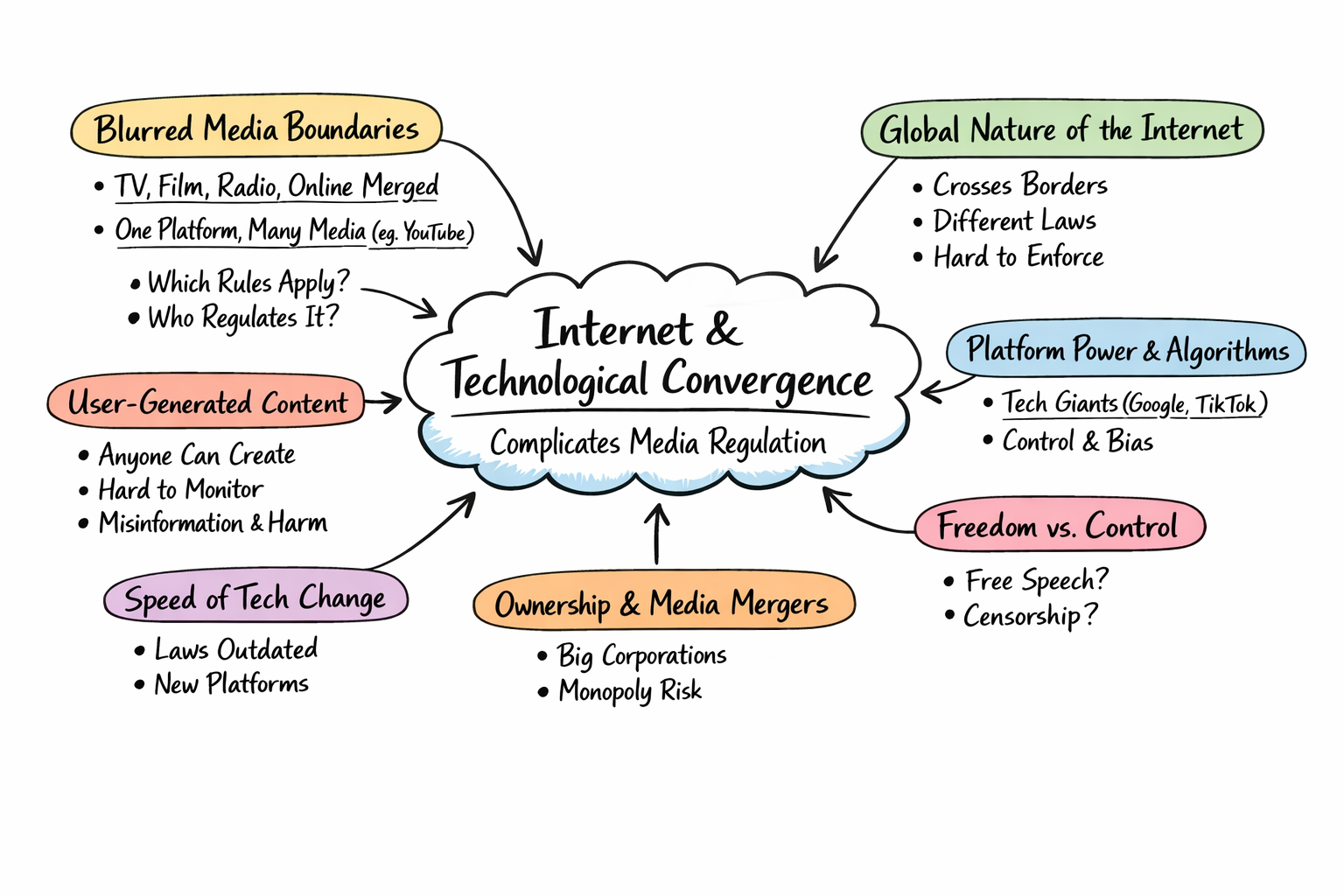
Regulation in the Contemporary Online Age
The advent of the internet complicates media regulation due to its vast reach and user-generated content.
Regulation challenges include:
Morality and Decency: Unlimited content access can expose young viewers to harmful materials.
Accuracy and Impartiality: User-generated content may enrich diversity but challenges accuracy. Grassroots journalism offers alternate perspectives but often lacks editorial oversight.
Fake News: Growing misinformation online demands scrutiny.
Theory Focus
Sonia Livingstone and Peter Lunt (2011):
Highlights the importance of balancing regulatory frameworks that ensure public protection while upholding the hurdles faced by regulatory agencies in an increasingly globalized media environment.
Activity 7.12
Create a mind map illustrating how the internet and technological convergence complicate media regulation.