Current in a Magnetic Field
Force on Current-Carrying Conductor in Magnetic Field
If a current-carrying conductor is within two magnetic fields the two fields interact (push off) eachother.
A current-carrying conductor in a magnetic field will always experience a force unless the conductor is parallel to the magnetic field
The direction is always perpendicular to the current and perpendicular to the magnetic field.
D.C motor, moving coil loudspeaker, galvanometer, voltmeter, ohmmeter, are all based on the above principle.
Fleming’s Left-Hand Rule
If the thumb, first and second finger of the left hand are held at right angles, with the first finger pointing in the direction of the magnetic field and the second finger pointing in the direction of the current, then the thumb points in the direction of the force.
Force on Current-Carrying Coil in Magnetic Field
Coil free to rotate around axis.
Based on current and Fleming’s Left Hand Rule the coil will rotate due to the forces acting on the two sides.
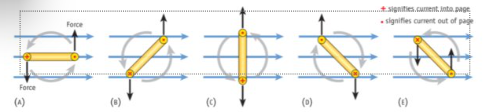
At vertical (c) the forces are no longer rotating the coil.
If the coil is sufficiently free to rotate, its momentum will carry it beyond vertical to (d).
But usually the forces tend to rotate it back to vertical and it ends up at rest.
If we could reverse the direction of current the coil would keep rotating in same direction (e).
A simple D.C. motor uses this.
Magnetic Flux Density
A vector whose magnitude is equal to the force that wokd be experienced by a conductor of length 1m carrying a current of 1A at right angles to the field at that point and whose direction is the direction of the force on a north pole at that point.
SI Unit: tesla (T)
The Tesla
The magnetic flux density at a point is 1 tesla (T) if a conductor of length 1m carrying a current of 1A experiences a force of 1N when placed perpendicular to the field.
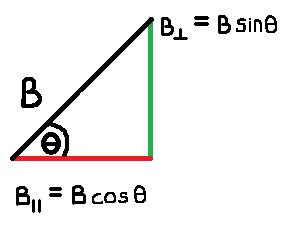
If not perpendicular we need to resolve the flux into perpendicular components.
Force on Moving Charge in Magnetic Field
Moving electrons have electric current and therefore have a magnetic field.
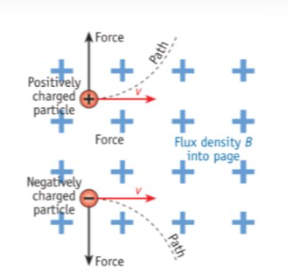
A proton in a uniform magnetic field has its own magnetic field so interacts uniform field causing deflection.
Charge Particle Moving in a Circle
If a charge particle moving at constant speed enters a uniform magnetic field and moves at right angles to the field, the particle moves in a circle.
Derivation of
1. Start with the "Wire" Formula
We know the force on a segment of wire with length and current in a magnetic field is:
(For this derivation, let's assume the charge is moving perpendicular to the field, so and we can use ).
2. Break down Current (I)
Current is just the amount of charge () passing a point over a certain amount of time ():
3. Break down Length (L)
The length of the wire segment can be defined by how far a single charge travels at velocity in that same amount of time :
4. Substitute and Simplify Now, let's plug these definitions for and back into our original force equation:
Ampere and Coulomb
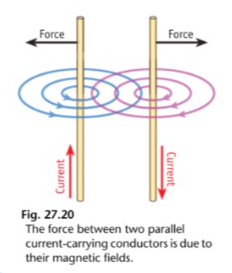
The ampere (A) is that constant current which, if maintained in two straight parallel conductors of infinite length, of negligible cross section and placed 1m apart in a vacuum, would produce a force on each conductor of 2×10-17 newtons per metre length.
The coulomb (C) is the amount of charge that passes any point in a circuit when a current of 1 ampere flows per second.