Universal Gravitation
Mass vs Weight
Mass
Mass is the amount of matter in an object.
It determines how heavy or light something is.
Mass is an inherent property of an object.
It does not change whether the object is:
On Earth
On the Moon
In space
Mass determines inertia (resistance to change in motion).
Type of quantity:
Scalar (has magnitude only)
SI unit:
Kilogram (kg)
Weight
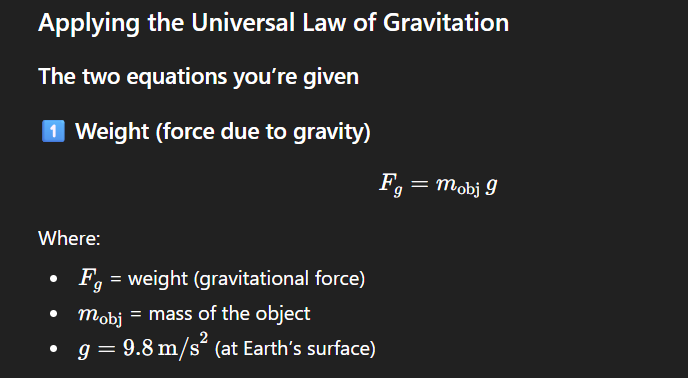
Weight is the force of gravity acting on an object’s mass.
It depends on the gravitational pull of the place where the object is.
Weight changes depending on location:
Less on the Moon
More on Earth
Weight is not a property of the object itself, but of the gravitational field acting on it.
Type of quantity:
Vector (has magnitude and direction)
SI unit:
Newton (N)
Relationship Between Mass and Weight
Weight=Mass×Gravity\text{Weight} = \text{Mass} \times \text{Gravity}Weight=Mass×Gravity
Same mass + different gravity = different weight
Quick Comparison Table (Exam-Ready)
Feature | Mass | Weight |
|---|---|---|
What it is | Amount of matter | Force of gravity |
Changes with location? | ❌ No | ✅ Yes |
Depends on gravity? | ❌ No | ✅ Yes |
Quantity type | Scalar | Vector |
SI unit | Kilogram (kg) | Newton (N) |
One-sentence summary (perfect for tests)
Mass is the amount of matter in an object, while weight is the gravitational force acting on that mass.
Memory trick 🧠
Mass = matter
Weight = pull
Mass stays, weight changes
Why astronauts jump higher on the Moon 🌙
The Moon’s gravity is much weaker than Earth’s
Gravity on the Moon ≈ 1/6 of Earth’s gravity
Because gravity pulls less, astronauts weigh less, so they can jump higher and land softly
📌 Their bodies did NOT change — only gravity did.
Mass vs Weight (the core difference)
Mass
Amount of matter in an object
Never changes
Same on Earth, Moon, Jupiter, space
Measured in kilograms (kg)
Weight
Force of gravity acting on mass
Changes with gravity
Measured in newtons (N) (or kg-force in everyday language)
Examples from the passage
On Earth 🌍
Person: 60 kg
Machine: 1000 kg
On the Moon 🌙 (1/6 gravity)
Person: 10 kg
Machine: 166 kg
On Jupiter 🟠 (2.5× Earth gravity)
Person: 150 kg
Machine: 2500 kg
👉 The numbers change, but the amount of matter does not.
Why food is labeled by mass 🍎
Mass is constant everywhere
Weight depends on gravity
So food packets use mass (kg or g), not weight
The formula you’re about to learn
This answers the question at the end:
Weight formula
Weight=Mass×Gravity\textbf{Weight} = \textbf{Mass} \times \textbf{Gravity}Weight=Mass×Gravity
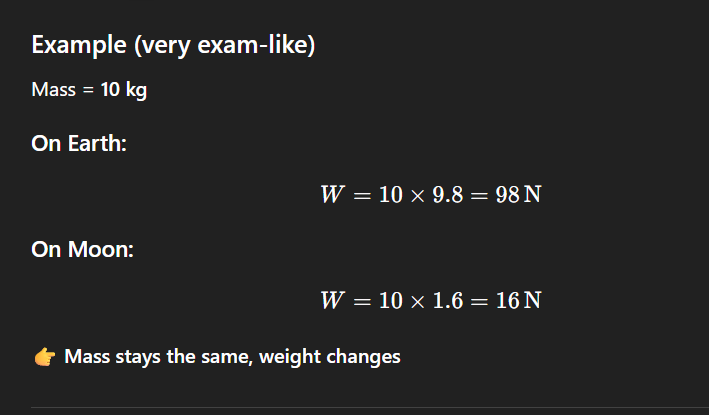
On Earth: gravity ≈ 9.8 m/s²
On Moon: gravity ≈ 1.6 m/s²
On Jupiter: gravity ≈ 24.5 m/s²
One-sentence exam summary
Mass remains constant everywhere, but weight changes depending on the gravitational force acting on the object.
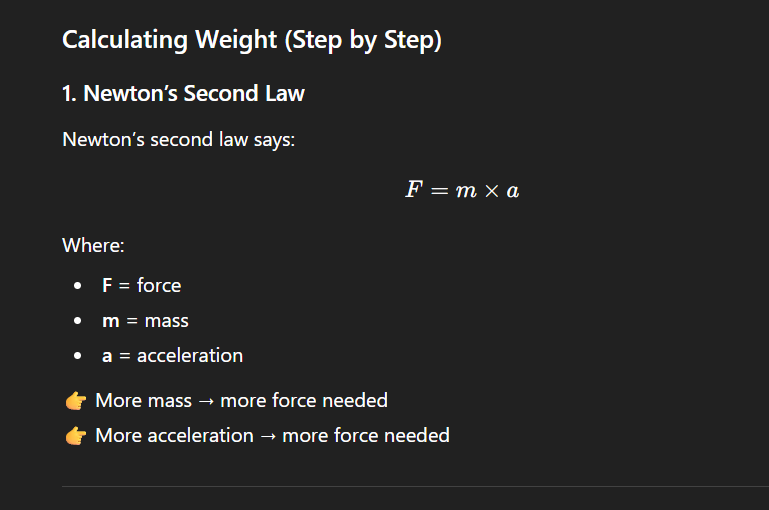
2. Connecting this to weight
Weight is a force
The force causing weight is gravity
Gravity causes an acceleration called g
So for a falling object:
Acceleration = g (acceleration due to gravity)
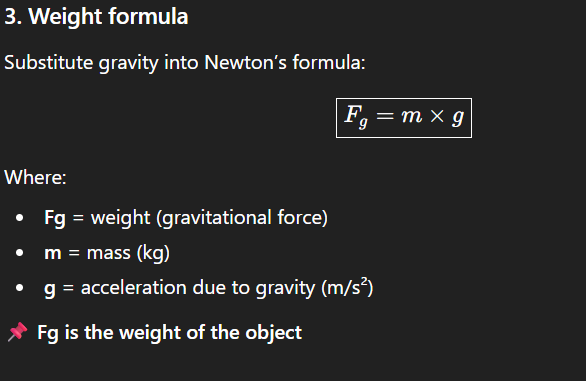
4. Direction of weight
Weight always acts toward the center of the Earth
Because gravity pulls everything inward
That’s why weight is a vector (it has direction).
Values of g (important)
Earth: 9.8 m/s²
Moon: ~1.6 m/s²
Jupiter: ~24.5 m/s²
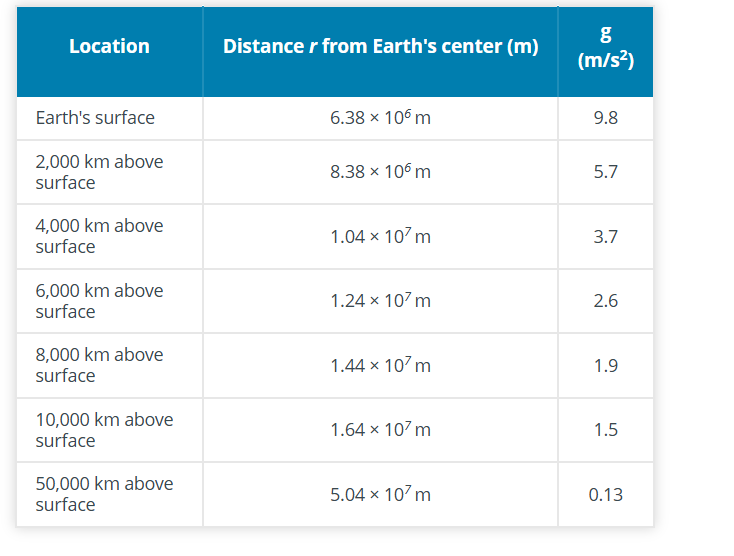
Inverse Square Law (Plain Explanation)
1. What Newton noticed
By studying how planets move, Newton realized:
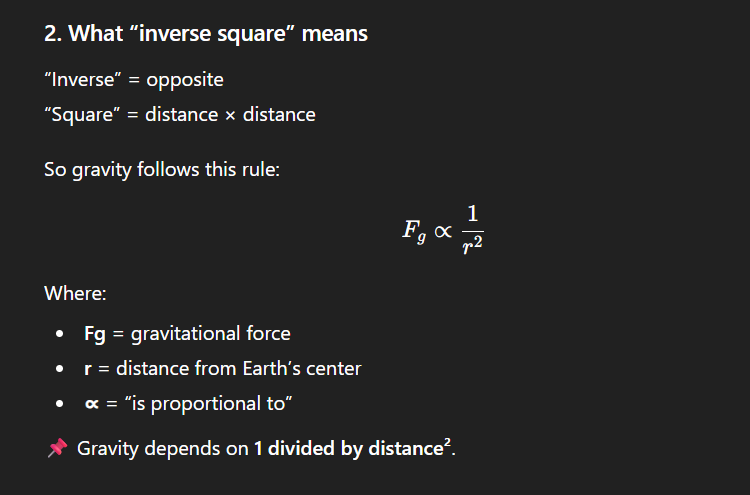
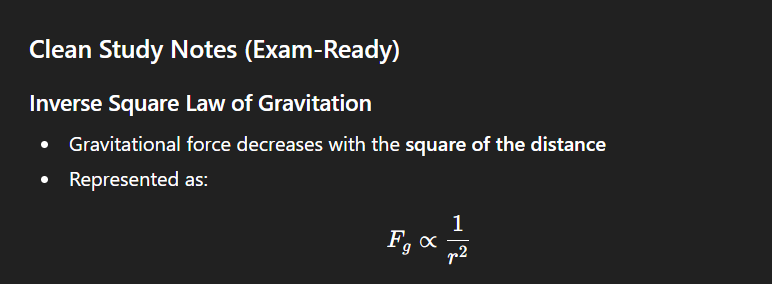
Gravity gets weaker very fast as distance increases.
Not just weaker — weaker by the square of the distance.
3. What happens when distance changes?
Let’s say the distance from Earth’s center changes:
Distance from Earth | Gravity strength |
|---|---|
r (normal) | 1 |
2r (double) | 1/4 |
3r (triple) | 1/9 |
4r | 1/16 |
👉 Double distance → gravity becomes 4 times weaker
👉 Triple distance → gravity becomes 9 times weaker
4. Why gravity weakens so fast
Gravity spreads out in all directions (like ripples in water 🌊).
As distance increases, the same force is spread over a much larger area.
More area → less force per area → weaker pull.
Key points
Gravity is strongest close to Earth
Gravity weakens rapidly with distance
Doubling distance → force becomes 1/4
Tripling distance → force becomes 1/9
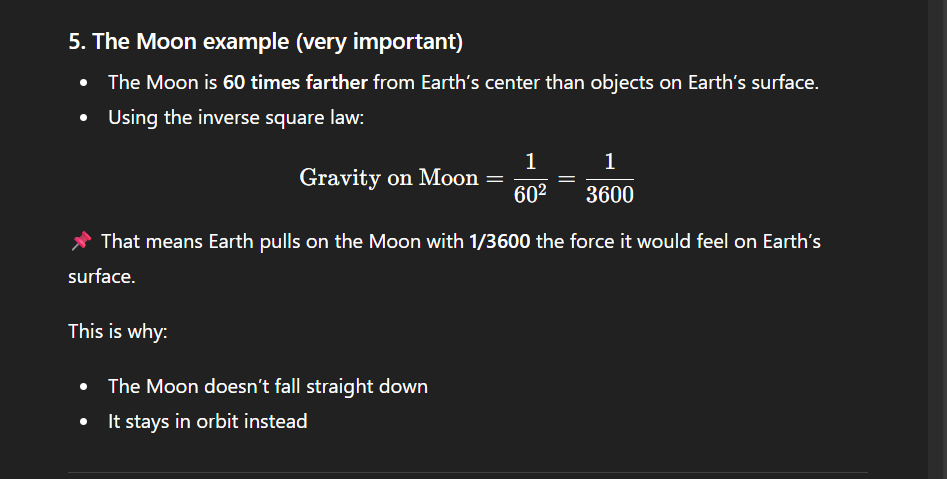
Moon fact
Moon is 60× farther than Earth’s surface
Gravity on Moon = 1/3600 of Earth’s surface gravity
One-sentence exam summary
According to the inverse square law, gravitational force decreases as the square of the distance from Earth’s center increases.
Memory trick 🧠
Distance × 2 → force ÷ 4
Distance × 3 → force ÷ 9
Square the distance, then divide
Explanation (Plain Language)
1. Mass matters in gravity
Newton realized gravity depends on more than distance.
More mass → stronger gravitational pull
A heavier object feels a greater force of gravity than a lighter one (if distance is the same)
So gravity is directly proportional to mass.
👉 Directly proportional means:
If mass increases, gravity increases
If mass decreases, gravity decreases
2. Newton’s Third Law (Action–Reaction)
Newton’s third law says:
Every action has an equal and opposite reaction
So:
Earth pulls on an object
The object pulls back on Earth
The forces are equal in size, opposite in direction
📌 Even a small object pulls on Earth, but Earth’s huge mass means it barely moves.
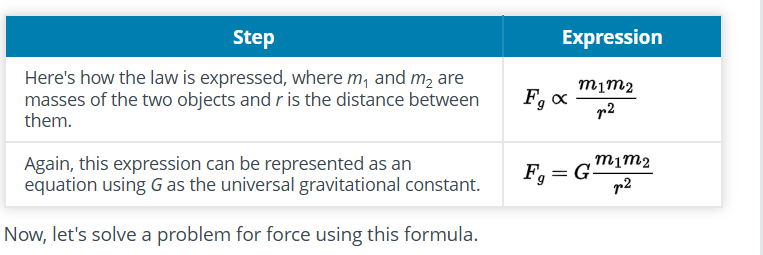
3. Gravity depends on BOTH masses
The gravitational force depends on:
Mass of Earth
Mass of the object
Distance between their centers
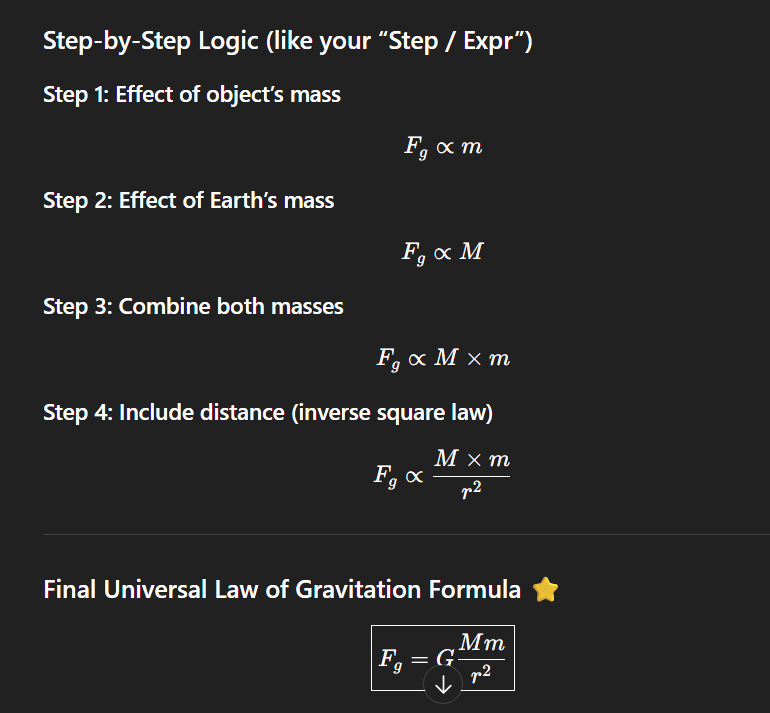
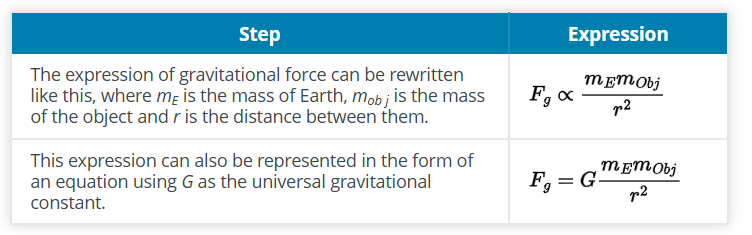
So gravity is:
Directly proportional to both masses
Inversely proportional to the square of the distance
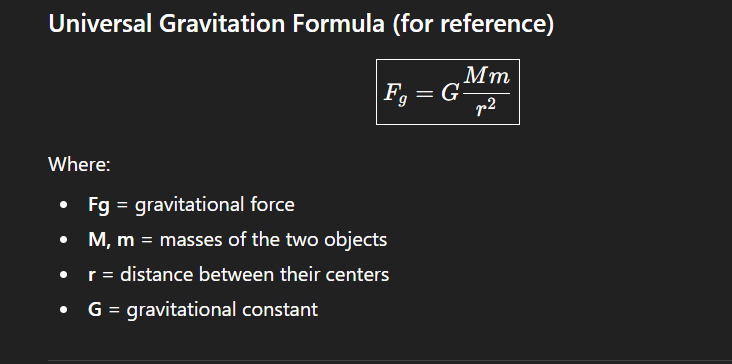
Where:
Fg = gravitational force
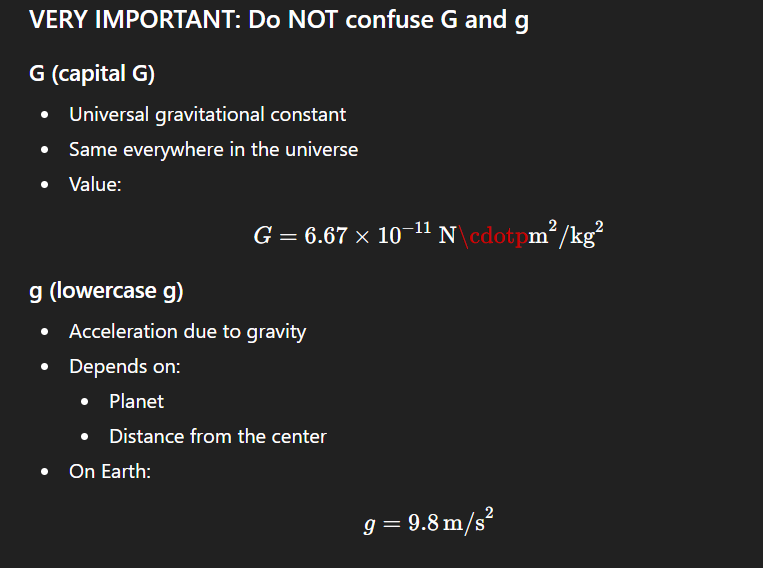
G = universal gravitational constant
M = mass of Earth (or one object)
m = mass of the other object
r = distance between their centers
Clean Study Notes (Exam-Ready)
Universal Law of Gravitation
Gravitational force:
Increases with mass
Decreases with distance
Depends on both interacting masses
Acts equally on both objects (action–reaction)
Key relationships
More mass → more gravity
More distance → less gravity
Force is mutual between objects
One-sentence exam summary
Gravitational force is directly proportional to the product of the two masses and inversely proportional to the square of the distance between them.
The Value of G (Universal Gravitational Constant)
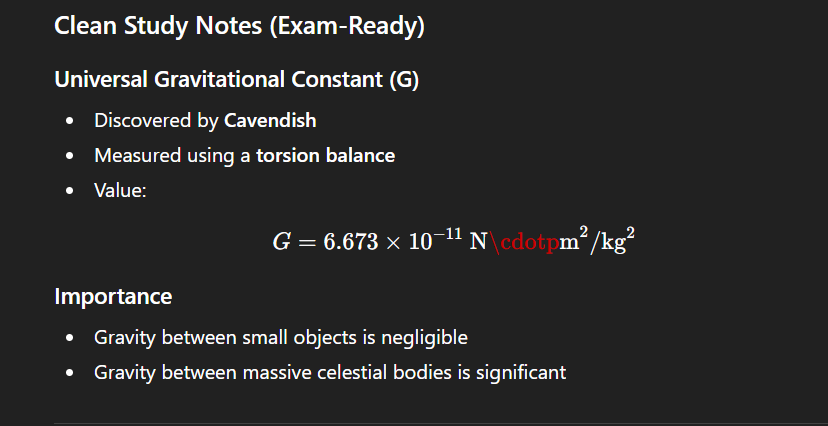
What is G?
G is a constant number that appears in the Universal Law of Gravitation.
It tells us how strong gravity is everywhere in the universe.
The value of G is the same everywhere (on Earth, in space, in other galaxies).
How was G discovered?
Lord Henry Cavendish measured G using a device called a torsion balance.
This experiment measured the very tiny gravitational force between small masses in a lab.
It was done almost 100 years after Newton.
📌 Newton knew the formula for gravity, but not the numerical value of G.
Gravity in the Solar System (Explained Simply)
Newton did NOT “discover” gravity
Gravity already existed.
Newton discovered that gravity is universal:
The same law applies on Earth
And in the solar system
And throughout the entire universe
Gravity and the Sun 🌞
The Sun has a very large mass, so it has a strong gravitational pull.
Planets closer to the Sun feel a stronger pull.
Planets farther away feel a weaker pull.
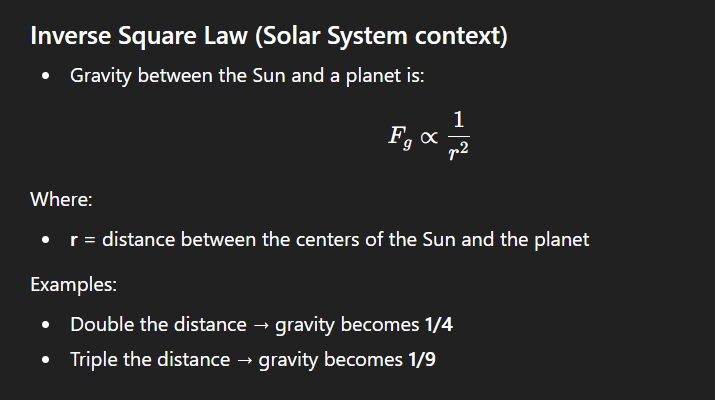
This happens because gravitational force:
Decreases with distance
Follows the inverse square law
📌 If distance increases, gravity decreases rapidly.
Clean Study Notes (Exam-Ready)
Key ideas
Gravity is universal
All objects attract each other
More mass → stronger gravity
More distance → weaker gravity
Gravity follows an inverse square law
Solar system
Sun’s gravity keeps planets in orbit
Inner planets feel stronger gravity than outer planets
One-sentence exam summary
Newton’s universal law of gravitation states that all objects attract each other with a force proportional to their masses and inversely proportional to the square of the distance between them.
Memory trick 🧠
Big mass = big pull
Far away = weak pull
Same law everywhere
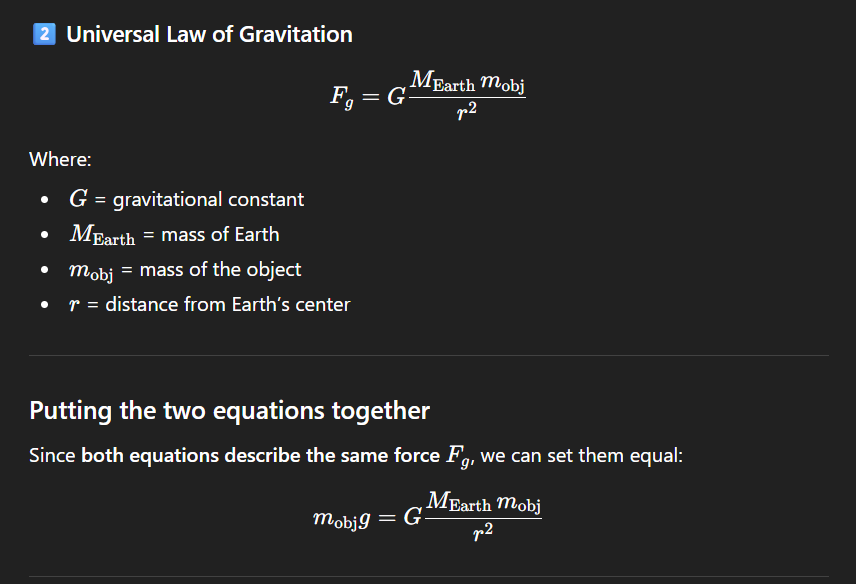
What this result means (VERY important)
Key conclusions
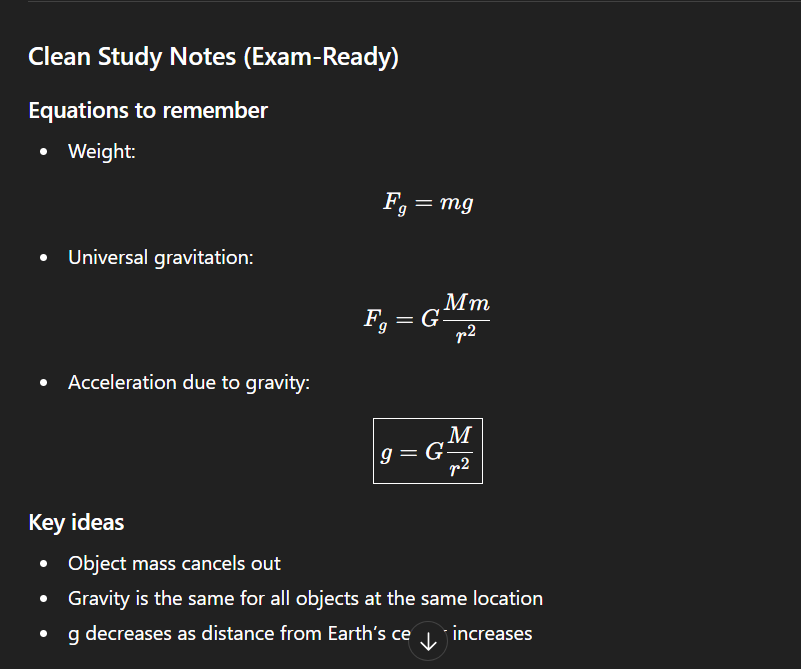
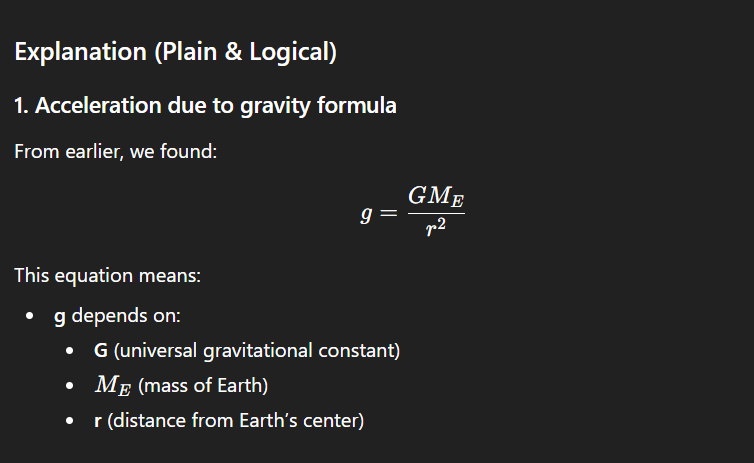
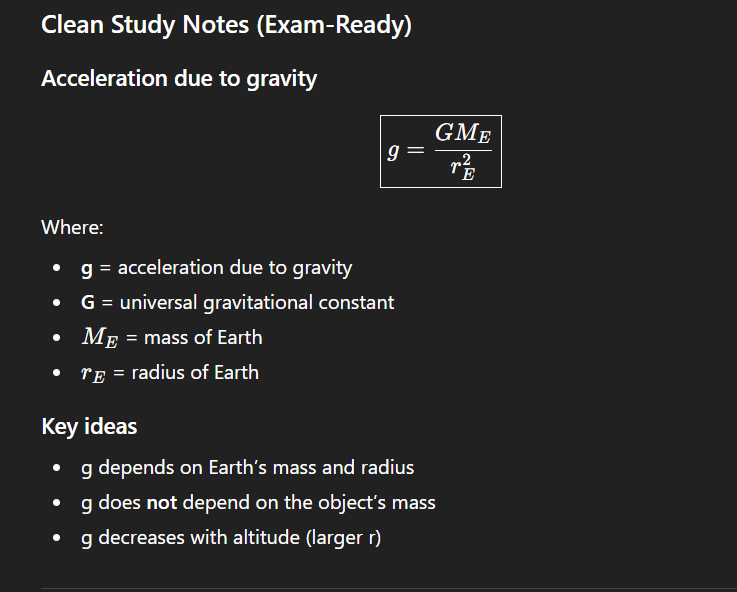
The value of g does NOT depend on the object’s mass
All objects fall at the same acceleration (ignoring air resistance)
Gravity at a location depends only on:
Earth’s mass
Distance from Earth’s center
📌 That’s why a feather and a hammer fall together on the Moon.