Comets
Comets
How to seek a prediction: Wait for a comet to appear
Equipment: naked eye
Personnel: Any #human who attributes meaning to the appearance of a comet
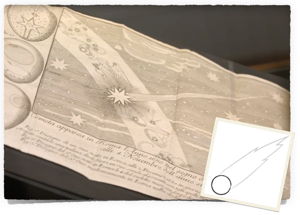
Suddenly, and unexpectedly, the apparent perfection and regularity of the Heavens are disturbed by an unknown interloper: a comet. For thousands of years, myriad civilizations around the globe saw comets as supernatural signs--sometimes as portents of good news, and other times as harbingers of doom. For cultures striving to understand the world around them, the capricious, seemingly #random, unpredictability of comets is what imbued them with meaning: where else could comets be coming from, if not from the divine?
Some examples of famous comets in Western history include:
44 BCE: An appearance of a comet soon after Julius Caesar’s death was taken as a sign that Caesar had become a god.
12 BCE: The appearance of the “Star of Bethlehem” during the birth of Jesus is often interpreted as a comet (perhaps Halley’s Comet).
1066 CE: An appearance of Halley’s Comet was supposedly a good omen for William the Conqueror and the Norman’s conquest of England at the Battle of Hastings (or, alternatively, a bad sign for the defeated King Harold and his Anglo-Saxons).
The change over time in humanity’s feelings about comets offers a great example the same phenomenon taking on very different meaning within the predictive systems we discuss in this course (see Framework diagram). Before Newton worked out his predictive theory of gravity, comets were almost universally thought to be signs from the gods, appearing to be #random phenomena as we mention above. Once Edmund Halley made the bold claim, using calculations based on Newton’s theory, that the “Great” Comet of 1682 (now called “Halley’s Comet!”) would return 75 years later, and that claim was posthumously verified, comets were effectively demoted (in some people’s view!) to being great demonstrations of the near-fully #deterministic nature of gravity, rather than supernatural messengers.
We will have much more to say on this topic in the forthcoming PredictionX mini-course, The Path to Newton and video for this section will be released at a later due -- stay tuned!
Timeline: Comets have been seen as omens for perhaps as long as human history. A scientific understanding of comets came more into focus around 1687, with the publication of Newton'sPrincipia, as well as work being done by Halley at the same time, which culminated in the successful prediction of the return of Halley's Comet in 1758.