Chapter 1: INTRODUCTION TO PLANET "EARTH"
oceans: the entire body of saltwater that covers 70.8% of Earth’s surface
largest and most prominent feature on Earth
volume of oceans is immense: 97.2% of surface water
interconnected global or world ocean
contains the greatest number of living things on the planet
1.1 How are Earth’s Oceans Unique?
Earth is only planet that has liquid water on its surface
How many oceans exist on earth?
Four principal oceans
Pacific: largest, deepest
13,000 feet
Atlantic: second largest
Indian: mainly the southern hemisphere
Arctic: smallest, shalowest, northern hemisphere, icy
Southern/Antarctic: surrounds Antarctica in the southern region, connects pacific, atlantic and indian
Comparison of land and depth
average depth of ocean 3729 m
average elevation of land 840 m
deepest ocean Mariana Trench 11,022 m
Highest mountain Mt. Everest 8850 m
1.2 How was Early exploration of the Oceans Achieved?
Pacific Islanders traveled Pacific widely for food 40,000 years ago
small islands widely separated
micronesia, melanesia, polynesia
Pacific navigators
the people of pacific islands required extensive travel in open boats and exceptional navigation skills
difficult because islands are widely scattered
Pacific People
no written records exist of Pacific human history before 16th century
archeological evidence suggests island occupation by people from New Guinea as early as 4000-5000 B.C.
Thor Heyerdahl sailed on a balsa raft - the KON TIKI to demonstrate migration of south americans to pacific ocean
European Navigators
Phoenicians: lived at eastern end of Mediterranean sea around Africa and sailed as far north as British Isles
Phytheas greek astronomer-geographer reached Iceland 325 BC
Herodotus map med. areas 450 BC
Romans
strabo land rises and sinks
ptolemy map of world at that time 150 AD
The Middle Ages
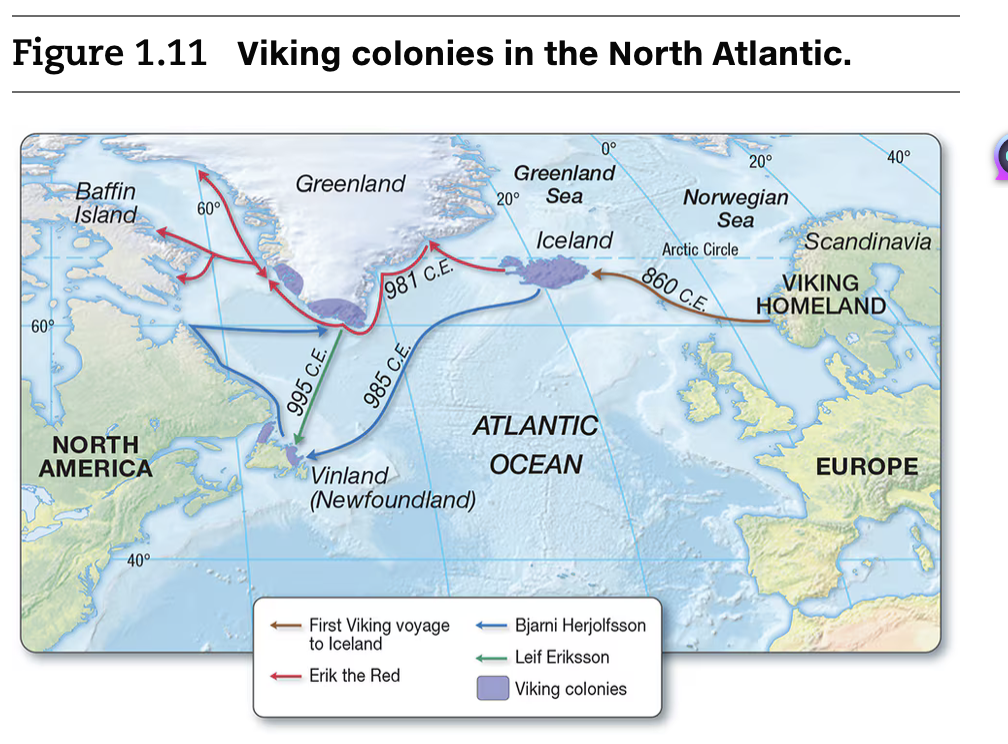
Vikings explored North Atlantic Ocean
iceland and greenland 9th and 10th centuries Ad
Leif Eriksson Vinland 995 AD
Greenland, Vinland settlements abandoned by 1450 AD
Chinese
Pacific and Indian Oceans
Age of Discovery
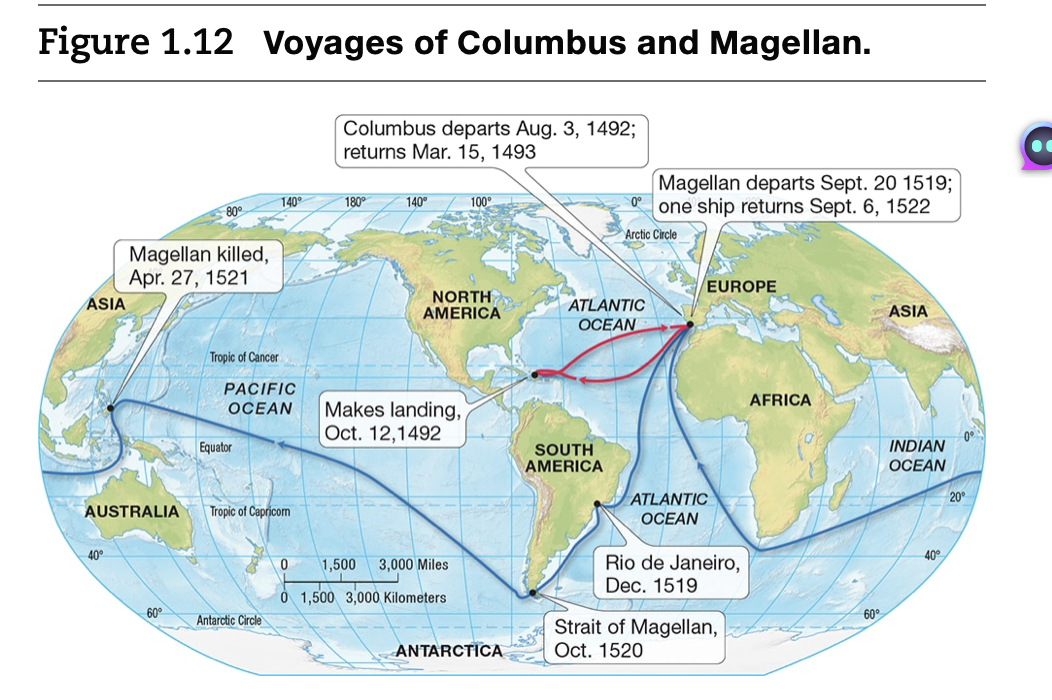
30 year period from 1492 to 1522
portugal trade routes around africa
europeans explore north and south america
columbus, cabot
Magellan and del Cano circumnavigate world
British Isles dominant naval power from 1588 to early 1900s
spanish armada 1588
New technologies at those times
magnetic compass, china, 13th century
three-masted ships long distance
maps with latitude/longitude 1569
Beginnings of Ocean Science
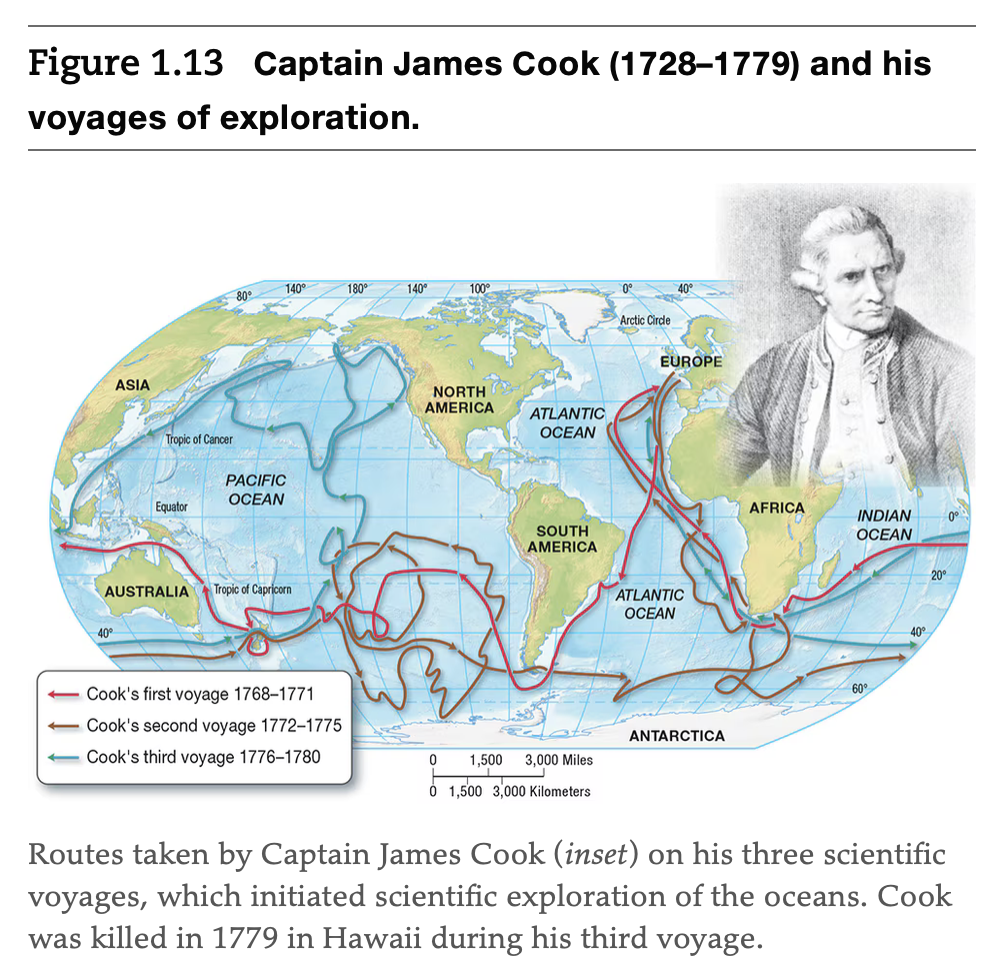
Captain James Cook (1728-1779)
ships HMS Endeavour, Resolution, Adventure
mapped many islands in pacific
systematically measured ocean characteristics
marine chronograph (longitude)
John Ross, James Ross
Distribution of life in oceans
arctic and antarctic
amount of life in ocean lessens with increasing depth
Edward Forbes
hardly any life in deep oceans
Fridtjof Nansen
Fram
Arctic Ocean
V. Walfrid Ekman, Ekman spiral, Ekman Transport
Early American contributions
Benjamin Franklin
postmaster general
map of gulf stream
Matthew Maury
father of oceanography
first textbook
Alexander Agassiz
U.S. oceanographic research
HMS Challenger 1872-1876
Birth of oceanography
seawater chemistry, depth, temperature, life, sediments
4714 new species
deepest depth
analyses of seawater
classification of deep sea sediments
20th Century new technologies
Meteor, 1925, German, echo sounding
increased insturmentation
gravity
magnetic field
seismic structure of sea floor
Deeper sampling of sea floor
1968 ongoing, deep sea drilling project
different project names
currently international sponsorship
drill through sediments on ocean floor
Modern fields of research
marine geology
marine geophysics
ocean geochemistry
ocean currents
climate change
marine life
Plate Tectonics from DSDP
geophysics applied to ocean floor
Hess develops sea floor spreading concept
Submersibles and ROVs
deep-diving small submarines
first-hand look at sea floor
hot vents, unique ecosystem
Remotely operated vehicles (ROV)
instruments to collect information
not staffed
Dives to the deepest part of the Mariana Trench
Don Walsh, 1960 on the Trieste
James Cameron, 2012 on the Deep Sea Challenger
Victor Vescovo, 2019 on DSV limiting factor, 35,849 ft! Finds a Plastic Bag!
Satellites
instruments on satellites
global scale
measure characteristics on ocean surface
surface temperature
ice cover
water color
changes in sea level
Underwater human habitats
continental shelf
mainly in 1960s
three small underwater habitats today (Key Largo, FL)
mainly for research
1.5 how were earth and the solar system formed?
the “Big Band” 13.7 Ga is accepted as the start of the Universe. The term Big Band was first used by Sir Fred Hoyle
First 200 million years “Dark Ages”
gasses (H, He) start to condense and stars begin to form
approx. 500 billion Galaxies in the Universe
Our galaxy (milky way) has approx. 400 billion stars and 10s of millions have planets
Universe
milky way galaxy
Solar System: the sun and the celestial bodies, asteroids, planets, and comets that orbit around it
light year for distance
galaxies moving apart (red shift)
nebula: a cloud
Stellar Evolution
All stars initially contract, H → He (Fusion) and light is emitted
subsequent contraction results in nucleosynthesis, leading to the formation of the heavier elements
stars form an iron core and contracts and explodes, the gas cloud derived from an exploding star is called a supernova. a neutron star forms a remnant of a supernova event
nebular is an interstellar gas cloud
our solar system formed from the gas cloud derived from an exploding star approx. 5 billion years ago
Big Band
elementary particles
H and He
Stars from H → He
He → C and so on
Supernova explosions eject heavier elements
Nebular Hypothesis
all bodies in the solar system formed from an enormous cloud composed mostly of hydrogen and helium, with a small percentage of heavy elements
rotating cloud of dust and gases
supernova earlier
center sun
outskirts
planets
Early evolution of Earth
origin of planet earth
nebular hypothesis
assumes a flat, disk shape with the protosun (pre-sun) at the center
inner planets begin to form from metallic and rocky substances
larger outer planets began forming from fragments of ices (H2O, CO2, and others)
rotating cloud called the solar nebula
composed of hydrogen and helium
nebula began to contract 5 million years ago
most researchers believe that Earth and the other planets formed at essentially the same time
Professor Kuiper
talked about early nebular hypothesis in his work
formation of earth’s layered structure
metals sank to the center
molten rock rose to produce a primitive crust
chemical segregation established the three basic divisions of Earth’s interior
Primitive atmosphere evolved from gases in earth’s interior
A view of Earth
Earth is a planet that is small and self-contained
Earth’s four spheres
Hydrosphere
Atmosphere
Biosphere
Solid Earth
Proto-planet to Earth
Layered Earth
Densest core
Fe and Ni
Less dense material in mantle
still less material in crust
least dense material in atmosphere and ocean
Earth’s Internal Structure
Layers defined by composition
crust: The outermost layer of the Earth, composed primarily of silicate rocks, which can be divided into continental and oceanic crust.
mantle: the zone between the core and the crust of the earth; rich in ferromagnesian minerals
core: the deep, central layer of Earth, composed primarily of iron and nickel; subdivided into liquid outer core and solid inner core
Layers defined by physical properties
lithosphere: earth’s cool, rigid, outermost layer; brittle and includes the crust; divided into tectonic plates that move and interact, leading to geological activities such as earthquakes and volcanic eruptions.
asthenosphere: plastic; it will flow when a gradual force is applied to it; it lies beneath the lithosphere and is composed of partially molten rock, allowing tectonic plates to glide over it, thereby facilitating their movement.
Mesosphere: the layer of Earth’s mantle located beneath the asthenosphere; it is characterized by its solid state and increased temperatures, which can reach up to 4,000 degrees Celsius, contributing to the dynamics of mantle convection and further influencing tectonic plate behavior.
Inner and outer core: the innermost layers of the Earth; the inner core is solid, primarily composed of iron and nickel, and has temperatures that can exceed 5,000 degrees Celsius, while the outer core is liquid and plays a crucial role in generating the Earth’s magnetic field through the movement of molten metals.
Rocks
rocks made of minerals
igneous rocks
molten rock material
basalt - oceanic crust
granite - continental crust
Sedimentary rocks
pre-existin rocks
weathered fragments
dissovled ions
lithified
sandstone
limestone
Metamorphic rocks
transformed pre-existing rocks
higher pressure
higher temperature
not molten
roots of mountains
Minerals
Most Common mineral in crust and mantle
silicates
silicate tetrahedron
four oxygen
one silicon
SiO4
Common minerals on the ocean floor
Silica (SiO2): weathering of continents and shells of organisms
Carbonate (CaCO3): shells of organisms and precipitates from ocean water
clays: weathering of continents
Salts: evaporation of saltwater
Formation of minerals
minerals form by the sharing (covalent) and/or exchange (ionic) of electrons between atoms of elements.
Occurs in nature because the tendency in nature is to achieve a stable state by filling the outer shell of electrons
Covalent bond: SiO2
Ionic bond: NaCl
Isotopes
atoms of an element that contain different numbers of neutrons (1H, 2H, 3H)
16O, 17O, 18O
12C, 13C
Some isotopic are stable (1H, 2H) and others are unstable (3H)
Fractionation
the redistribution of the stable isotopes of an element
we will see there are a variety of of ocean processes that result in fractionation
evaporation, condensation
photosynthesis
1.6 How were Earth’s atmosphere and oceans formed?
Origin of Earth’s Atmosphere
outgassing: the release of gases from Earth's interior during volcanic activity, played a crucial role in creating the early atmosphere and contributing to the formation of oceans.
released by partial melting
Origin of Earth’s Oceans
H2O released by outgassing
condenses to form water
water evident in oldest rocks
about 4 billion years ago
oceans on other planets/mood
distance from sun
rotational period
natural greenhouse effect
Alternative hypothesis for formation of the oceans
Continuous delivery of water to earth by comet bombardment
lewis frank (1997)
Earliest atmosphere composition like modern volcanoes
dominantly CO2, H2O, N2, and others
modern atmosphere N2, O2, Ar
O2 from photosynthesis
some discussion based on stable isotope data that oxygen levels may have been higher during the early archean that previously thought (H. Ohmoto, Penn. St.)
Ocean Salinity
saltiness
rain/rivers deliver dissolved ions to oceans
volcanic gases deliver “ions” to ocean
dissolved ions precipitate to form minerals and shells
ocean salinity balance of input and output of ions
Mass balance and cycling
water in ocean from mantle
salts in ocean from rocks on land
salts in ocean from volcanoes
1.7 Did life begin in the Oceans?
Life
self-replicating
separate from environment (membrane)
responds to environment
carbon-based (on earth)
contains water
Importance of Oxygen to life
oxidize food to provide energy for cellular processes, enabling growth and survival of living organisms.
deconmposition
ozone stratosphere takes in ultraviolet radiation
UV dangerous for most living organisms
ocean readily absorbs UV
likely life developed in ocean
Stanley Miller’s Experiment
first organic substances H, C, and N
22 year old graduate student chemist
CO2, CH4, NH3, H, and H2O
electricity
mixed they made prebiotic soup
amino acids and nucleotides
First organic molecules
life started in ocean with lighting?
life started at hot vents using geothermal energy?
life from outer space?
Problems
early atmosphere of the earth was oxidizing (carbon dioxide, water, nitrogen) and an oxidizing atmosphere is not conducive to organic sythesis
miller type experiments result in “racemic” mixtures of organic compounds
life as we know it is based on enantiopure compounds (L-amino acids and D-sugars) which are a necessary precondition to form the alpha-helix
Origin of Chirality in the Solar System
prebiotic synthesis on meteorite parent body
partial destruction of d-amino acides by CPL from neuron stars
Enhanced L-excess by solid-liquid phase interactions on the parent body
Meteorite impacts on early earth
Plants and Animals Evolve
Heterotrophs: very earliest forms of life
external food supply
fermenting bacteria
Autotrophs: manufacture their own food supply
anaerobic bacteria
chemosynthesis: able to derive energy from inorganic compounds at deep water hydrothermal vents using a process
Photosynthesis and Respiration
Photosynthetic organisms
sunlight energy
earliest may have used H2S
earliest cyanobacteria 3 billion years ago
oxygen released “polluted” early atmosphere
atmosphere no longer dominant
Multicellular life
prokaryotic cells
earliest
single celled
no nucleus
no internal membrane
Eukaryotic cells
earliest fossil evidence 1.4-1.6 billion years ago
multi-celled
nucleus
complex membranes
intracellular bodies
Problems interpreting the fossil record
microfossils interpreted as being of great antiquity have sometimes been shown to be either pseudofossils or contaminants
much of the biomarker evidence for early cyanobacteria and eukaryotic from australia has been recently retracted
evolution
organisms change through time
responsive to environment
change environment
major changes in life forms
extinction events
GREAT OXIDATION EVENT/ OXYGEN CRISIS
1.8 How old is Earth?
Radiometric Age Dating
extremely powerful tool for determining the age of rocks
radioactive elements change spontaneously
fixed rate of change
ratio of original to decayed product is proportional to time or age
half-life is time to change ½ original to product
half-life: the time required for one half of the atoms in a sample to decay to other atoms
Geologic Time Scale
lists the names of geologic time periods as well as important advances in the development of life-forms on Earth
time periods
ages of boundaries
major extinction episodes
oldest rocks about 4 billion years old