Earth's Interior
Earth’s Interior
Divided into two layers based on
Geochemical Composition (Types of rocks and minerals)
Minerals - naturally occurring crystalline solids with defined chemical compositions
Crystalline solid - material whose atoms are arranged in a fixed and repeated pattern
Rocks - aggregates of one or more minerals stuck together by weak chemical bonds
Geologists approximate the compositions of the Earth with an average igneous rock composition
(Felsic (light elements, Si, Al, K; Granite/Rhyolites) <———————Mafic Rock (Ca, Fe, Ms; Basalt, Gabbro) ———→ Ultramafic Rich in heavier elements, Fe, Mg Peridotite )
Crust surface of planet, hosts life; 7-70 km thick
Continental Crust - granitic in composition, very felsic; 95% igneous and metamorphic, 5% sedimentary rocks; 10-70 km thick. Thickest under mountains, thinnest under continental rifts
Oceanic Crust - mafic, basaltic in composition; 7-10 km thick
“MOHO” TRANSITION BETWEEN MANTLE AND CRUST
Mantle - layer below crust, 7-70 km until core mantle boundary at 2900 km depth; ~2800 km thick; BULK of planet; ultramafic, peridiotite
CORE-MANTLE Boundary
Core - Fe-Ni alloy; 3450 km
Rheology (mechanical layers) - the study of how materials change in size, shape, or position (deform) when under stress
How the material responds to stress!
Stress - not uniform Pressure - uniform around it
3 kinds of deformation
Brittle Deformation - material breaks under stress
Hammer
Elastic Deformation - material temporarily changes shape but returns to original configuration after stress is removed
Rubberband
Ductile/Plastic Deformation - material flows/changes shape permanently but does not break Playdoh
Stress - not uniform Pressure - uniform around it
Lithosphere - cold and rigid, outermost layer, crust and uppermost part of mantle, under stress it deforms brittlely
Earthquakes are a manifestation of brittle deformation in the lithosphere
—Geophysical Moho—-
Asthenosphere- (80-200km), ductile like playdoh!, rest of upper mantle plus the top of the lower mantle
Mesosphere - the rest of the mantle in its entirety, under more pressure than asthenosphere so it flows much slower, less ductile than asthenosphere
—Core Mantle Boundary—
Outer Core- Fe-Ni liquid
Inner Core - Fe-Ni solid (alloy)
make sure able to draw pizza
Pressure Gradient
Pressure experienced in Earth is due to the weight of overlying rocks
p=pgh
density of material, gravity, thickness of overlying material
Higher density, higher pressure
Linear through mantle; pressure increases more rapidly in core than mantle
Temperature Gradient/ Geothermal Gradient (respect to depth)
Core has primordial heat, descent of core caused a TON of friction and heat; EnGiNe oF EnTiRe PlAnET
Mantle - source of heat = from core
Crust - predominant source of heat is radioactive decay; felsic things have a lot of K and K has radioactive isotope that decays rapidly and produces lots of heat
Temperature increases with depth
Geophysical Insights
Seismology - study of Earthquakes, the seismic waves they produce, and how those waves propagate through the planet
Earthquakes occur when faults move and rocks fracture
Releases a TON of energy and is released as WAVES
Earthquakes produce waves of traveling energy
P-Waves - Compressional waves; materials move parallel to propagation direction
rock —>
—>
P-Waves can propagate through solids, liquids, and gasses
P-Waves bend when they enter a new material - lets us know the composition
Shadow Zone - There are no P-Waves between 103-150
S-Waves - Shear Waves; material moves perpendicular to propagation direction
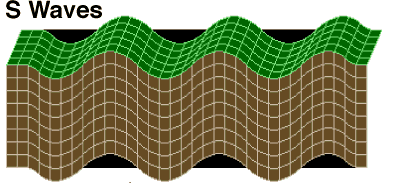
S-Waves can only propagate through solids since the outer core is liquid!
How we know that the outer core is liquid because of the S-Wave shadow zone, much more dramatic
Seismogram - tool that measures waves
Waves tend to curve and refract and reflect
Meterorites
Iron meteorites - fragments from the core of planetesimals and thought to be similar to our core
Pallasite/stony iron meteorites - pieces of core-mantle boundary of planetisimals