Exam II
what is a benefit of using of MRI compared to CT? does not expose patients to radiation
MRI scans can take as long as thirty minutes.
Before ultrasound, echolocation has been used in application such as radar and sonar.
Acoustic impedance is the property of medium that makes the propagation of sound waves more difficult.
which of the following is not limitation of MRI? exposes patients to radiation
which of the following is not a classification of biosensors? mechanical
for a device to be classified as a biosensor, and not just a biomedical sensor, it must have a transducer
biopotential can be measured be both noninvasively and invasively. True
copper and aluminum are place in an electrolyte solution, calculate the potential drop between these 2 electrodes. copper half-cell potential 0.340, aluminum half-cell potential: -1.706 = 0.340- (-1.706) = 2.046
copper and aluminum are placed in an electrolyte solution. calculate the current rate (mA) that will flow through the electrodes if the equivalent resistance of the solution is equal to 3komega? copper half-cell potential: 0.340 aluminum half-cell potential: -1.706: 0.340- (-1.706) = 2.046 2.046/3 = .682mA
for implantable biopotential measurements, noble metals should be used because they do not react chemically with tissue electrolytes and therefore minimize tissue toxicity.
a thermistor with a material constant 6 of 2500 k is used as thermometer. calculate the resistance of this thermometer at 25 C. Assume that the resistance of the thermistor at body temp (37 C) is equal to 85 omegas. = Rt = Ro * exp [B *(1/T-1/To)] = 117.61
which of the following cannot be detected to determine blood glucose levels with an enzyme-based glucose biosensor? glucose oxidase
microbial biosensors are composed of immobilized microorganisms that serve as recognition elements and as an electrochemical or optical sensing device. true
a higher index of refraction is associated with decreased velocity.
Biomedical sensors I:
biomedical sensors/transducer:
main building blocks of diagnostic medical instrumentation found in physicians’ offices, clinical laboratories, and hospitals.
classifications:
physicals
electrical
chemical
biosensors are a special subclassification of biomedical sensors.
consists of:
a biological recognition element such as purified enzyme, antibody, or receptor, which functions as a mediator and provides the selectivity that is needed to sense the chemical component (often referred to as an analyte) of interest.
supporting structure, which also acts as a transducer and is in intimate contact with the biological component.
transducer- convert the biochemical reaction into the form of an optical, electrical, or physical signal that is proportional to the concertation of specific chemical.
biopotential measurements
made of different kinds of specialized electrodes to couple the ionic potentials generated inside the body to an electronic instrument.
can be classified as:
noninvasive (skin surface)
invasive (microelectrodes or wire electrodes)
Electrocardiogram (ECG)
choosing electrodes:
implantable applications (strong metal electrodes),
stainless steel
noble materials such as gold or from various alloys such as platinum-tungsten, platinum-iridium, titanium-nitride or iridium-oxide.
do not react chemically with tissue electrolytes and therefore minimize tissue toxicity. large interface impedances (opposition to electrical flow) and unstable potentials.
External applications:
non-noble materials
less-biocompatibility concerns
have to deal with large skin interface impedance and unstable biopotential.
physical measurements:
airflow transducers are used in ventilators to measure airflow.
thermistors (thermometer)
are temperature sensitive transducers made of compressed sintered metal oxides (such as nickel, manganese, or cobalt) that change their resistance with temperature. resistance temperature can be approximated by:
Rt = Ro *exp[b*(1/T-1/To)]
practice problem
bioanalytical sensor:
enzyme-based biosensors:
enzymes constitute a group of more than 2000 proteins having bio-catalytic properties.
accelerated chemical reactions.
in enzyme-based biosensors, these enzymes can be immobilized I stable matrix such as starch gel, silicon rubber, or other synthetic polymers until they are released and therefore activated.
glucose sensors:
background: in patients suffering from diabetes, the pancreas does not produce sufficient amounts of insulin to control adequately the level of glucose in their blood.
To manage the disease, patients must monitor and regulate their blood glucose levels.
enzyme: glucose oxidase.
Detection: amount of gluconic acid, hydrogen peroxide (H2O2), or oxygen consumption.
microbial biosensors are composed of immobilized microorganisms that serve as recognition elements and as an electrochemical or optical sensing device.
the operation of microbial sensor:
the substrate is transported to the surface of the sensor
the substrate diffuses through the membrane to the immobilized microorganism
a reaction occurs at the immobilized organism
the product formed in the reaction are transported through the membrane to the surface of the detector
the products are measure by the detector.
microbial biosensors:
ammonia (NH3) biosensor
microorganism: Nitrosomonas sp.
uses ammonia as a source of energy.
detection: oxygen consumption via oxygen electrode.
Optical Biosensors II
optical biosensors
based on the change in optical properties of biological or physical medium
the change produced can be the results of changes in:
absorbance
reflectance
scattering
fluorescence
polarization
refractive index
optical fibers:
what is it?
transmit light from 1 location to another
made of 2 transparent glass or plastic materials, the core and the cladding.
the core has a lower refractive index than the cladding.
the core and the cladding have different index of refraction(n)
index of refraction-a number that expresses the ratio of light velocity in free space to its velocity in a specific material
high n, decreased velocity, the more light is bent.
any light passing from a lower refractive index to a higher refractive index is bent toward the line perpendicular to the interface of the 2 materials.
for small incidents angles, the light enters the fiber core and bends inwards at the core/cladding interface.
for large incidence angles, the light exceeds a minimum angle and escapes into the cladding.
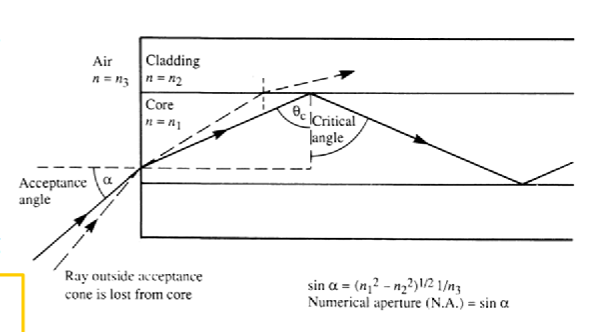
sensing mechanism
medical imaging
ultrasound
origins: RADAR and SONAR and bats use echolocation.
what is ultrasound/sonography:
what is it?
ultrasounds are a non-invasive method based on ultra-high frequency sound waves (20kHz) that are send into the body and received to create images. a wave is a disturbance that move though or alone the surface of a medium.
how is it used in the medical field?
view the uterus and ovaries during pregnancy and monitor the developing baby’s health.
diagnose gallbladder disease.
evaluate blood flow.
guide a needle for biopsy or tumor treatment.
examine a breast lump
check the thyroid gland
find genital and prostate problems.
asses joint inflammation, called synovitis.
evaluate metabolic bone disease.
characteristic of ultrasound or waves in general:
ultrasound also has wavelengths that limits the fineness of detail it can detect.
we can never observe details significantly smaller than the wavelength of our probe
the transducer is piezo electric converts mechanical energy to electric energy
ultrasound-acoustic impedance
reflection at boundaries between two different media occur because of differences in a characteristic known as the acoustic impedance, Z, of each substance.
impedance [kg/(m²*s))] is defined as Z = pv, p density of the medium and v is the speed of sound through the medium (m/s).
ultrasound-pros and cons
benefits:
low cost
portability
safe to use
non-invasive
limitations
high skill is needed to obtain good images
a great deal of experiences is necessary to recognize, interpret, and measure images for diagnosis.
computed tomography (CT) imaging
what is it?
a noninvasive imaging technique that uses computers to analyze several cross-sectional x-rays in order to reveal minute details about the structures in the body
tomography: imaging by sections
used in CAT (computerized axial tomography) scans
useful for soft tissue scanning, such as: the brain and the thoracic and abdominal viscera
CT imaging in BME research
CT - pros and cons
Benefits:
so precise that it can allow physicians to measure the size of a mass down to a millimeter
quantitative data
Limitations:
exposes patients to a dose of radiation many times higher than that of X-rays.
Children who undergo CT scans are at increased risk of developing cancer, as are adults who have multiple CT scans.
Magnetic Resonance Imaging (MRI)
what is it?
technique based on a phenomenon of nuclear physics discovered in the 1930’s, in which matter exposed to magnetic fields and radio waves was found to emit radio signals.
resolution is mainly determined by the gradient or shape of the magnetic field and is typically 1 mm.
images are calculated by reconstruction algorithms based on the sensed voltages proportional to the relaxation times. subjects the patient to such a powerful electromagnet that the scan room must be shielded.
the patient must be enclosed in a metal tube- like device for the duration of the scan, sometimes as long as thirty minutes, which can be uncomfortable and impractical for ill patients.
so noisy that, even with earplugs, patients can become anxious or even fearful.
MRI - pros and cons
benefits:
does not expose patients to radiation
imaging is relatively fast
limitations:
high cost
patients discomfort
patients with iron-containing metallic implants (internal structures, some prosthetic devices, and so on) cannot undergo MRI scanning because it can dislodge these implants.
high skill is necessary to produce images and to interpret them.
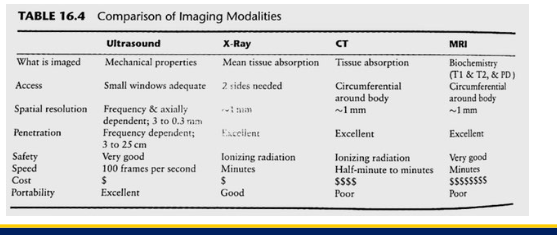
comparison of imaging models.