Reducing the Risk of Medication Errors
The Medication Prescription
A complete medication prescription should contain the following information: client’s name, date/time that the prescription was written, medication name (generic), dosage, route of administration, frequency, indication for use, and provider’s signature.
Prescription Example
John Doe
6/22/2020
10:00am
Indomethacin 50 mg by mouth every 12 hours for osteoarthritis
Dr. Sam Jones
The MAR is a record of the medications prescribed for the client by the provider. It is used by the nurse to record and confirm medication administration per the prescription. In health care organizations that use computerized physician order entry (CPOE), the provider enters the medication prescription electronically. The information regarding the medication order then goes to the pharmacy, where the pharmacist reviews the prescribed medication. An electronic version of the MAR appears in the client’s electronic health record (EHR); a paper copy of the MAR is used if the organization is still using paper medical charts.
When administering medications to the client, the nurse uses the MAR to comply with the right of administration. The right client is confirmed as the nurse confirms the client’s identity using two identifiers and compares them to the MAR. Right drug, dose, and route are confirmed as the nurse checks the label of the medication against the MAR. This step is carried out three times—when the nurse removes the medication from the drawer, when the nurse pours the medication, and at the bedside. The right assessment is completed before the medication is given by assessing the client physically and reviewing lab work and/or vital signs. The right documentation involves the nurse documenting on the MAR after the medication has been administered. The right to refuse is documented on the MAR as well. The right evaluation is completed after the medication is given, and is charted on the MAR.
Review the following provider prescription and then identify the following information as missing or present. (Drag the options to the desired category. If you select the wrong category, the description will automatically move to the correct category.)
Prescription reads:
Alice Sample
10/12/2020
Tylenol 650 mg every 6 hours for pain
Missing
Present
Factors Contributing to Medication Errors
Failure to follow the rights of medication administration (e.g., giving the wrong dose, wrong time, or wrong medication). A late dose or missed dose is considered a medication error.
Failure to check for accuracy of the medication prescription. The nurse must collaborate with the pharmacist and the provider in checking for accuracy and appropriateness of medication prescriptions prior to administration.
Failure to assess the client for any high-risk variables related to age, disease states, laboratory data, allergies, and prior response to medications.
Giving medications before they can be verified by the pharmacist and other members of the interprofessional team. The pharmacist should review all medications before they are delivered to the nurse for administration.
Incomplete or illegible prescriptions with missing components of the medication prescription. Unofficial abbreviations should not be accepted.
Working under stressful conditions with numerous interruptions.
Medication Reconciliation
Medication reconciliation is another important aspect of maintaining and ensuring client safety. Through its Patient Safety Goals and other initiatives, The Joint Commission has emphasized that facilities need to maintain an accurate, up-to-date list of every client’s medications. Medication reconciliation is performed upon admission; whenever the client transitions from one level of care to another, both within the facility (e.g., from the intensive care unit [ICU] to the general medical–surgical unit) or from one health care facility to another (e.g., a client transferred from the hospital to a rehabilitation facility); and when the client is discharged home from a facility. According to The Joint Commission the goal of medication reconciliation is to develop, update, coordinate, and communicate accurate client medication information during transitions of care.
The reconciliation process involves reviewing the client’s current medications, comparing them to the newly prescribed medications, and addressing omissions, duplications, interactions, and discrepancies. The nurse considers any potential drug–drug interactions. All types of medications, including over-the-counter (OTC) medications and herbal supplements, should be included in the reconciliation process, as there may be a potential risk for interactions with newly prescribed medications. Having a complete medication list can reduce polypharmacy, which is common among the geriatric population. The interprofessional team, consisting of the pharmacist, provider, nurse, and in some cases, the registered dietitian, is instrumental in the reconciliation process, and their collaboration can result in improved client outcomes.
over-the-counter (OTC) medications
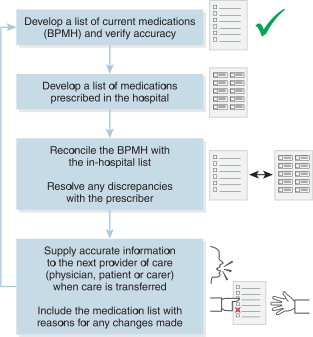
Medication reconciliation is a process to maintain an accurate list of client medications and prevent medication errors. BPMH is Best Possible Medication History.
Medication reconciliation process
Medication Reconciliation Process
Document an accurate and comprehensive list (name, dose, route, frequency, and purpose) of home medications upon admission.
Compare the list of home medications to newly prescribed medications during the current hospitalization and reconcile any discrepancies.
Update the medication list and repeat the comparison and reconciliation process at any transition of care during the client’s hospitalization, as well as at discharge.
Communicate the reconciled medication list to the next care provider.
Educate the client and caregivers upon discharge and provide the client with written information about their medication.
A nurse is admitting a client to the medical-surgical unit. Place the following steps of the medication reconciliation process in the correct order that they should be performed.
1
2
3
4
5
The FDA (2020) defines a medication error as any avoidable event that could result in an incorrect use or client injury during the time frame in which the medication is the possession of the nurse, client, or health care provider. Most errors occur when the nurse neglects to observe standard procedures and does not follow the rights of medication administration, leading to errors such as wrong time, wrong dose, or failure to give the medication as prescribed. The best strategy for preventing errors associated with medication administration is to acknowledge basic concepts and follow the rights of medication administration. The nurse is both legally and ethically responsible for all steps within the medication administration process, including observation, client education, and documentation. The nurse should never leave medications at the bedside for a client to self-administer, as this practice fails to follow the rights of medication administration and may lead to a medication error or a serious ADE.
Technological advances such as automated medication dispensing systems (AMDS) and barcode technology may aid in the reduction of medication errors and support record-keeping of medications on the unit. Research shows that the use of AMDS can lead to a 31% reduction in dispensing medication errors, and barcoding technology can yield a 41% decrease in errors and 51% decrease in potential adverse drug events. AMDS are medication storage machines that control the dispensing of medications, including narcotics. Every nurse has a personal password to access the system. After the nurse enters the client’s name, the name of the medication, the dosage, and the medication route, the system dispenses the medication. The AMDS can also link the medication administration and the nurse who accessed the system to the client’s electronic record.
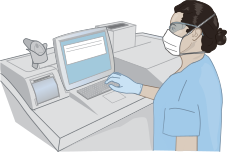
The nurse obtains the client’s medications using an automated medication dispensing system (AMDS).
An automated medication dispensing system (AMDS)
When using a barcode system, at the time of medication administration, the nurse uses a handheld scanner device to scan the client’s identification wristband and the medication label. If there is a discrepancy between the scanned medication and the client’s bracelet, the system will alert the nurse as to the discrepancy. The medication should not be administered until the reason for the alert is resolved.
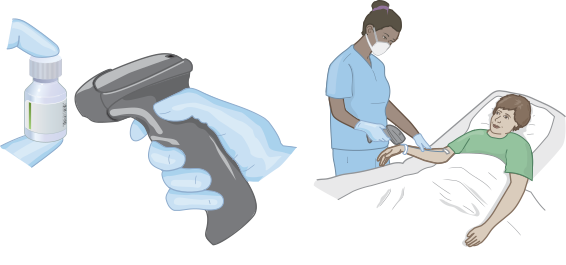
The nurse scans the prescribed medication and the client to reduce the risk of medication errors.
Barcode scanning
Three factors reported by nurses as contributing to medication errors are identification, interruption, and correction. Identification components are associated with the nurse’s depth of knowledge regarding the medication and observing the rights of medication administration.
Interruption occurs when the nurse is preparing or administering a medication and is interrupted during the process. Interruptions during the medication process impact client safety, quality of care, and workload. Strategies to prevent interruptions include marking the area where medication preparation occurs to prevent people from conversing with a nurse working in the labeled area, limiting excess noises, decreasing the use of cellphones by the nurse, and educating staff not to disturb those preparing medications unless the need is critical in nature.
Correction relates to the number of alerts and warnings frequently communicated to nurses on a daily basis and the temptation to ignore an alert that could potentially cause harm to the client. When using an automated dispensing cabinet system, the pharmacist reviews the order before the medication is removed from the system and administered. If the nurse removes the medication before the pharmacist has reviewed the medication for administration, an alert will be generated, requiring the nurse to override the system.
override
Nurses should not resort to using workarounds when problems arise with the normal process of medication administration. A workaround is the practice of avoiding a policy or procedure in a system. For example, the nurse may be tempted to override the AMDS if a client’s medication wristband falls off or if an error code is displayed after scanning a medication barcode. Taking a shortcut or using a workaround lessens the system’s safety features and leads to errors. The ISMP defines an override as an instance where the nurse removes a medication from the automatic dispensing system before the pharmacist has reviewed the order because the nurse perceives that the client will be harmed if administration of the medication is delayed. Overriding the system creates a risk to the client and should occur only in an emergent situation.
workaround
High-alert medications are associated with an increased risk of causing considerable client harm when errors in their administration occur. To reduce the risk of harm to clients, safeguards are put into place for such medications. For example, all forms of insulin are regarded as high-alert medications. One strategy that has been instituted as a safety protocol is manual independent double checks, in which two nurses verify the identical information when administering insulin. The information checked by each nurse includes the rights of medication administration—medication order, right dose for client’s age and weight, right time (when the last dose was administered), right dose (right amount of medication drawn up in the syringe or right number/dose of pills), right dose calculation, and right client. Two nurses independently checking the information should result in fewer medication errors. Other high-alert medications include opiates, narcotics, intravenous heparin, and injectable potassium chloride.
Safe Medication Administration
Medication Administration
A nurse is reviewing the factors contributing to medication errors and the appropriate actions to reduce these risks. Match the contributing factors in the left column with the appropriate risk reduction strategies in the right column.
Minimize disruptions during medication preparation and administration.
Follow established safeguards and protocols for medications with increased risk of harm.
Follow policies and procedures without taking shortcuts.
Adhere to the rights of medication administration and enhance knowledge about medications.
Pay attention to alerts and warnings and avoid ignoring them.
Medication Errors
Medication errors are the most common medical errors, resulting in more than 770,000 injuries or deaths each year in the United States. While nurses are responsible for preventing many medication errors by intervening during the prescribing, transcribing, and dispensing aspects of medication administration, the highest risk of committing a medication error occurs when the nurse actually gives the medication. This increased risk is related to having fewer systems in place to prevent medication errors at the bedside The client could suffer harm—possibly lethal—if an error is not addressed.
When it has been determined that a medication error has occurred, the client must be assessed for any change in medical condition.Notify the health care provider as soon as possible to remedy any potentially harmful effects of the error. The organizational protocols will dictate the steps to complete following a medication error, which typically involve notifying the nursing supervisor and completing an incident report once the health care provider has been notified.
When completing the incident report, the nurse explains the situation surrounding the error, including what happened, which actions were taken, other people involved, and circumstances that may have played a role in the error. It is important to state only the facts in the incident report, while avoiding any personal opinions or excuses, omitting facts, or trying to place the responsibility on someone else. Although the incident report is considered a legal document, it is not placed or mentioned in the client’s medical record. Following health care facility’s policy, the erroneous medication administered, or scheduled medication omitted, should be documented in the client’s medical record, along with the client assessment, interventions provided, and notification of the health care provider.
Strategies for Reducing Medication Administration Errors
1. Identify client by using two types of identifiers (e.g., name, date of birth, Social Security number, medical record number, or telephone number)
Use appropriate administration techniques for the prescribed medications. Use aseptic technique when administering parenteral medications. Wear gloves when administering medications per the facility’s policies and procedures.
Calculate all doses of medications correctly, with a double-check for complicated calculations, high-risk medications, IV medications, and pediatric dosages.
Be alert for sound-alike medications (e.g., dopamine/dobutamine, heparin/Hespan).
Clarify any questions or concerns about the medication prescription with the health care provider. The health care provider’s medication prescription must include the medication name, dose, form, route, and time of administration.
Never leave any medications at the bedside. Ensure that the client has swallowed the medication.
Always have another nurse witness insulin doses and disposal of unused narcotic doses, as required by the facility.
Become familiar with the medication prior to administration by consulting a drug reference guide, the health care provider, the pharmacy, or a facility approved application on an electronic device.
Educate clients when all new medications are prescribed or when they have questions.
Recognize that the client has the right to refuse medications.
Observe and assess the client prior to medication administration and following the administration of any PRN or new medications for efficacy and adverse medication effects.
Check and confirm client allergies before administration of medications.