Reliability and validity
Basics of Research Methods
Key Concepts
Psychological Constructs: Constructs like anxiety, intelligence, and self-esteem often lack universally agreed measures, leading to varying scales with different levels of agreement on what they measure.
Reliability: Refers to the consistency of measurements. Key types include:
Internal Reliability: Internal reliability refers to how consistently different items within a psychological scale measure the same concept. For example, if a questionnaire is designed to assess anxiety, all the questions in that questionnaire should produce similar results if they are indeed measuring anxiety consistently. High internal reliability means that the items work well together to provide a clear picture of the construct being measured.
Reliability Over Time: If a test is administered multiple times to the same individuals, the scores should be similar across those instances. This type of reliability is crucial for ensuring that the measurements are not influenced significantly by external factors or changes over time.
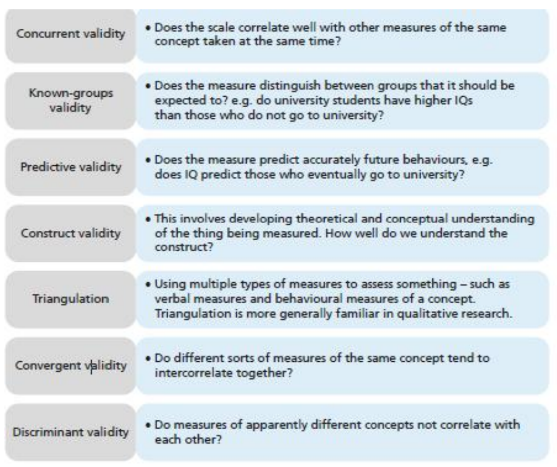
Validity: The ability of a measure to assess the intended psychological construct.
Face Validity: Whether a test appears to measure what it's designated to measure. NO EXPERT REVIEW, JUST AT FIRST GLACE HOW DOES THE TEST SEEM.
Content Validity: Evaluation by experts to determine if items properly represent constructs. OKAY NOW WE ARE TALKING EXPERTESE. THIS MEANS THAT THE VALIDITY OF THE TEST IS REVIEWED BY PROFESSIONALS.
Criterion Validity: It looks at the relationship between a new test and a known standard or criterion. For instance, if a new depression scale is developed, its criterion validity would be evaluated by comparing its results to those from an already validated depression assessment.
Convergent Validity: Checks if different tests that are supposed to measure the same thing give similar results. If two anxiety tests show similar scores for people, then they have good convergent validity.
Discriminant Validity: Checks if tests measuring different things give different results.
Importance of Reliability and Validity
High reliability ensures consistent outcomes, while high validity ensures accurate measurements. Examples include COVID-19 tests or polygraphs, which assess both reliability and validity.
Applications and Evaluation
Continuous evaluation of testing scales demonstrates the importance of reliability and validity. Statistical methods, like Cronbach’s alpha, help analyze internal reliability, guiding the refinement of assessment tools to ensure they effectively measure the intended constructs.
Key Takeaways
Understanding and ensuring high reliability and validity are fundamental in psychological research and practice, enhancing the credibility and effectiveness of psychological measures.