Ap Biology Exam #2 Study Guild (Notes)
Cell Structure & Function
Subcellular components & organelles:
Nucleus: Stores DNA, controls gene expression.
Mitochondria: Produces ATP via cellular respiration.
Chloroplasts (plants/algae): Capture light energy, perform photosynthesis.
Endoplasmic Reticulum (ER): Rough ER makes proteins; Smooth ER synthesizes lipids, detoxifies.
Golgi Apparatus: Modifies, sorts, and packages proteins/lipids for transport.
Lysosomes: Break down waste & macromolecules with enzymes.
Vacuoles: Store water, nutrients, and waste; maintain turgor pressure in plants.
Cytoskeleton: Maintains shape, aids in transport, and enables cell movement.
Ribosomes: Protein synthesis.
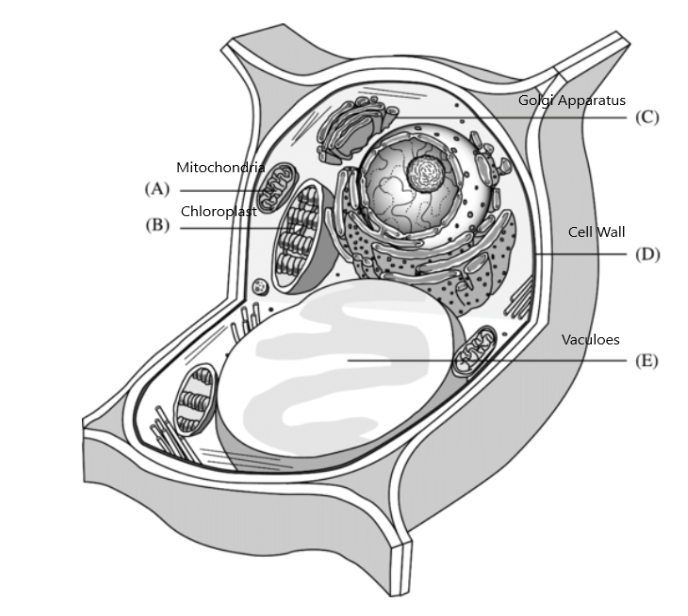
Contribution to cell function: Each organelle has a specialized role, but together they maintain homeostasis and allow cells to grow, divide, and respond to their environment.
Energy Capture, Storage, and Use
Mitochondria: Use glucose & oxygen to produce ATP.
Chloroplasts: Capture sunlight, convert it to chemical energy.
Cell membranes: Regulate nutrient/waste exchange for energy balance.
Structural features: Folding of inner mitochondrial membrane (cristae) and thylakoid stacks increase surface area for energy reactions.
Surface Area-to-Volume Ratio
High SA:V ratio → more efficient exchange of materials (nutrients in, waste out).
Low SA:V ratio (large cells) → less efficient, which is why cells divide or adopt shapes (like microvilli) to increase surface area.
Specialized Exchange Structures
Alveoli in lungs: Large surface area + thin membranes for gas exchange.
Root hairs in plants: Maximize water/mineral absorption.
Capillaries: Thin walls for rapid diffusion of nutrients and gases.
Cell Membrane
Components:
Phospholipids: Form bilayer, create selective barrier.
Proteins: Channels, pumps, receptors, enzymes.
Carbohydrates: Cell recognition and signaling.
Cholesterol: Maintains fluidity and stability.
Fluid Mosaic Model: Membrane is fluid (lipids and proteins move laterally) and mosaic (diverse proteins embedded in the bilayer).
Selective permeability: Small/nonpolar molecules pass freely, while large/charged molecules need transport proteins.
Cell Wall
Provides rigidity, protection, and shape (plants, fungi, bacteria). Prevents lysis in hypotonic environments.
Transport & Membrane Mechanisms
Small molecules:
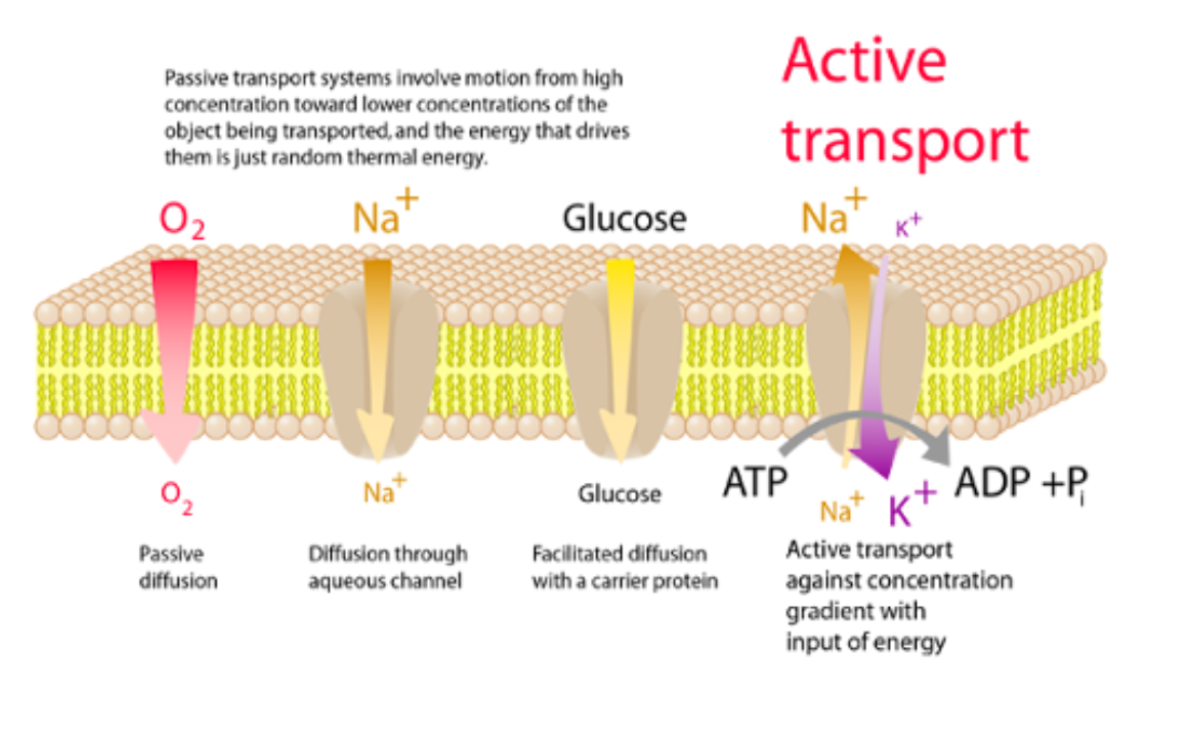
Passive transport (diffusion, osmosis, facilitated diffusion).
Active transport (uses ATP to move against gradient).
Large molecules:
Endocytosis (phagocytosis, pinocytosis).
Exocytosis (vesicles fuse with membrane to release material).
Concentration gradients: Molecules move down gradients unless energy is used to move against them.
Osmoregulation:
Freshwater organisms pump out water with contractile vacuoles.
Plants use cell walls & vacuoles for turgor pressure.
Animals rely on kidneys and ion channels.
Membrane-Bound Organelles & Compartmentalization
Eukaryotes: Organelles like nucleus, ER, mitochondria, chloroplasts, etc., separate processes (e.g., transcription in nucleus, translation in cytoplasm).
Prokaryotes: No organelles; functions occur in cytoplasm or across plasma membrane.
Endosymbiosis theory: Mitochondria and chloroplasts evolved from free-living prokaryotes that were engulfed by early eukaryotic cells. Both have double membranes, circular DNA, and ribosomes—similar to bacteria.
Statistical Analysis in Biology
Ratios are often used in surface area-to-volume comparisons, solute concentrations, or experimental results.
Example: If a cell has surface area of 6 mm² and volume of 1 mm³, then SA:V = 6:1, showing efficient exchange.
AP Bio Unit 2 Concept Notes
Living systems are organized in a hierarchy of structural levels that interact.
Ribosomes comprise ribosomal RNA (rRNA) and protein. Ribosomes synthesize protein according to mRNA sequence. Ribosomes are found in all forms of life, reflecting the common ancestry of all known life.
Endoplasmic reticulum (ER) occurs in two forms—smooth and rough. Rough ER is associated with membrane-bound ribosomes—
Rough ER compartmentalizes the cell.
Smooth ER functions include detoxification and lipid synthesis.
The Golgi complex is a membrane-bound structure that consists of a series of flattened membrane sacs—
Functions of the Golgi include the correct folding and chemical modification of newly synthesized proteins and packaging for protein trafficking.
Mitochondria have a double membrane. The outer membrane is smooth, but the inner membrane is highly convoluted, forming folds.
Lysosomes are membrane-enclosed sacs that contain hydrolytic enzymes.
A vacuole is a membrane-bound sac that plays many and differing roles. In plants, a specialized large vacuole serves multiple functions.
Chloroplasts are specialized organelles that are found in photosynthetic algae and plants. Chloroplasts have a double outer membrane.
Organelles and subcellular structures, and the interactions among them, support cellular function—
Endoplasmic reticulum provides mechanical support, carries out protein synthesis on membrane-bound ribosomes, and plays a role in intracellular transport.
Mitochondrial double membrane provides compartments for different metabolic
Lysosomes contain hydrolytic enzymes, which are important in intracellular digestion, the recycling of a cell’s organic materials, and programmed cell death (apoptosis).
Vacuoles have many roles, including storage and release of macromolecules and cellular waste In plants, it aids in retention of water for turgor pressure.
The folding of the inner membrane increases the surface area, which allows for more ATP to be synthesized.
Within the chloroplast are thylakoids and the stroma.
The thylakoids are organized in stacks, called grana.
Membranes contain chlorophyll pigments and electron transport proteins that comprise the photosystems.
The light-dependent reactions of photosynthesis occur in the grana.
The stroma is the fluid within the inner chloroplast membrane and outside of the thylakoid.
The carbon fixation (Calvin-Benson cycle) reactions of photosynthesis occur in the stroma.
The Krebs cycle (citric acid cycle) reactions occur in the matrix of the mitochondria.
Electron transport and ATP synthesis occur on the inner mitochondrial membrane.
The highly complex organization of living systems requires constant input of energy and the exchange of macromolecules
Surface area-to-volume ratios affect the ability of a biological system to obtain necessary resources, eliminate waste products, acquire or dissipate thermal energy, and otherwise exchange chemicals and energy with the environment.
The surface area of the plasma membrane must be large enough to adequately exchange materials—
These limitations can restrict cell size and shape. Smaller cells typically have a higher surface area-to-volume ratio and more efficient exchange of materials with the environment.
As cells increase in volume, the relative surface area decreases and the demand for internal resources increases.
More complex cellular structures (e.g., membrane folds) are necessary to adequately exchange materials with the environment.
As organisms increase in size, their surface area-to-volume ratio decreases, affecting properties like rate of heat exchange with the environment.
Organisms have evolved highly efficient strategies to obtain nutrients and eliminate wastes. Cells and organisms use specialized exchange surfaces to obtain and release molecules from or into the surrounding environment.
Cells have membranes that allow them to establish and maintain internal environments that are different from their external environments.
Phospholipids have both hydrophilic and hydrophobic The hydrophilic phosphate regions of the phospholipids are oriented toward the aqueous external or internal environments, while the hydrophobic fatty acid regions face each other within the interior of the membrane.
Embedded proteins can be hydrophilic, with charged and polar side groups, or hydrophobic, with nonpolar side groups.
Cell membranes consist of a structural framework of phospholipid molecules that is embedded with proteins, steroids (such as cholesterol in eukaryotes), glycoproteins, and glycolipids that can flow around the surface of the cell within the membrane.
The structure of cell membranes results in selective permeability.
Cell membranes separate the internal environment of the cell from the external
Selective permeability is a direct consequence of membrane structure, as described by the fluid mosaic model.
Small nonpolar molecules, including N2, O2, and CO2, freely pass across the membrane. Hydrophilic substances, such as large polar molecules and ions, move across the membrane through embedded channel and transport proteins.
Polar uncharged molecules, including H2O, pass through the membrane in small amounts.
Cell walls provide a structural boundary, as well as a permeability barrier for some substances to the internal environments.
Cell walls of plants, prokaryotes, and fungi are composed of complex carbohydrates.
Passive transport is the net movement of molecules from high concentration to low concentration without the direct input of metabolic energy.
Passive transport plays a primary role in the import of materials and the export of wastes.
Active transport requires the direct input of energy to move molecules from regions of low concentration to regions of high concentration.
The selective permeability of membranes allows for the formation of concentration gradients of solutes across the membrane.
The processes of endocytosis and exocytosis require energy to move large molecules into and out of cells—
In exocytosis, internal vesicles fuse with the plasma membrane and secrete large macromolecules out of the cell.
In endocytosis, the cell takes in macromolecules and particulate matter by forming new vesicles derived from the plasma membrane.
Membrane proteins are required for facilitated diffusion of charged and large polar molecules through a membrane—
Large quantities of water pass through aquaporins.
Charged ions, including Na+ and K+, require channel proteins to move through the membrane.
Membranes may become polarized by movement of ions across the membrane
Membrane proteins are necessary for active transport.
Metabolic energy (such as from ATP) is required for active transport of molecules and/or ions across the membrane and to establish and maintain concentration gradients.
The Na+/K+ ATPase contributes to the maintenance of the membrane potential.
External environments can be hypotonic, hypertonic or isotonic to internal environments of cells—
Water moves by osmosis from areas of high water potential/low osmolarity/low solute concentration to areas of low water potential/high osmolarity/high solute concentration.
Growth and homeostasis are maintained by the constant movement of molecules across membranes.
Osmoregulation maintains water balance and allows organisms to control their internal solute composition/water potential.
Cells have membranes that allow them to establish and maintain internal environments that are different from their external
A variety of processes allow for the movement of ions and other molecules across membranes, including passive and active transport, endocytosis and exocytosis.
Cells have membranes that allow them to establish and maintain internal environments that are different from their external
Membranes and membrane-bound organelles in eukaryotic cells compartmentalize intracellular metabolic processes and specific enzymatic reactions.
Internal membranes facilitate cellular processes by minimizing competing interactions and by increasing surface areas where reactions can occur.
Membrane-bound organelles evolved from once free-living prokaryotic cells via endosymbiosis.
Prokaryotes generally lack internal membrane-bound organelles but have internal regions with specialized structures and functions.
Eukaryotic cells maintain internal membranes that partition the cell into specialized regions.
https://quizlet.com/915928734/ap-bio-unit-2-test-flash-cards/