Chapter 14: Mountain Belts and the Continental Crust
every main continent has a shield
orogenies = the processes that build mountain belts
collisional boundaries are a show of plates moving around
name of the orogeny that created the mountain belt is often different than the name of the mountain chain (Alleghenian orogeny = Appalachian Mts)
Intense deformation:
plate convergence causing folding, faulting, sedimentation, volcanism, metamorphism, foliation
isostasy: vertical movement of crust due to differences in density between the crust (ex. wood floating in water)
Weathering & erosion:
rate and nature of weathering and erosion
based on climate, type of rock, and height
new crust has been added to continents over time but how?
magmatic addition: vertical transport of mafic materials (basalt), magmas created at subduction zones; flux melting
continental accretion: horizontal transport of material (island arcs, old mt. ranges, seamounts, basaltic plateaus). crustal fragments are glued onto more stable cratons
accreted terrains
exotic terrains
paleo magnetic records help map from millions of years ago
fossils that once lived in different climates and at different times found next to each other bc they’ve been put together by moving of continents
large faults bound the accreted terrains
rocks of different age and lithology next to each other
paleomagnetic differences (can’t tell eastern or western hemisphere)
supercontinent events create and build crust which are convergent boundries that create mountains.
The Wilson Cycle: the IDEALIZED plate tectonic cycle of supercontinents and then no supercontinents (over time, there are cycles of building mountains)
cycles of building mountain - Appalachians have been activated/reactivated
rifting within a continent splits the continent
Rodinia (1.2 billion years old), supercontinent
leading to the opening of a new ocean basin and creation of new oceanic crust, starting the cycle
Tethys Ocean forms (equatorial sea way)
as spreading continues and an ocean opens, passive margin cooling occurs and sediment accumulates during seafloor spreading
convergence begins; an oceanic plate subducts beneath a continental plate, creating a volcanic chain at the active margin
North American-Europe (Laurentia) begins to converge with Africa-South America-Australia (Gondwana)
Terrane accretion - from the sedimentary accretionary wedge or fragments carries by the subducting plate - welds material to the continent
As two continents collide, orogeny thickens the crust and builds mountains, forming a new supercontinent
all continents collide to form Pangaea, supercontinent
Continent erodes, thinning the crust = process may begin again
Tectonic History of North America
1.6 - 1.1 bya:
southern US was converging with an oceanic plate and formed the supercontinent Rodinia
400 - 200 mya:
eastern US was converging toward South America, Europe and Africa forming Appalachians and Pangea, then rifted apart forming Atlantic Ocean
80 - 55 mya:
Laramide Orogeny created the Rockies
Today:
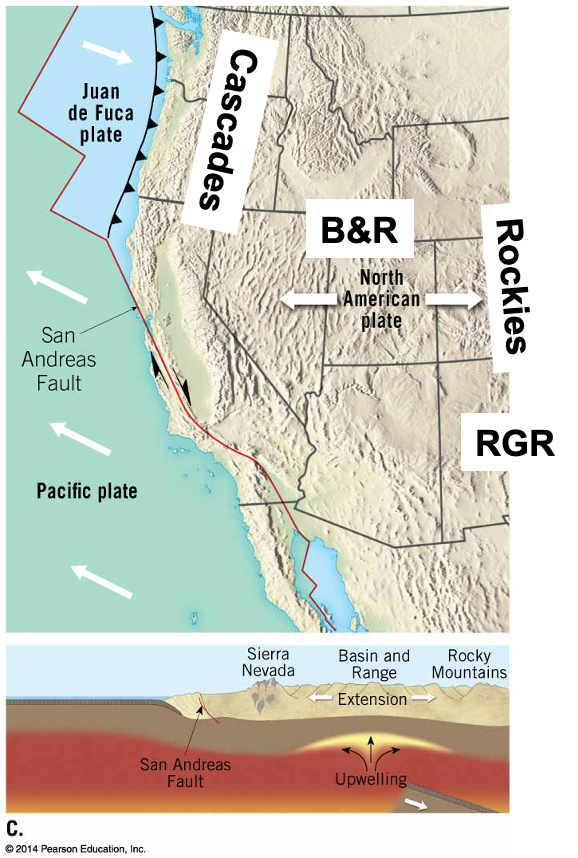
SW US is extending forming the Rio Grande Rift, Basin and Rang and San Andreas Fault (passive margin to east)
Tectonic History of North America: Appalachian Mountains
Taconic Orogeny: Ordovician period
island arc formed and wash pushed into N.A.
Acadian Orogeny: Devonian period
continental crustal fragment pushed onto N.A.
Alleghanian Orogeny: Permian period
N.A. and Africa collide = Pangea
Today: history of these events in geologic record (rock from alabama all the way to florida, and basically all of the East Coast)
passive margin in Gulf of Mexico and Atlantic Ocean
West Coast
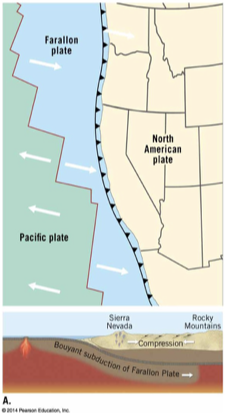
Cretaceous Period: subduction, formation of the rockies
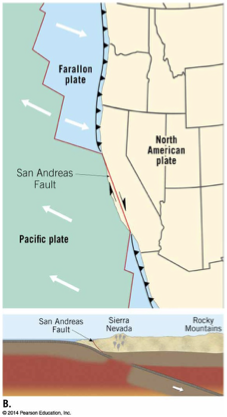
Oligocene Epoch: subduction of EPR, formation of SAF
Today: SAF, Cascades, Basin and Range, Rio Grande Rift