COM 178 PR Study Guide
Aug 20, 2024
PR Defined
According to Public Relations Society of America (PRSA)(2017; 2019)...
Two explanations, used in tandem:
“Public relations is a strategic communication process that builds mutually beneficial relationships between organizations and their publics.”
“At its core, public relations is about influencing, engaging and building a relationship with key stakeholders across a myriad of platforms in order to shape and frame the public perception of an organization.”
HubSpot Definition
Hubspot (2018): “Public relations (PR) is the practice of leveraging media channels to promote your organization and cultivate a positive public perception.”
This focuses on the use of the media – through which most PR happens (social, traditional, owned, etc. More later!)
Publics
Groups of people who are interested in you for any reason. Not just customers.
Groups with shared interests, related to you: Activist group, regulations, funding bodies, the government, competition, the media.
Stakeholders: An individual who has a vested interest in the organization
Latent public: A public that isn’t aware that it could be publics if you engage them (or if you do something dumb and they realize…)
Active public: The groups you are already engaging with
Organizations
A group of people (or smaller orgs) in pursuit of some mission or goal.
The shared goal, and some sort of system to structure the people involved, is
key to something being an actual org and not just random folks interested in
something (i.e., a public)
Target Markets
Nope. That’s (mostly) the purview of advertising or marketing broadly (more in the newxt few weeks)
Advertising just deals with target markets. We deal with everyone in PR.
It End With Us
People actually like the book but of how the producers have behaved.
The association between Blake Lively and Collene Hoover
Aug 22, 2024
Review Terms
Public relations
Publics
Stakeholders
Latent publics
Active publics
Organizations
PR Defined
What it is: Strategic communication that builds relationships between organizations and their publics. (PRSA, 2010)
What it does: Influence, engages, and builds relationships with stakeholders to shape the public perception of an organization. (PRSA, 2019)
How it does it: By leveraging* media channels to promote your organization and cultivate a positive public perception. (Hubspot, 2018)
This gets us to the PESO model, later!
Trends in PR: Shaped by changes in the broader social, technological and economic landscape.
*Note, “leverage” means to use something to maximum advantage
Common Oversimplifications
Spin
Damage control
Event planning
Publicists
Image management
All of these exist, but they are all small parts of PR. And then, there’s confusion with marketing or advertising.
4p’s of Marketing
Some forms of public relations and advertising are a part of the “marketing mix” – choices marketers have to best communicate with customers and publics
PR is a choice, within promotion, in the marketing mix
Examples of PR Tactics & Strategies
Social media outreach
Events (Festival ISU!)
Fundraising and donor relations
Media relations
Influencer relations
Special customer programs (think rewards)
Crisis management & communication
Reputation management
Definitely not an exhaustive list! See Spin Sucks reading for more
How PR is NOT Advertising
Advertising in purchased media you (as the professional) have control over.
Public relations is earned or organic coverage.
“Leveraging the media” is earning coverage or conversation, not buying it (through sometimes we buy media in PR)
PESO Model
The big four categories
Earned
Paid
Shared
Owned
So what are relationships
PR practitioners are the bridge that connects marketing, advertising, journalism etc.
PR are the ones that have been mostly working with communication compared to
We cultivate relationships with earned media channels (media relations, blogger relations, organic influencer content, etc.) to target and communicate (both 1-way and 2-way com)
Aug 27, 2024
Organization of Industry
Major types of PR
Agency is considered as more traditional type of PR
Working on bunch of different project compared to
Corporate Communication mainly work with the same customers.
Chapter 14 for more info
History of PR
Grundig’s Four Models of PR
They are not inherently bad, just the people who use it make it seem bad…
UNDERSTANDING THE MODELS:
Role- A defined specific role for the senders and receivers of messages your public and your orgs mostly
Lines of communication - one (and probably many) always exists between the senders and receivers whether it is one way communication or two way communication.
Message* strategy:
Communicating a specific message to key audiences for a specific reason.
Persuading an audience to think and/or act differently about a brand or person.
Crafting messages in different ways to accomplish a goal.
*Don’t forget that messages can be visual, too.
Behavioral intention - Ultimate goal is to motivate audiences through specific messages to take action or think a different way. Attitudes can be changed through strong relationship building measures, strategies, and efforts. It is related to two theories:
Theory of reasoned action (TRA) – a person’s behavior is determined by their intention to perform the behavior
Theory of planned behavior (TPB) – builds on TRA, looks at how we shape that intention (essentially goes back a step)
Models of PR
Universal Themes
Roles: A defined specific role for the senders and receivers of messages.
Your publics & your org, mostly.Sender to Receiver.
One of many forms of communication exist between the Sender and the Receiver.
Lines of communication: One (and probably MANY) always exists between the sender and the receiver whether it is one-way communication or two-way communication.
Message* strategy:
Communicating a specific message to key audiences for a specific reason.
Persuading an audience to think and/or act differently about a brand or person.
Crafting messages in different ways to accomplish a goal.
*Don’t forget that messages can be visual, too.
Behavioral intention: Ultimate goal is to motivate audiences through specific messages to take action or think a different way. Attitudes can be changed through strong relationship building measures, strategies, and efforts. It is related to two theories:
Theory of reasoned action (TRA) – a person’s behavior is determined by their intention to perform the behavior
Theory of planned behavior (TPB) – builds on TRA, looks at how we shape that intention (essentially goes back a step)
Function of the Models
Press agentry and publicity model
Getting the audience feedback (that’s it)
Can be negative toward certain groups they might want to attract (its intentional, and sometimes bad, not always tho)
“Any press is good Press”
Pubic Information
Primarily truthful and useful
Mostly one-way communication
Press Conferences
Any video or public communication.
Two way asymmetrical Model
The Kim Tape on roblox
Clickbait, lack of equal participation
The reason why we PR has a bad name
Two Way Symmetrical Communication Model
The Ideal PR model before PR was a thing.
Research based
Dove beauty, know for their campaigns to be empowering people and their relationships with beauty.
The goal is to make the audience to feel good about themselves
Models roughly illustrates the evolution of PR through the last 120 years or so. They all still exist, and none are inherently “bad”
There is always a line in communication
Aug 29, 2024
Common Myths
It would be important to talk to other people to understand that other people or companies talk when in business lingo
Emerging Skils
Needs efforts to working with other agency and celebrities.
Social networks being a sale key and drivers (the #sharescoke campaign)
Focusing on pacific goals as a agency
Corporate government’s provide a framework for PR to follow.
CSR page; a brag page in how they care
Telling numbers into pr
The treasury and intrists rate
Providing guidance in business and communications.
Where does pr exist?
Traditionally
More structure
New areas
More flexable
A lot of cases PR would work on more then one in the positions.
PR and Marketing love hate relationship
Our goals are different despite our values being the same
Qucker turnaround times in Marketing
Building a positive relationship with customers takes time in PR
PR and Sale
Learning the difference between hard sales and soft sales
PR and Advertising
Mad Men is a great example with this.
Pr and Entrepreneurship
Must be persistent empathetic and a stong leader
PR and Human Resources
Between the communication of the business and the employees
Internal communications with the
PR and C-Suite
Easier to figure out and getting to know
What does PR do?
Impats sales and giving a more data forced approach, a go to for a lot of our adrenaline junkies in PR.
Making sure the bands message is on going and if chaged to be more beneficial in getting our customers.
Common goals
Figuring our ways to help adapt their ways based on current Public Option.
Ambassador and advocacy is a for of getting outside and inside intel of the audiences feedback.
Hearing stories via internally organically gives your ideas on the culture of the company via internal source is a great indicator their business is good.
Taco Bell is known for horrible corporate culture, but their social media is really good.
Best Practices
• Be a student of business and management
• Take additional business-focused classes and workshops
• Add business insights into your PR work
• Embrace statistics
• Expand your network to include business professionals
Sep 10, 2024
Research
The systematic gathering of information conducted in a scientific and objective manner to help answer questions. (Primary duties as PR professionals)
Allow us to understand which stories
How does this benefits PR?
Provide direction for understanding our key audiences
Also help us identify gaps and opportunities relative to our competitors
Additional insights and evidence that can help determine what decisions and investments are needed.
Selection of Influencers
Return on influence was a claim they made in order to catch more engagement.
Bussiness belive micro influencers work better with PR because of higher consistent return of interests.
Research also help understand audience behavior.
Data-Driven Deicisions
Understanding demand and issues
Evaluating a Shaky world
Media Monitoring
Allows strategists to evaluate real-life feedback and can illuminate the overall impact of a rebranding campaign.
Edelman
Publishing researches to look more interesting or reliable as a company that provide resources for Media Monitoring.
EBP’s
Comprehensive view of what is happening in a campaign and a road map for how to address challenges.
Environment and organization contexts
*Avoid making assumption at all costs.
Audience segmentation
Process of categorizing people into certain groups based on specific criteria.
Broad in nature
Niche
Collect information so we can create profiles of audiences with whom our organizations and brands should engage.
Outputs and outcomes
Outputs
immediate and direct results of a particular PR or communication program.
Outcomes
more important results because they reflect the behavioral actions of our audiences.
Social and digital communications.
analyzing, and reporting insights on a brand’s position and reputation, the health of its audiences and communities, and the opinions of key audience members.
Allowing us to discover new brand partnerships, identify emerging trends, and engage with new audiences, listening is about learning and uncovering the latest issues and events that may affect our clients either positively or negatively.
Sep 12, 2024
Identifying Audiences
Audiances segmation: The process of categorizing people into groups based on specific criteria (demographics, population data, more niche: industries/interests/ect.)
Identify subgroups within a larger target audience strategy to develop stronger connectioins with clients, brands, and the public.
Influencers
Creators
Activists
Levels:
♣ Hero/celebrity
♣ Macro/mega
♣Micro
♣ Nano
Audience segmentation categories:
Behavioral segmentation
Communication channel segmentation
Situational Theory of Publics
It's important to classify audiences based on these attributes to better group them into different categories
Problem recognition
Constraint recognition
The level of involvement of an audience, which includes those who seek information and those who process information
Who are we talking to?
Media
Fellow employees, vendors, and customers
Influencers and creators
Relationship Management
Strategy that allow us to focus on our connections with audiences, especially on the strategic comm between client orgs and their key publics
Controlling mutuality
Trust
Satisfaction
Commitment
Types of managed relationships:
Exchange relationships
Communal relationships
Sep 24, 2024
Chapter Recap
For all of these except agency PR, it might not actually be called “PR” in the job title.
Things like corporate communication, public affairs, marketing, outreach, lobbying, investor relations, media relations, etc., are common in titles.
Agencies
Agencies provide corporate clients with specialized services:
Research
Brand management
Campaign planning and implementation
Speech writing
Crisis management
Special events
(Big) Examples: Fleishman-Hillard, Weber Shandwick, Walker Sands, Edelman, Ogilvy, Motion PR, Burson-Marstellar.
Holmes Report Agency Playbook for more
Corporate
Work internally at a particular company to manage PR.
Only one “client”
But, many, many publics (biggest difference between agency and corporate)
Nonprofit or NGO
Working on behalf of a non-profit or cause toward a specific society-serving goal
Sometimes working for the cause, sometimes for specific non-profit
Volunteers, donors, community, funding bodies, communities served as publics
Government or Institutional
Focused on public information provision rather than influence or persuasion
Work with governmental entities (local, state, national) or institutions (like ISU) to best provide their publics with information about services, activities, laws, etc.
Examples: Parks and rec catalog of offerings and website; science center factsheets on invasive species; university town- gown informational sessions; university media relations efforts
Areas of Specialization
Health
Sports and entertainment
Political, public affairs, and lobbying
Financial and entrepreneurial
International
Typical Job Titles
Account Executive/Jr Account Exec
PR Coordinator or Assistant
Copywriter
Media Relations Specialist
Account Specialist
Account Director/Manager
Communications Manager
AND A LOT MORE!
Best Practices
Know the benefits and challenges of working in PR
Start small and work your way up in public relations
It's not only about what you know, but also about whom you know (and who knows you)
Social media is a significant skill. Embrace it
Picture where you'd like to see yourself working
Explain why this is PR?
Entry to Mid-Level Jobs (1 to 3 years)
4-5 years rec is a no-go
Sep 26, 2024
Poor rebrands – where do we come in?
Work with clients to create a brand or manage one that already exists
Invest in the tools, resources, and talent needed to create the visual, written, and branded content that will support the brand
Promote the brand and its story to the audiences we want to reach through various channels (traditional, digital, social, or emerging).
Aligning Brands and Creators
Lack of trust with radiational advertising
Influencers are the trusted voices
According to a recent influencer marketing report, nearly half of all
consumers make daily, weekly or monthly purchases due to influencer
posts (PR News, 2024).
Personal Branding
Similar to what we’ve discussed about networking, it takes time and intention!
Personal brand: a collection of a person's various accomplishments, expertise, personality characteristics, and insights that take place both on- and offline.
Picture perfect is not the best strategy, won't feel as authentic
Alignment balance: having a consistent, authentic, and true representation of who we are in various circles and communities
Best Practices
Be yourself: the goal is not to be like everyone else
Be authentic and transparent
Be your best spokesperson: the best person to tell your story is YOU
Invest in quality exchanges, partnerships, and collaborations
Collect social, digital, and physical proof of your expertise
Oct 1, 2024
Reputation Management
First, what is a reputation?
“It’s the single most powerful brand identity tool to make people
advocate for and buy from you: reputation.” – Meltwater
Is it the same thing as a brand?
No, though they are often confused. You can have a strong brand but a weak reputation.
Reputation: an evaluation stakeholders make about an organization. Formed by both direct and indirect (through other people) experience with the org.
Different perceptions/variables make it up...
Difference Between Brand and Reputation
Brand: A differentiator (between products) constructed by marketing efforts. Advertising, PR, and actual product all contribute to.
Reputation: Earned. Yes, PR efforts contribute to it, but what you DO is more important than what you say. You don’t own it. It is an evaluation assigned by others. What you think does not matter.
Things an organization controls does contribute to reputation, however, and that’s why we talk about it in this class.
(ex. Hinge, they have a really strong brand ‘that app meant to be deleted’ yet they have a reputation for not giving their users what they want)
What is it?
Your reputation is a collection of other people’s opinions about the things you say, do, and sell.
Your employees, products, services, and even your community presence all help to shape your reputation.
Every interaction a customer has with your company is an opportunity for your reputation to change (for better or worse).
Online situations give everyone more opportunity for interactions – so reputation as a concept to protect in PR is more important than ever (Kiely, 2021)
Reputation Framework
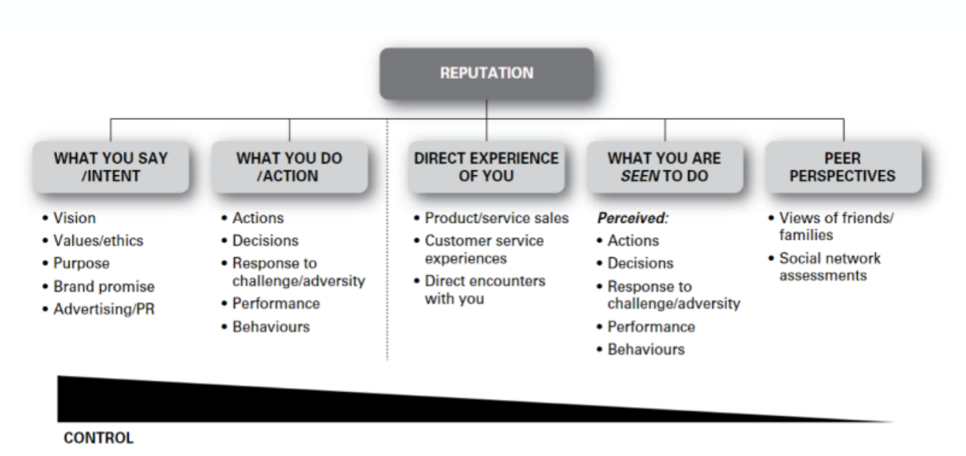
What you say/intent
Vision
Values/ethics
Purpose
Brand promise
Advertising/PR
What you do/Action
Actions
Decisions
Response to challenge/adversity
Performance
Behaviors
Direct Experience of You
Product/Service sales
Customer Service Experiences
Direct encounters with you
What you are seen to do
Perceived:
Actions
Decisions
Response to challenge/adversity
Performance
Behaviors
Peer Perspectives
Views of friends/families
Social Network assessments
So Why Do We Care?
Reputation is insulation from judgment in times of disturbance (crises, issues, & incidents).
“Your most valuable intangible asset” – Meltwater
A good reputation can prevent a crisis, as the media will give you a chance to correct/amend/address incorrect information, and the public will trust your explanation of events.
Reputation is invaluable – once lost, hard to regain
Measured and managed in the industry
(ex. ‘I really hate that organization’ while you would say to yourself you enjoy it)
Bud Light’s Recovery
Toppled from #1 spot following a social media promotion with transgender influencer Dylan Mulvaney was met with conservative outrage.
Lost $1.4 billion in beer sales last year.
Not recovering at the pace they were expecting, but they’re gradually recovering lost market share in the U.S. Bud Light sales
Parent company Anheuser-Busch InBev has seen uptick in sales for other beers like Michelob Ultra and Busch Light
Lost trust on both sides, active and latent publics
Reputation Management
Reputation is what much of our PR efforts seek to develop but...
The active practice of monitoring, fixing, and proactively campaigning for, a positive reputation
Sometimes is seen of as a subfield or separate practice of PR, but I don’t know if I buy that
Practices of Reputation Management
Monitoring
Listening and proactive efforts
Content removal, media engagement, reports to broader PR staff
Crisis management
Setting campaign goals to adjust
Microsoft/CrowdStrike
In case you somehow missed it, in July there was a catastrophic software update from CrowdStrike, a cybersecurity firm based in Austin, Texas, that wreaked havoc worldwide.
How was this a PR blow to Microsoft’s reputation?
How did Delta Airlines fumble the bag?
Amazon has an excellent reputation because their business relies on the promise, they make with Amazon Prime. They have fast delivery and reliable and cheap product in their storefront. They also provide services like Prime Video and Amazon Music just for being a prime member. With Adobe, they use their customers work in their terms and services, also implementing AI in their products. Which some artists are entirely against on the use of AI. Then also overcharging their customers in using their cloud service as a monthly plan instead to their old licensing plan. Which what Adobe could do is creating a more robust planning structure for people to only me limited to certain product besides their cloud service.
Oct 3, 2024
Ethics
A code of how one should behave based on values and an understanding of what is right or wrong
Must have a foundational, personal code of conduct that will guide our actions and interactions with colleagues and clients
Its important to have these boundaries in place, because once something happens that may not be good. PR gotta fix that themselves.
We are viewed as the "consciousness" of our brands and organizations, meaning we must have strong ethical practices ourselves
Challenges
PR departments and firms consider graduates to be unprepared
Lack of legal knowledge places both the PR practitioner and the organization or client at risk
High expectations for PR pros to be sensible, resourceful, accountable, and principled.
The field is under scrutiny by the general public, by nonprofit organizations, and by the government.
What legal matters do we need to know about?
Libel – printed falsehood, to show that harm was caused by a published story or broadcast.
Slanders – false oral statement, may come up at a press conference, at a public event, or even during an interview.
Deformation – any fault statement about a person or organization that creates public hatred, contempt, or ridicule or that inflicts injury on a reputation.
Deception – when someone makes a false or misleading statement in order to persuade audience.
Puffery – an exaggerated statement
The PRSA Code of Ethics
Advocacy – We serve the public interest by acting as responsible advocates for those we represent. We provide a voice in the marketplace of ideas, facts, and viewpoints to aid informed public debate.
I’d say advocacy is one of the most important elements in the Code of Ethics for PRSA because we’re proving a point in our loyalty with the public. This also ensures we’re highlighting the different values that are important to certain aspects and keeping things aligned with our audience and other people.
Honesty – We adhere to the highest standards of accuracy and truth in advancing the interests of those we represent and in communicating with the public.
Expertise – We acquire and responsibly use specialized knowledge and experience. We advance the profession through continued professional development, research, and education. We build mutual understanding, credibility, and relationships among a wide array of institutions and audiences.
Independence – We provide objective counsel to those we represent. We are accountable for our actions.
Loyalty – We are faithful to those we represent, while honoring our obligation to serve the public interest.
Fairness – We deal fairly with clients, employers, competitors, peers, vendors, the media, and the general public. We respect all opinions and support the right of free expression.
Best Practices
Be aware that, when you take on controversial clients, organizations, or brands, public perception and your reputation will be affected.
Know that ethical practices are different from country to country.
Set clear expectations and take specific actions when responding to an ethical challenge or crisis.
Act in the public interest by setting a strong ethical example.