Sources of Diversity: Hybridization
Overview of Hybridization
Hybridization involves interactions between different species, resulting in mixed offspring.
It is primarily the result of incomplete reproductive barriers and occurs in designated "hybrid zones."
Learning Objectives
Understand and describe hybrid zones and hybridization events as they pertain to speciation and evolution.
Discuss various examples of hybridization events corresponding to different species concepts:
Biological
Morphological
Phylogenetic
Ecological
Apply theoretical concepts from speciation, hybridization, and hybrid zones to real-world examples.
Key Concepts in Hybridization
Hybridization:
Occurs due to incomplete reproductive barriers, resulting in hybrid offspring across two species or subspecies.
Can be classified into two categories:
Intra-specific hybridization: Occurs between different subspecies within a single species (e.g., two subspecies of a bear).
Inter-specific hybridization: Occurs between different species (e.g., Grizzly bear and Polar bear).
Hybridization is less common in animals than in plants, where cross-pollination is more prevalent.
The limitations of the concept of species are highlighted by the existence of hybrid networks which demonstrate that species are not discrete entities but part of a continuum.
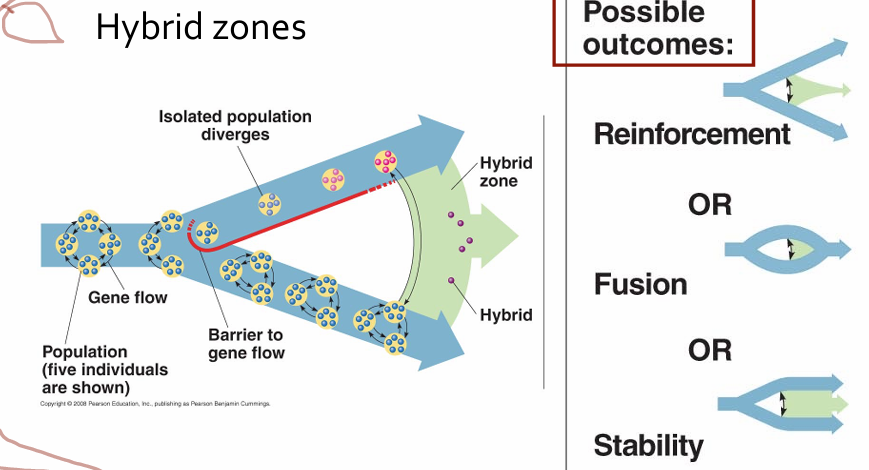
Speciation through Hybridization
In the context of speciation, hybridization can lead to different possible outcomes:
Reinforcement: Strengthening of reproductive barriers to prevent hybridization.
Fusion: Merging of two distinct species back into one as barriers weaken.
Stability: Continued existence of hybrid zones with ongoing gene flow.
Visual Representation of Speciation through Hybridization
Diagram showcasing the relationship between isolated populations, gene flow, hybrid zones, and barriers to gene flow in speciation processes.
Case Study: Nanulak / Grolar Bear
Grolar Bear (Nanulak or Pizzly Bear):
Hybridization between Grizzly bear (Ursus arctos) and Polar bear (Ursus maritimus) under changing environmental conditions in the Canadian Arctic.
Mixed offspring have been documented both in zoos and in the wild, with eight individuals observed in nature and verified through DNA testing over the last 20 years.
Geographic distribution: Observations based on data from the International Union for Conservation of Nature (IUCN), highlighting various bear species' distribution within North America:
Ursus maritimus (Polar bear)
Ursus arctos (Grizzly bear)
Ursus americanus (American black bear)
Ursus malayanus (Malayan sun bear)
Ursus ursinus (Sloth bear)
Tremarctos ornatus (Spectacled bear)
Ursus thibetanus (Asian black bear)
Summary of Grolar Bear Dynamics
Grizzly and Polar bears diverged only recently.
The reproductive barrier exists primarily due to habitat isolation, with Grizzlies favoring land-based habitats, while Polar bears are adapted to water and ice.
Climate change prompts Grizzly bears to expand their range northward, increasing contact and potential hybridization with Polar bears.
This dynamic raises concerns regarding the long-term viability of Polar bear populations as climate shifts continue.
Additional Examples of Hybridization and Speciation
Wood Bison:
Example of intra-specific hybridization between two subspecies of Bison:
Bison bison athabascae (Wood Bison)
Bison bison bison (Plains Bison)
Coywolf:
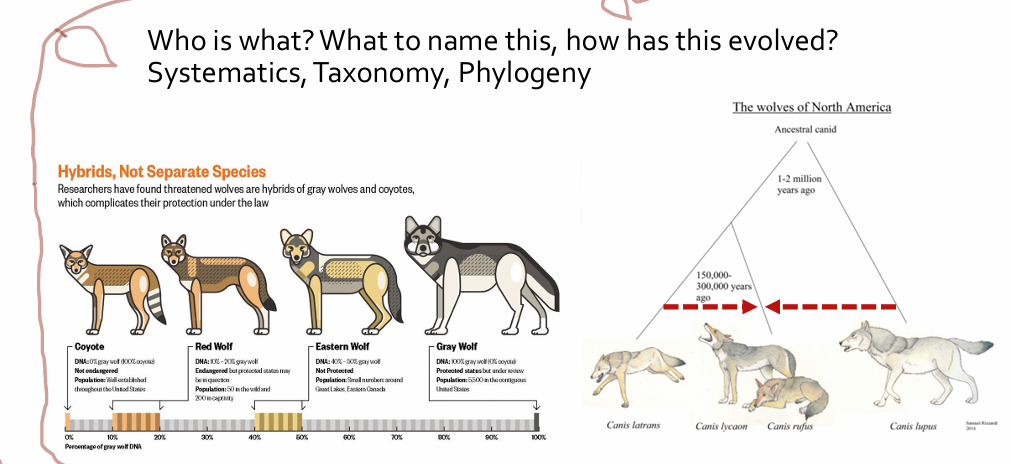
An example of inter-specific hybridization involving the Eastern Coyote (Canis latrans), Red Wolf (Canis rufus), and Western Coyote (Canis latrans).
The expansion of Western Coyotes into Eastern North America due to decimation of native wolves.
Assessment of Eastern Coyote / Coywolf Dynamics
In North America today, there are two primary roaming canine species:
Canis lupus (wolf)
Canis latrans (coyote)
The western Coyote's migration eastward into habitats previously occupied by wolves has led to hybridization events.
This instances of hybridization do not align with the biological species concept due to the presence of gene flow, contradicting the idea of reproductive isolation.
The term "Coywolf" remains a subject of debate among scientists and does not correspond to a recognized species.
Key Points on Speciation and Hybridization
Evolution is an ongoing and dynamic process; speciation may be observed in various stages.
Some species do not conform neatly to the biological species concept due to hybridization events.
Diverging populations do not always result in the creation of a new species.
Notable hybridization events include:
Grolar Bears in the Canadian Arctic.
Wood Bison in Alberta.
Coywolves along the East Coast of North America.