Exam 3
Chapter 18 (16) Oxidative Phosphorylation
Electron Transport Chain
Complex 1 NADH-Q oxidoreductase
NADH gives its electrons, they jump down to higher and higher affinity groups until it lands on Q
Complex 2 Succinate-Q reductase
FADH gives its electrons, jumps down to Q, but no H’s pass through
Complex 3 Q-cytochrome c oxidoreductase
electrons go from Q to cytochrome c
weird because Q has 2 e-, but cytochrome c can only take 1
Complex 4 cytochrome c oxidase
cytochrome c gives its electrons, oxygen to water, last step
ATP Synthase
rotates through open (ADP/ATP go in/out), loose (stuck but not reacting), and tight (reaction happening)
H+ gradient from electron transport chain makes H+’s go into the matrix, which is what makes it spin
Chapter 20 (4) Pentose Phosphate Pathway
Modes
mode 1: more ribose 5-phosphate than NADPH required
mode 2: needs of ribose 5-phosphate and NADPH balanced
mode 3: more NADPH than ribose 5-phosphate required
mode 4: ribose 5-phosphate and NADPH required, a bit more wishy washy
Overall Pathway
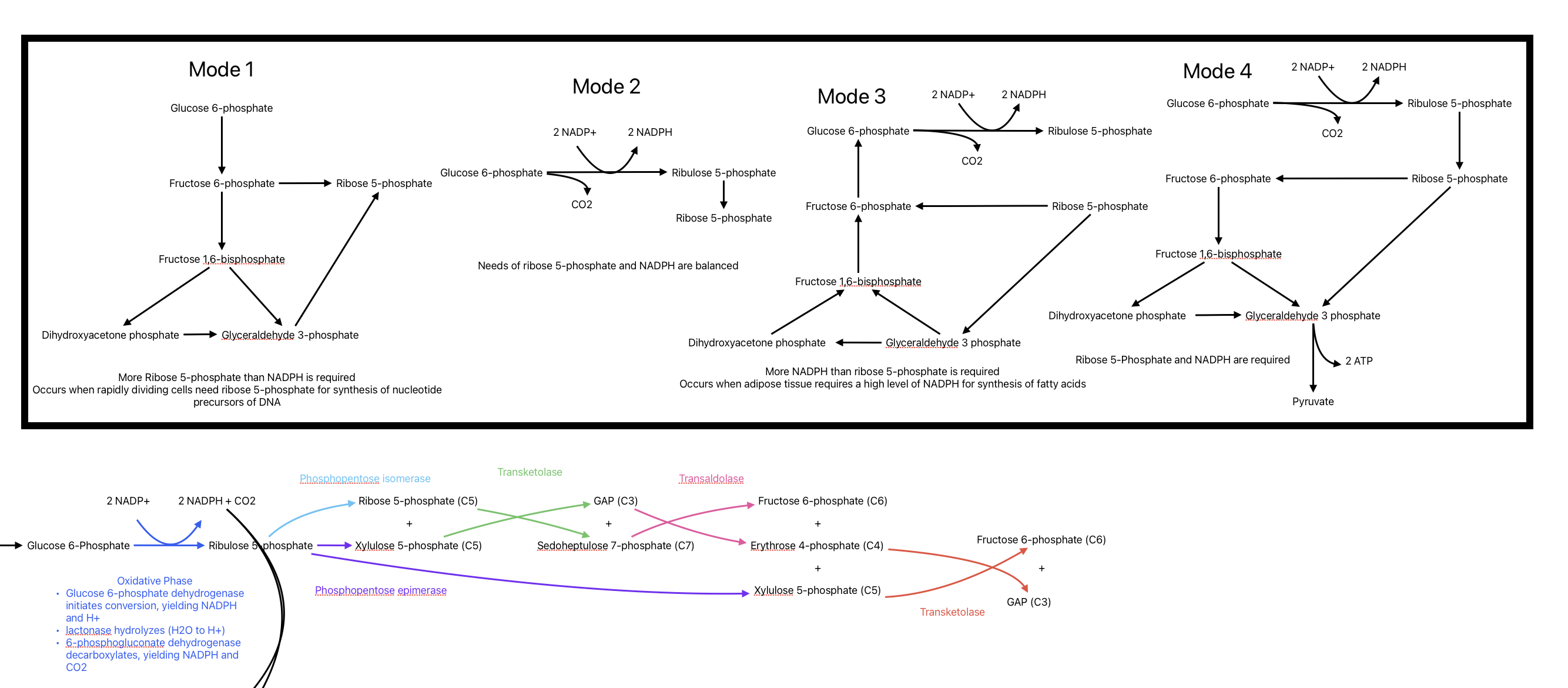
What converts what
phosphopentose isomerase: ribulose 5-phosphate → ribose 5-phosphate
phosphopentose epirmerase: ribulose 5-phosphate -> xylulose 5-phosphate
transketolase: ribose 5-phosphate + xylulose 5-phosphate → GAP + sedoheptulose 7-phosphate
transaldolase: GAP + sedoheptulose 7-phosphate → Fructose 6-phosphate + erythrose 4-phosphate
transketolase: erythrose 4-phosphate + xylulose 5-phosphate → Fructose 6-phosphate + GAP
Chapter 21 (15) Glycogen
Breakdown
Glycogen phosphorylase (PLP): takes glucose 1-phosphate off, phosphorylation turns on
phosphoglucomutase: moves phosphate to make glucose 6-phosphate from glucose 1-phosphate
transferase: moves shortened branches
alpha-1,6-glycosidase: removes the one 1,6 linked that started the branching
Synthesis
glycogen synthase: phosphorylation turns off
branching enzyme
Chapter 22 (14) Fatty Acid and Triacylglycerol Metabolism
Breakdown
TAG → DAG → MAG → FA (to mitochondria after adding CoA) and glycerol (to glycolysis/gluconeogenesis)
FA + CoA = acyl CoA
translocase to get acyl CoA in matrix, after turned into acyl carnitine
oxidation → hydration → oxidation → cleavage
forms L-3-hydroxyacyl CoA
makes acetyl CoA and succinyl CoA
Synthesis
in cytoplasm
acetyl acp and malonyl acp
reduction → dehydration → reduction → put it all together
Stuff
Products
Synthesis: c16-acyl ACP, NADP+, H2O,
Breakdown:acetyl CoA, succinyl CoA, NADH, FADH2, glycerol
Enzymes
Breakdown: lipases, dehydrogenase, hydratase, dehydrogenase, beta-ketothiolase, (isomerase)
Synthesis: carboxylase, synthase, reducatse, dehydratase, reductase
D vs L
breakdown is L, synthesis is D
Chapter 23 (16) Protein Turnover and Amino Acid Catabolism
Transaminases
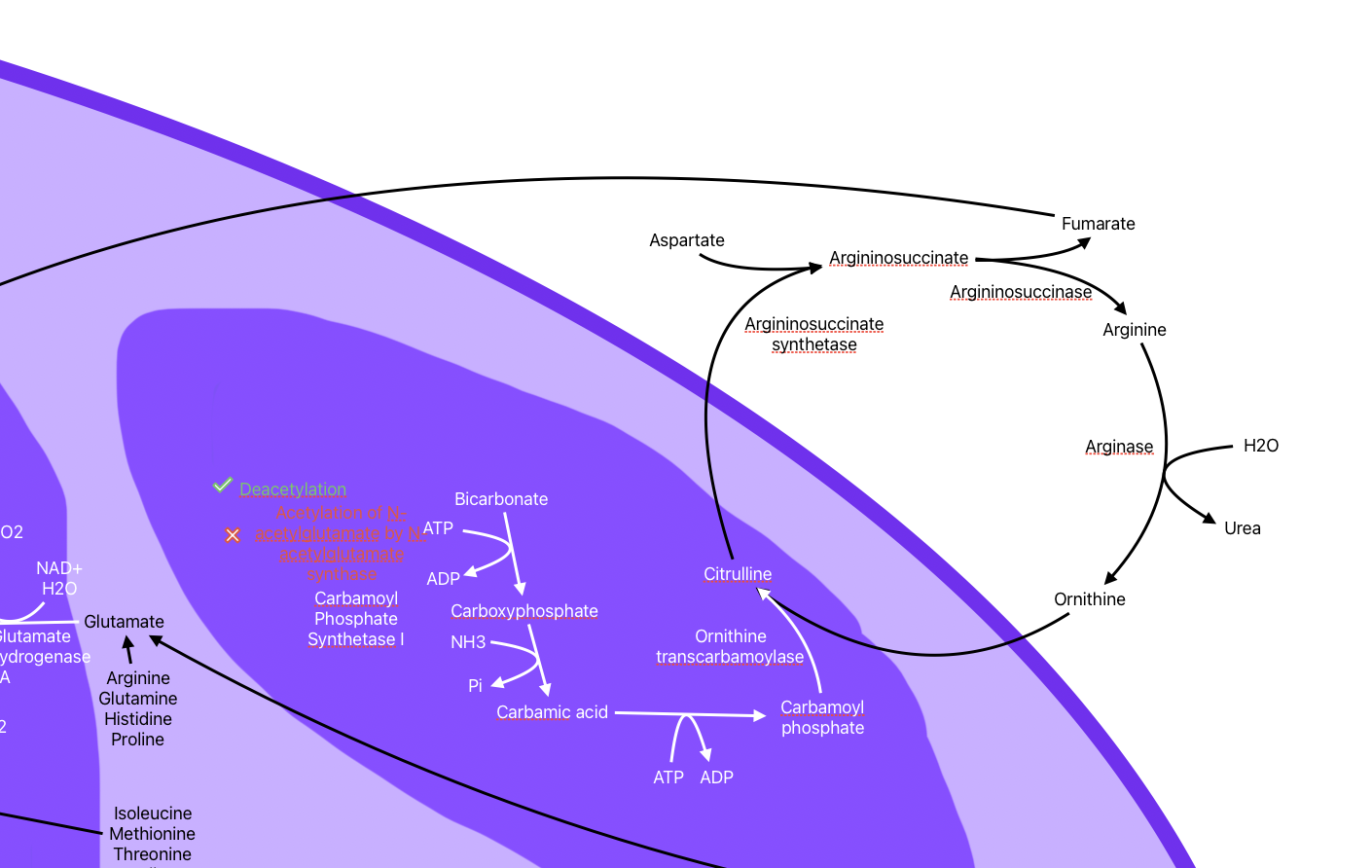
Urea Cycle