Gaifman, M. 2016 - Theologies of Statues in Classical Greek Art
Theologies of Statues in Classical Greek Art
Introduction
The term 'theology' is not commonly used in scholarly literature of Classical art, unlike terms like 'ideal,' 'beauty,' or 'democracy.'
The decision to use 'theology' reflects fundamental assumptions about Greek art.
Theology carries connotations that may seem incompatible with Greek art.
This chapter explores ancient ideas about the relationship between divinities and statues of gods, focusing on visual discourse in painted vases and relief sculpture from the fifth and fourth centuries BCE.
The variety of Classical imagery featuring statues of gods articulates complex perceptions of the relationship between material objects and divine beings, constituting multiple theologies of statues.
Theology and Greek Art?
The use of 'theology' in the context of ancient Greek art is questionable because it is often associated with Christianity.
Theology is defined as the study of God, His nature, attributes, and relations with humans and the universe.
However, since the seventeenth century, 'theology' has been applied to the study of any religion, including pagan systems.
The use of 'theology' in relation to Greek art is problematic because it risks ascribing Christian ideas to a pagan visual tradition.
Ancient Greek religion lacked firm and coherent doctrine, unlike other religious systems.
If 'theology' signifies a coherent system based on scripture or sanctified laws, it is inapplicable to Greek religion.
In modern English, 'theology' does not pertain solely to Christianity or a firm religious doctrine.
The ancient Greek word, theologia, predates Christianity and supports the use of 'theology' in discussions of various religions, especially pagan antiquity.
'Theology' highlights issues related directly to the gods and the relationship between images and the divine, unlike 'religion' or 'religious thought/ideology,' which encompass the sacred more broadly.
Richard Gordon's 'The Real and the Imaginary: Production and Religion in the Graeco-Roman World' and Verity Platt's 'Greek Votive Reliefs: An Exercise in Visual Theologies' exemplify different approaches.
Gordon discusses images of gods in terms of material production and religious imagination.
Platt argues that carved images make statements about the nature of divinities and the relationship between mortals and immortals.
'Theology' focuses attention on subjective and nuanced issues entailed in worshippers’ perceptions of gods and religious experiences.
'Theology' forces us to consider the core of ancient engagement with the divine, without obstructing consideration of image-making or ritual practices.
Theological considerations are particularly pertinent to the study of Greek sculpture, as three-dimensional statues were widely incorporated in ancient Greek worship.
Examples include the three figures from the temple at Dreros on Crete and Mantiklos’ dedication to Apollo from Thebes, both bronze statuettes from ca. 700 BCE.
Scholarly discussions of these objects revolve around challenges such as their uncertain identification.
The Dreros triad is often assumed to represent Apollo, Artemis, and Leto, but this classification cannot be confirmed beyond doubt.
It is uncertain whether Mantiklos dedicated an image of the god or a man to Appolo. The hexameters inscribed on the figure’s bronze thighs read
The lines in verse tell us that the male figure was given as a tithe to the Far-Shooter in hope of divine favour.
The archaeological record and state of preservation complicate interpretation. The assumption that the Dreros statuettes served as cult statues is questioned due to missing documentation of their original placement.
The idea that Mantiklos’ dedication is a free-standing statue may be reconsidered given that the figure is not fully preserved and is missing its legs.
The limited evidence challenges empirically grounded interpretation and classification of the statues.
In both cases, the bronzes appear to have been of primary importance in worship.
Despite uncertainties, the statuettes of Dreros appear to have belonged to the part of the sanctuary in which ceremonies and sacrifices were conducted.
Their relative monumentality, material, and mode of production suggest significant meaning.
The dedicatory text on Mantiklos’ bronze situates the object as key for Mantiklos’ hoped-for exchange with Apollo.
Exploring the statues’ theological significance is appropriate.
Examining possible theological aspects shifts the emphasis from a purely taxonomic approach to considering ancient perceptions of these images, particularly their relationship to the gods.
Questions arise, such as whether the bronze statues were perceived as the god(s) themselves and perceived as imbued with something of the divine, and whether certain elements in their appearance and materiality rendered them powerful.
Theological inquiry highlights the potential pertinence of these bronze images in their original context.
Complex artistry becomes not merely the result of ability to hammer and manipulate bronze but also an articulation of profound religious ideas, while choice of size can become a marker of potential divine presence.
Mantiklos’ dedication reveals that the figure with its unique visual force gives material affirmation to Mantiklos’ devotion and future hopes.
Including 'theology' in scholarly discourse of Greek art may sharpen our grasp of the complex relationship between visual culture and religion in Greek antiquity.
A Visual Discourse on Statues of Gods
'Theology' is mostly absent from literature on Greek statues of gods, but scholars have examined theological problems pertaining to images of divinities, particularly the relationship between statues of gods and the divine.
Studies highlight the coexistence of varying views, ranging from complete identification between material object and divinity to clear distinction.
Greek engagement with the relationship between gods and their representations is witnessed in both ancient texts and imagery.
A fragmented calyx krater from Tarentum (ca. 380 BCE) at the Allard-Pierson Museum in Amsterdam features two portrayals of Apollo: a statue in a temple and the living god playing the lyre.
By comparing the two images, the painted pot explores theological questions regarding representation of the divine.
The Amsterdam krater belongs to a large group of Attic and South Italian painted pots featuring images of statues clearly identifiable as material objects.
These representations emerge with the rise of naturalism.
Depictions of statues and animated divinities side by side are first witnessed in the middle of the fifth century BCE.
By presenting three-dimensional representations next to living deities, this corpus of painted pots explores the relationship between image and prototype.
The focus on representation of gods, goddesses, and heroes renders this group of vases theological in essence.
These painted pots articulate a variety of theological positions on the representation of the divine that together constitute a discourse about human life and its relation to what is supra-material.
An early example is a fragmented volute krater attributed to Polygnotos (ca. 440 BCE) depicting Cassandra being attacked by Ajax at Athena’s statue.
Two figures of the goddess are observable: a frontal statue and a larger head of the animated Athena.
The name ΑΘΕΝΑ identifies both the goddess and her statue.
On this vase, the violent attack takes place in the presence of the goddess’ material image and the living divinity.
The visual force of the Getty krater’s depiction is clearer when compared with earlier renditions, such as one on a plate from the late sixth century BCE.
On the plate, inscriptions identify the protagonists as Ajax, Cassandra, and Athena, but it is unclear how Athena is to be understood.
The plate raises theological questions about the goddess's presence during the attack and whether the armed figure is a statue or the goddess in person.
In contrast, the Getty krater does not leave room for doubt: Athena is distinct from her representation and witnesses the assault at her sacred image.
The vase makes a statement: supplication at the statue of the goddess and divine presence at the holy site do not necessarily lead to the divinity’s protection.
The Getty krater demonstrates that the relative simplicity and low cost of painted pottery need not undermine its complexity.
The imagery reveals that interest in the nature of representation pervaded different strata of Greek society and was not only a concern of theoreticians.
Visual engagement with statues of gods was conducted not only through vases viewed in private settings but also in relief sculpture displayed in public religious arenas.
Carved portrayals of divine images in sanctuaries had immediate relevance to their environment, where statues were the primary focus of worship.
Like ancient theological texts, depictions of statues of gods invite analysis that considers the medium (e.g., shape of pot, format of relief) and contexts (e.g., small gathering, public shrine).
Imagery of statues of gods and animated divinities demands familiarity with visual tradition, visual cues, deployment of attributes, styles, and inscriptions.
These visual means articulate complex theological ideas on the statues of gods.
On the Getty krater, the frontal figure gazing at the viewer and holding a spear is presented as Archaic, with a decorated peplos, curls, and a slight smile.
In the vase’s mid-fifth-century BCE naturalism, the statue is older.
In a scene referencing the Trojan cycle, the archaising style signifies a specific object, Athena’s ancient statue – the Palladion.
Stylistic analysis is useful for unpacking meanings, as distinctions in style were significant within ancient Greek visual culture, specifically from the Classical period onwards.
On the Getty vase, styles distinguish between the goddess and her material representation while underscoring the affinity between human and divine; the profiles of Athena and her suppliant are parallel and closely resemble each other.
Returning to the Amsterdam krater, visual cues include the architectural frame, the relatively small size and the bright skin tone indicating a material object inside a temple.
The seated male figure is recognizable as an animated being due to his skin tone, bent head, and finger position on the instrument.
The letters ΑΠΟΛΛ render his identity unmistakable.
Labels are deployed as visual strategies to identify figures, but they may have further consequences.
In contrast to the example of Athena on the Getty krater, where the name is between the goddess and her statue and is therefore associated with both, on the vase in Amsterdam the label is linked with the living divinity.
The Amsterdam krater contrasts different modes of identification and highlights the role of attributes in the Greek visual tradition.
Both the animated god and the statue inside the temple are recognizable as Apollo due to their attributes.
The language of attributes articulates a complex relationship between the god and his representation.
Physical resemblance proclaims strong affinities, namely that the statue captures salient features.
The difference in attributes suggests that traits presented by the statue are not necessarily reflective of the nature of the god.
While the statue projects power through its weapon, Apollo playing his lyre invites us to imagine divine music.
The god engenders inspiration, whereas his material representation demands awe.
A Visual Meditation on Apollo’s Statue
The Amsterdam krater articulates theological ideas regarding a statue’s materiality, appearance, position in time and space, and relationship to viewers, worshippers, and ritual.
On the krater, the statue and the god differ in size and materiality.
The statue seems grand, yet fits within the architectural frame. The animated god can hardly be contained within the pictorial space.
The manner in which the god is framed on the vase recalls Pheidias’ monumental chryselephantine Zeus, whose head nearly touched the temple’s roof.
The statue of Appolo doesn't even come close in stature to the god, who is larger than life.
Apollo’s skin is rendered in red-figured technique to appear soft and smooth. The statue’s line work, shading, highlights, and gold wash emphasize musculature and create the effect of shiny metal.
This three-dimensional metalwork recalls the Piraeus Apollo and the Kassel Apollo. These resemblances demonstrate that it is sometimes difficult to assess a figure’s model or style. The fourth-century BCE South Italian vase references earlier statuary from mainland Greece and implies that the appearance of the statue is not dictated solely by the wish to replicate Apollo’s appearance, it is also guided by the qualities of its material, the process of its making and artistic traditions.
The artifice attracts the beholder’s eye and presents it as an object made to be seen, to shine at worshippers and to exchange direct glances with them on the occasions when the temple is not closed.
The opening of the doors revealing the statue inside may generate an experience of the apparition of the god, an epiphany.
Apollo, in contrast, appears to be consumed in his own world, for he turns his gaze to the side and thereby prevents eye contact with any beholder. Next to him sits what appears to be Artemis.
While the statue faces out towards mortals, the god enjoys the company of other immortals. Apollo remains invisible even if he is nearby.
Apollo is caught in mid-action playing his music, whereas his statue remains inactive.
The material object is fixed within the building, the doors of which may be closed.
Outside the temple, Apollo may come and go as he wishes, yet inside the temple his metal image asserts the constancy of his presence in his abode .
The depiction is a reference to Delphi. A reference to Delphi on a Tarentine vase made in the early fourth century BCE may have carried more specific significance for the vase’s original patrons and audiences, because the city erected victory monuments at the shrine in the fifth century BCE, and reinscribed them in the second half of the fourth century BCE.
Consider how the image presents the tripod, for example. It is a seat neither of Apollo nor of the Pythia, as it is portrayed in some Classical images. Rather the three-legged metal object is a triumphant Delphic monument in its own right. Painted above the now-lost handle and in between Apollo’s temple and the Dionysiac satyr, the tripod demarcates the space and simultaneously connects two divine spheres. The Amsterdam krater also reflects upon the complex relationship between Apollo and Dionysus at Delphi.
Although not identical, the two gods resemble each other in appearance, dress and attitude; they share size, long curls and exposed torso. Both have a mantle and a distinctive crown and both tilt their head to the side.
The Apolline and the Dionysiac belong to the same space, yet they cannot be seen together because of their positions on the pot’s surface. Both realms are filled with music, although the sounds are not the same.
The vase joins ancient accounts about the two divinities in Delphi, as well as fifth- and fourth-century BCE engagements with the paean and the dithyramb.
Dionysus’ depiction as Apollo’s counterpart brings to mind the fourth-century BCE rise in Dionysiac worship in Delphi and reveals engagement with the sanctuary’s monuments and cults.
The vase presents the statue alone among the offerings and artefacts
The statue is a primary point of attention for pilgrims visiting the shrine. The shiny image communicates with the world outside and invites worshippers into the god’s realm.
Whether or not the Amsterdam krater references Delphi, the statue engages with beholders, not only with its gaze but also with its extended libation bowl.
For the statue is not active, it holds out the phiale in a manner that would suggest possible interaction with the figure; specifically of letting liquid into the phiale so that it would trickle down to the ground.
In painting, the statue's potential ritual is juxtaposed with the satyr’s actual ritual shown on the other side of the pot. In krater (wine and water vessel), the reference to wine libations is relevant; the pot’s form construes its potential viewers as participants in the symposium.
The gods and their companions, who are immersed in their own world and only offer models and sources of inspiration, the statue alludes to its viewers’ active engagement with the divine.
The statue is part of the god’s entourage, it is inanimate. The small detail presents it as similar to an attribute. Apollo touches the bottom of the temple with his right hand.
The statue is one of the god’s possessions, which offer his viewers and worshippers different ways of experiencing his presence.
On the Amsterdam krater, the god’s image has a complex relation to the divinity, which allows it to be an experiential vehicle for its viewers to come closer to Apollo.
Magnifying an Ancient Statue on the Athenian Acropolis
Visitors to the Athenian Acropolis in the late fifth century BCE could see depictions of statues among the Parthenon’s sculptural reliefs.
At least two of the building’s ninety-two metopes included an image of an ancient statue: South 21 and North 25. Both metopes, however, have a grim history.
North 25 invites examination because it juxtaposed a statue of a divinity and a goddess in a mythological context.
Viewers could have seen the metope’s portrayal of an ancient image of a divinity, as they walked close to Athena’s most venerated object and the primary focus of worship on the Acropolis, the so-called Athena Polias.
Cult practice, myth, and representation were inextricably linked.
On the right side stands a small figure in profile on a base. The statue is female. To its left stands a woman in a peplos, who stretches her arm towards the statue. Further to the left is Aphrodite and Eros.
The central woman seeks protection at a divinity’s image.
North 25 shows a statue of a goddess next to the animated Aphrodite and Eros.
North 25 shows a woman holding on to a statue of a goddess in the presence of another female divinity.
On the metope, the contrast in stylistic features can be observed in the rendition of the figures’ clothes. On North 25, the portrayed statue is visibly Archaic, whereas the other figures conform to the Parthenon’s High Classical style.
The scene of the metope recalls Cassandra at the statue of Athena, but the presence of Aphrodite and Eros suggests a different scene which brings to mind Helen, the unfaithful wife.
It is also the version attributed to the lyric poet Ibykos.
The metope is a parallel to North 25, with the face depicting Helen, identified by an inscription, touches the statue of Athena. The area of the vase beneath the spout depicts the armed Menelaos, who is also labelled, encountering Eros and Aphrodite when he rushes in Helen’s direction.
North 24 and 25 are connected to each other, and that together they show Menelaos pursuing Helen, who seeks divine protection at a statue, while Aphrodite and Eros intervene.
The identity of the deity represented by the archaising statue is unclear.
According to Ernst Berger’s study, the statue shown on North 25 must represent Aphrodite.
If one accepts this position, North 25 should be imagined with two figures of Aphrodite side by side. Since the animated goddess was in naturalistic style, her femininity was more accentuated. Aphrodite outshone her own image and raises this question: can any image of the goddess of corporeal beauty truly capture her appearance?
Whether the escaping adulteress sees her divine patroness by her side is unclear, and yet the most beautiful woman seeks the ancient object. As Helen comes into physical contact with the statue, Aphrodite stands by her side and Eros facing left is ready to ward off the cuckold husband’s attack.
The idea that touching Aphrodite’s statue has yielded divine protection would have had specifi c resonance in the metope’s location facing north. The metope and its cultic environment may be even stronger. Helen finding protection at the ancient statue of Aphrodite would have offered a mythological frame for worshippers to imagine a successful supplication, and would have affirmed the veneration of the goddess of love, Eros and possibly Persuasion.
The statue shown on North 25 was an ancient image of Athena, a Palladion. The arguments in favor of Athena are based on the evidence from vases, particularly the jug in the Vatican
For if this is the correct reconstruction, then the Parthenon would have presented an unexpected turn of events from a Homeric perspective, it have made a noteworthy comment: even Helen can find refuge at the Palladion and while clinging to the warrior goddess be shielded by her divine guardians, Aphrodite and Eros.
Athens’ holiest image, as Pausanias described it, was effectively invisible to the public but visitors marching on the Acropolis would have been able to envision an ancient image of Athens’ patron goddess as a powerful protective object.
Was Athena thought to be present but hidden from sight?
Conclusion
Like ancient texts, ancient images do not present a uniform theological position on representations of divinities; and demand close consideration of each individual instance.
Image makers remain in the realm of the visual and highlight aspects of material objects that are often hard to grasp from written sources, namely the artefacts’ appearance, and the range of human and divine physical interactions with them.
Divinity and artefact can be distinct and at the same time linked together through a wide range of visual features.
Within this corpus, however, the myth of Cassandra fleeing Ajax raises the theological problem of a goddess’ relation to her own image; and speaks to a vibrant interest in this difficult question for centuries.
There is much to be gained from examining this imagery and Greek art more broadly with an eye for their theological dimensions.
DIRECT QUOTES
Theology and Greek Art?
Is the deployment of the term ‘theology’ viable in the context of a discussion of ancient Greek art?
The objection to such usage of the word is obvious: while Greek art was deeply embedded in a polytheistic religious system, ‘theology’ is often taken to pertain to Christianity.
Indeed, one formal definition of the term indicates that theology is: ‘the study or science which treats of God, His nature and attributes, and His relations with man and the universe; “the science of things divine” (Hooker); divinity.’
However, already from the seventeenth century, ‘theology’ has been applied to the study of any religion, including pagan systems of belief.
Still, like other terms with strong Christian associations, ‘theology’ appears problematic in relation to Greek art, for its use holds the danger of ascribing Christian ideas to a pagan visual tradition.
The objection to the term extends further. Unlike other religious systems, that of the ancient Greeks was distinguished by its lack of fi rm and coherent doctrine. If ‘theology’ signifies a coherent system based on scripture and/or a set of sanctified laws then it is inapplicable for Greek religion
Against these possible objections, it is worthwhile to keep in mind that in modern English ‘theology’ does not pertain solely to Christianity and/or a firm religious doctrine.
The ancient Greek word, theologia , the origins of ‘theology’ and its usage in Greek antiquity, centuries prior to the rise of Christianity, only speak to the modern word’s applicability in discussions of a wide range of religions, particularly of pagan antiquity.
Even without entering the long history of the term, there is a case to be made for its deployment in relation to Greek art, despite this move’s possible problems.
Unlike ‘religion’, or ‘religious thought/ideology’, which encompasses the sacred more broadly, when ‘theology’ is introduced to the discussion of Greek art, it highlights a particular aspect of Greek visual tradition; it focuses the attention on issues related directly to the gods, and the relationship between images and the divine.
The issues highlighted by the deployment of the adjective ‘theological’ are particularly pertinent to the study of Greek sculpture; three-dimensional statues were widely incorporated in ancient Greek worship, already from the rise of the Greek polis.
Take, for instance, the three fi gures from the temple at Dreros on Crete ( Fig. 11.1 ), and Mantiklos’ dedication to Apollo that is said to be from Thebes ( Fig. 11.2 ).
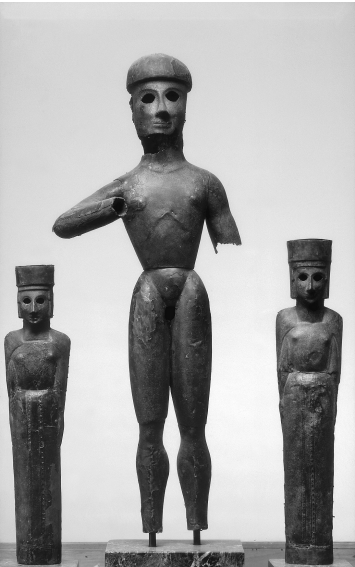
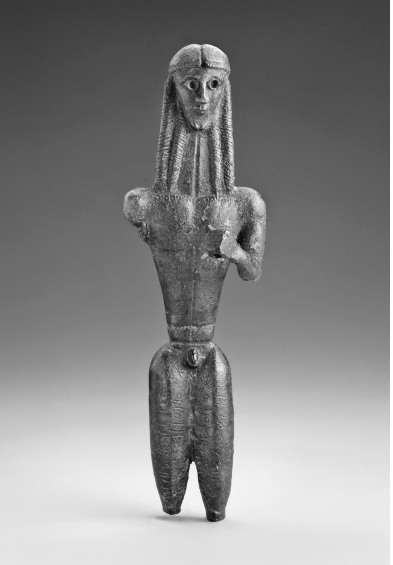
These bronze statuettes from ca. 700 BCE are familiar examples of early Greek sculpture.
The two instances have elicited ample discussion of their numerous aspects, including their date, iconography, identification, style, sources of influences and mode of production.
Both cases offer fundamental insights regarding Greek visual culture of their time.
The Dreros triad constitutes an important early instance of hammered bronze in three-dimensional imagery and evidence for technological investment in art.
Mantiklos’ inscription furnishes a primary example of early writing and dedicatory practices
Much of the scholarly discussion of these objects revolved around the challenges they present, such as their uncertain identifications.
For while it is often assumed that the three statuettes from Dreros represent Apollo, Artemis and Leto because of their original grouping together, this prevalent classification cannot be confirmed beyond doubt, particularly whether the female bronzes are goddesses or women, because their height is half that of the male figure.
Similarly, we will never be sure if Mantiklos dedicated to Apollo an image of the god or a man. All we have are the two hexameters inscribed on the fi gure’s bronze thighs:
Μάντικλός μ ’ ἀνέθεκε ϝ εκαβ.όλοι ἀργυροτόξσοι / τᾶς { δ } δεκάτας · τὺ δὲ Φ οίβε δίδοι χαρί ϝ ετταν ἀμοιβ [ άν ] (‘Mantiklos set me up for the far-shooting, silver-bowed (god), out of the tithe. As for you, Phoibos, grant a charis -fi lled return’).
The lines in verse tell us that the male figure was given as a tithe to the Far-Shooter in hope of divine favour.
In both cases, the archaeological record and state of preservation complicate the picture further; the often-held assumption that the Dreros statuettes served as so-called cult statues has been called into question because of the missing documentation of their precise original placement in the temple.
Along similar lines, the idea that Mantiklos’ dedication is a free-standing statue may be reconsidered given that the figure is not fully preserved and is missing its legs
The limited evidence challenges any empirically grounded interpretation and attempt at identifying and classifying the statues.
In both cases, however, the bronzes appear to have been of primary importance in worship. Even if we cannot be certain that the statuettes of Dreros were genuinely ‘cult statues’, by which I mean images that were a focus of ritual, they appear to have belonged to the part of the sanctuary in which the ceremonies and sacrifices were conducted.
Their relative monumentality compared to all other finds from the shrine, in addition to their material and mode of production, suggest that they are likely to have had some significant meaning.
The dedicatory text inscribed on the male bronze said to be from Thebes situates the object on which it is written – whether free-standing or part of a larger object – as the key for Mantiklos’ hoped-for exchange with Apollo.
In light of these observations, would it be completely inappropriate to explore the statues’ theological signifi cance? Although one may reject such a line of inquiry and assert that we cannot give a full account of the bronzes’ original theological meaning for lack of evidence, let us consider the consequences of introducing ‘theological’ to the discussion.
Once asked to examine possible theological aspects, the emphasis moves away from a purely taxonomic approach to consideration of the ancient perception of these images, particularly their relationship to the gods.
Instead of worrying about classifications and identifications, we are prompted to pose a different set of questions, such as:
Could the bronze statues have been perceived as the god(s) themselves and, if so, under what circumstances?
Were they seen as imbued with something of the divine?
Were there particular elements in their appearance and materiality that rendered them powerful in the eyes of ancient worshippers?
Were certain behaviours and rituals around these statues thought to bring worshippers in close proximity to the gods?
While answers to such inquiries and the entire discussion are bound to be hypothetical, the adjective ‘theological’ highlights the possible pertinence of these bronze images in their original context
Once we allow the Dreros statuettes to have some theological import, albeit unknown, complex artistry is not merely the result of the ability to hammer and manipulate bronze but also an articulation of profound religious ideas, while choice of size can become a marker of potential divine presence.
The exercise of including ‘theology’ in the scholarly discourse of Greek art may often fail to yield irrefutable affi rmations, but it may help sharpen our grasp of the complex relationship between visual culture and religion in Greek antiquity
A visual Discourse on Statues of Gods
‘Theology’ and its derivatives are mostly absent from the literature on Greek statues of gods. Still, scholars have examined certain theological problems pertaining to images of divinities.
In particular, the question of how the ancient Greeks perceived the relationship between statues of gods and the divine has received some attention. Studies that focus primarily on ancient writings highlight the coexistence of varying views, which range from complete identification between material object and divinity to clear distinction between the two
Greek engagement with the complex relationship between gods and their representations is witnessed not only in ancient texts but also in ancient imagery.
A well-known example is the fragmented calyx krater from Tarentum (modern Taranto), in Southern Italy, that is dated to ca. 380 BCE and is today at the Allard-Pierson Museum in Amsterdam ( Figs 11.3a–d ).
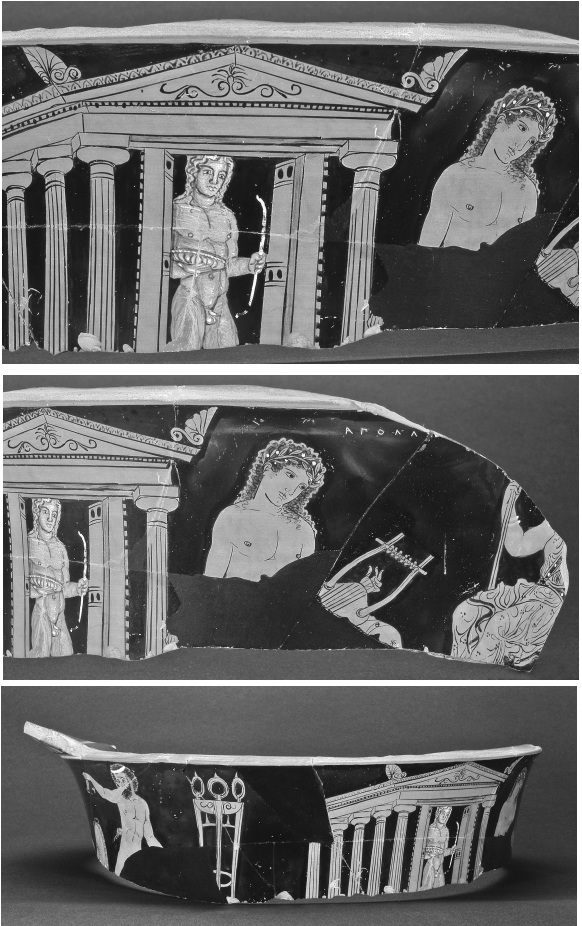
The vase features two portrayals of Apollo: a statue placed within a pedimental temple and, next to it, the living god sitting outside and playing the lyre.
As Platt noted, by inviting the viewer to compare and contrast the two images of the same god, the painted pot explores theological questions regarding the representation of the divine.
The Amsterdam krater belongs to a large group of Attic and South Italian painted pots featuring images of statues that are clearly identifi able as material objects.
These representations of representations emerge in Greek visual culture at the time of the rise of naturalism in the turn from the sixth to the fifth century BCE .
Depictions of statues and animated divinities side by side are first witnessed in the middle of the fifth century BCE .
By presenting three-dimensional representations next to living deities this corpus of painted pots explores the relationship between image and its prototype.
The focus on representation of gods, goddesses and heroes, rather than mortals and inanimate objects, renders this group of vases theological in essence.
These painted pots articulate a variety of theological positions on the representation of the divine that together constitute a discourse about human life and its relation to what is supra-material.
An early example of this visual phenomenon is seen on a fragmented volute krater attributed to Polygnotos and dated to ca. 440 BCE ( Fig. 11.4 ).
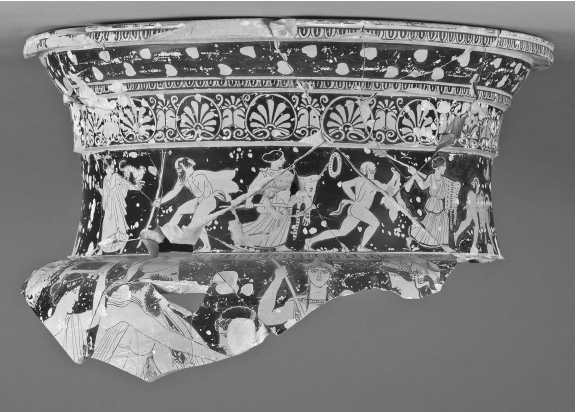
The vase depicts the episode in the Trojan cycle in which Cassandra is being attacked by Ajax son of Oileus at Athena’s statue, an assault and sacrilege that led to the warrior’s ultimate demise.
Two figures of the goddess are observable; in the centre stands a frontal and relatively small statue of the divinity holding a spear, and next to it, in profile, is a much larger head of the animated Athena, who wears an elaborately decorated Attic helmet.
The name ΑΘΕΝΑ is written in between the goddess and her statue and identifies both. Labels also accompany the other two protagonists.
Cassandra is the young woman to the left of the statue and Ajax is the man who stretches his right arm towards her. On this vase, the violent attack takes place in the presence of the goddess’ material image and the living divinity.
The visual force of the Getty krater’s depiction of the scene becomes clearer when compared with earlier renditions of the same subject, such as the one shown on a plate from the late sixth century BCE ( Fig. 11.5 ).
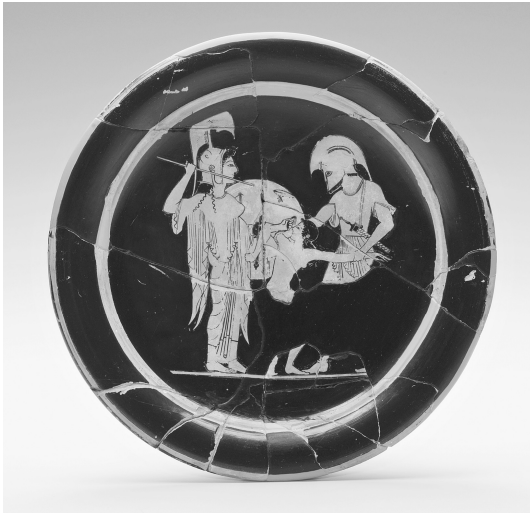
On the plate, a helmeted man grabs the arms of a small nude woman who latches on to a large armed female figure.
The accompanying inscriptions identify the protagonists as Ajax, Cassandra and Athena, yet it is unclear how the depiction of Athena is to be understood.
The plate raises a profound theological question: Was the goddess present during the attack? Is the armed female figure to be understood as a statue, distinct from the goddess? Might this be the goddess in person? Or perhaps the statue and the goddess are both represented in a single figure?
At first glance, the female figure appears as an animated divinity about to throw her weapon at the attacker, yet her stiff pose, and feet that are close together, suggest that she may be construed as a statue.
The plate presents Athena’s relationship to the enfolding drama as ambiguous.
In contrast, the Getty krater does not leave room for doubt: Athena is distinct from her representation, and she witnesses the assault at her sacred image.
The vase makes a harsh statement: supplication at the statue of the goddess and divine presence at the holy site do not necessarily lead to the divinity’s protection.
The example of the Getty krater demonstrates that the relative simplicity and low cost of painted pottery need not undermine its complexity.
The imagery such as the one shown on this vase reveals that interest in the nature of representation pervaded different strata of Greek society and was not only a concern of theoreticians, but was also explored among pot painters who were engaged in the act of image making, and through their humble art propagated particular ideas regarding images in different parts of society.
The visual engagement with statues of gods was conducted not only through vases that were mostly viewed in private settings and small groups, but also in relief sculpture displayed in public religious arenas.
Carved portrayals of divine images seen in sanctuaries had immediate relevance to their immediate environments; in these places statues constituted the primary focus of worship
Like ancient theological texts, depictions of statues of gods invite careful analysis that takes into account the particularities of the medium (e.g. shape of pot, format and position of relief) and the overall contexts in which they were most probably viewed (e.g. small gathering, public shrine).
Furthermore, imagery of statues of gods and animated divinities side by side demands familiarity with the visual tradition in which it was conceived, such as its visual cues, deployment of attributes, distinctive styles and usage of inscriptions. For these visual means articulate complex theological ideas on the statues of gods.
Let me consider some of these visual tools, starting with the Greek language of artistic styles.
On the Getty krater, for example, the frontal figure gazing at the viewer and holding a spear is presented as Archaic, for she has a richly decorated peplos , carefully arranged curls and a slight hint of a smile. In the context of the vase’s mid-fifth century BCE naturalism, the statue is visibly older.
In a scene that references the Trojan cycle, the archaising style has further consequences; the hieratic image is to be understood as a specific object, namely Athena’s ancient statue – the Palladion.
Stylistic analysis is useful not only for taxonomic purposes but also for unpacking a range of meanings, for distinctions in style were significant within ancient Greek visual culture, specifically from the Classical period onwards
On the Getty vase, styles distinguish between the goddess and her material representation
The Amsterdam krater contrasts different modes of identification of figures, and highlights the role of attributes in the Greek visual tradition.
For even without the label, both the animated god and the statue inside the temple are recognisable as Apollo. Both are clean-shaven, youthful and have long flowing locks as befit the god.
And both have his attributes: the animated figure wears a laurel wreath and plays a lyre, while the statue inside the temple holds the god’s weapon, the bow.
In order to gain a firm grasp of the painted vase one must be conversant in Greek visual culture.
For only a viewer who knows Apollo’s distinctive iconography can tell without difficulty that both figures represent the same divinity.
The language of attributes does more than enable identification; it articulates a complex relationship between the god and his representation
Physical resemblance proclaims strong affinities between the two, namely that the statue captures some of the god’s salient features, such as his youthfulness and attractive body.
At the same time, the difference in attributes suggests that traits presented by the statue are not necessarily reflective of the nature of the god.
While the gleaming statue projects power through its weapon, Apollo playing his lyre invites us to imagine divine music. The god engenders inspiration, whereas his material representation demands awe.
A Visual Meditation on Apollo’s Statue
Having considered some of the features of the Greek visual discourse on statues of gods, let me examine in greater length the Amsterdam krater, a case in point for how a painted pot can articulate a broad range of theological ideas regarding a statue’s materiality, appearance, position in time and space, and relationship to viewers, worshippers and the performance of ritual.
On the krater, the statue and the god differ in their size and materiality. The statue seems grand, with its head nearly reaching the roof of the temple, yet it fits in its entirety within the architectural frame.
The animated god, by contrast, can hardly be contained within the pictorial space; if Apollo were to stand up straight, he would break the vase’s upper edge.
The manner in which the god is framed on the vase recalls Pheidias’ monumental chryselephantine Zeus. At Olympia, the head of the Father of the Gods nearly touched the temple’s roof so that he appeared uncontainable within his own abode.
On the Amsterdam krater, the stature of the shining statue does not even come close to that of the god, who is larger than life.
Apollo’s skin is rendered in red-fi gured technique so that it appears to be soft and smooth. The decorated garment covering his left knee emphasises the appearance of living flesh.
By contrast, the statue’s line work, brown shading, white highlights and gold wash emphasise the figure’s musculature and create the effect of shiny metal.
The object is made from a material that was manipulated by a skilful hand. Notably, this three-dimensional metalwork recalls two statues, namely the bronze known as the Piraeus Apollo whose disputed date is possibly ca. 500 BCE and the so-called Kassel Apollo – a Roman statue said to be a copy of a lost bronze original from ca. 440 BCE .
The resemblances to two different known statues demonstrate that it is sometimes difficult to assess a figure’s model or style.
Still, comparison of the depicted statue to these existing statues shows that the fourth-century BCE South Italian vase references earlier statuary from mainland Greece and at the same time makes a powerful comment; the appearance of the statue is not dictated solely by the wish to replicate Apollo’s appearance, it is also guided by the qualities of its material, the process of its making and artistic traditions.
The artifice attracts the beholder’s eye. The vase presents it as an object made to be seen, to shine at worshippers and to exchange direct glances with them on the occasions when the temple is not closed. The opening of the doors revealing the statue inside may generate an experience of the apparition of the god, an epiphany.
Apollo, in contrast, appears to be consumed in his own world, for he turns his gaze to the side and thereby prevents eye contact with any beholder. He is disengaged from worshippers.
Next to him sits a fragmented female fi gure who appears to be a goddess, for she is of similar height, wears decorated clothes and a bracelet ( Fig. 11.3b ).
In fact, the two spears in her right hand and the strap which cuts across her breast suggest that she is likely to be Artemis. While the statue faces out towards mortals, the god enjoys the company of other immortals.
The painted pot raises a profound question: is the real Apollo visible to visitors to the temple?
Perhaps only his statue is available to them on certain occasions. For the god dwells in his own sphere in the company of other divine beings and may remain completely invisible even if he is nearby
Apollo is caught in mid-action playing his music, whereas his statue remains inactive. Frozen in time, its left thigh tilted forward and arms holding out the vessel and weapon, it signals only the possibility of motion.
The material object is fixed within the building, the doors of which may be closed. The representation of the divine is constrained by time and space.
Outside the temple, Apollo may come and go as he wishes, yet inside the temple his metal image asserts the constancy of his presence in his abode