The Sea
How Waves Erode
Hydraulic Action - the power of water as it crashes against the coast
Compressed Air - becomes trapped in rock cracks by incoming waves. The pressure of air can shatter the rock
Abrasion - erosion of the coastline by rocks that are hurled against it by the waves
Attrition - stones are carried by the waves and hit off of eachother, which wears and smooths them down.
Chemical Solution - saltwater slowly dissolves and decomposes some rocks along the coastline (eg chalk)
Features of Erosion
Bays and Headlands - a bay is a large curved opening into the coast. A headland is a is a piece of land sticking out into the sea. Example Dublin Bay and Howth Head.
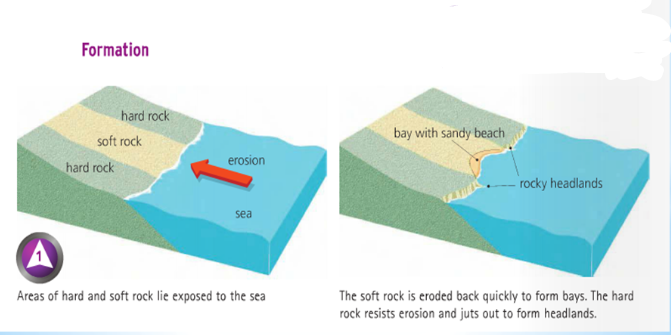
Bays and headlands are formed in areas where hard rock and soft rock are both present. The soft rock erodes quicker. The two main processes of erosion and hydraulic action and abrasion. Because soft rock erodes quicker, it leaves a bay and the hard rock jutts out to form headlands.
Sea Cliffs - a sea cliff is a high rock face that slopes up very steeply to the shore. Example Cliffs of Moher
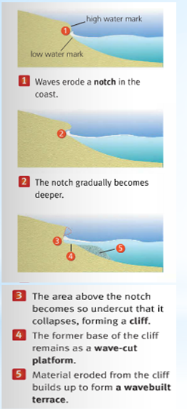
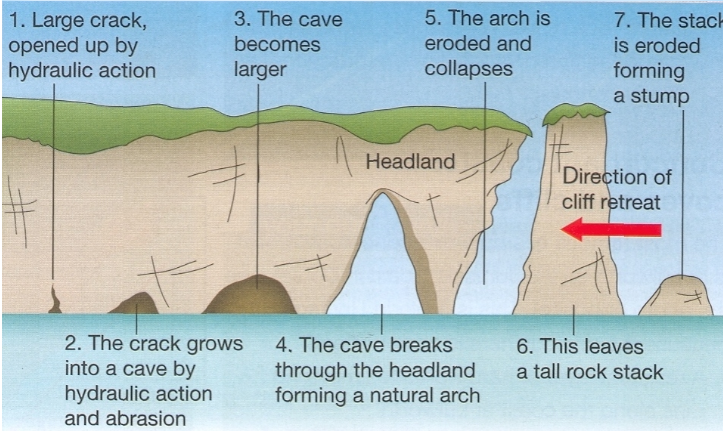
Sea Caves - The large hole or tunnel at the foot of a cliff. The waves find a weak spot at the base of the cliff and gradually erode until a cliff is formed. Example Cliffs of Moher
Sea Arches - A natural archway in a rocky headland. If the cave erodes through the headland, an arch may form. Example Old Head of Kinsale, Co. Cork
Sea Stacks - A pillar of rock sticking out of the sea near the coast. If the roof of an arch collapses, its outer wall may stand out as a pillar of rock. Example Ballybunion Co. Kerry
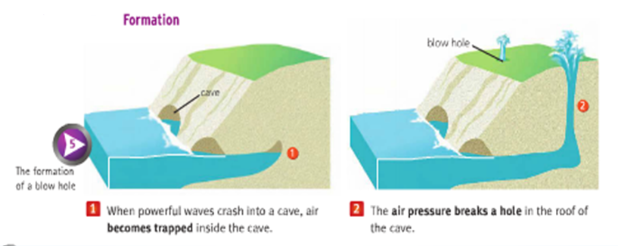
Blow Holes - A hole which joins the roof of a cave with the surface above. Sea spray may be blown up through it in stormy weather. Example McSweeney’s Gun Co. Donegal
Transport by Sea
Anything carried by sea is called its load.
Longshore Drift
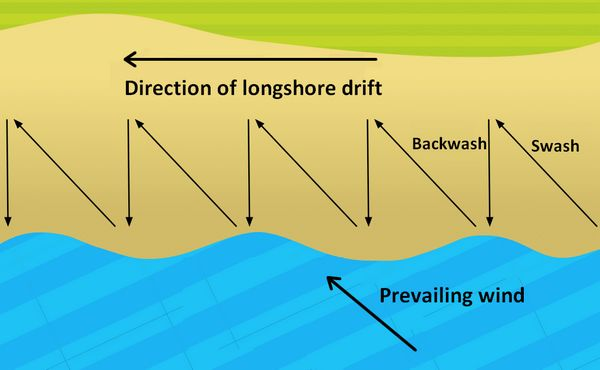
Waves approach the shore at a 45 degree angle.
The swash of each wave pushes the load at an angle.
Each backwash carries the load straight down.
As these processes repeat, the material is gradually transported in a zig zag manner.
Sea Deposition
How Sea Deposition Takes Place
The sea drops its load where the power of waves is reduced.
This may occur in sheltered bays, or in gently sloping coastal areas.
Features of Sea Deposition
Beaches - A gently sloping area of sand or shingle that occurs between high and low tide levels.
When waves break they lose their power and begin to deposit the material they are carrying.
The swash pushes materials up the beach. some of the swash seeps into the beach. The weaker backwash can then only pull finer materials back down.
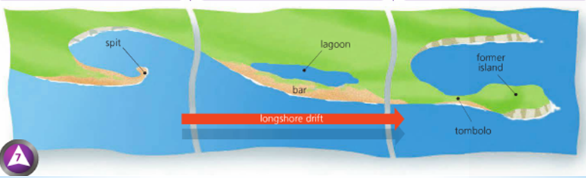
Spits - A narrow ridge of sand or shingle. One end juts out into the sea, while the other is connected to land. Example Portmarnock Co. Dublin
Longshore drift stops when it reaches the bay or other sheltered place. The material carried by the longshore drift is deposited at these places and may build up gradually to form a spit.
Bars - A narrow ridge of sand or shingle which seals off the mouth of a bay. Example Lady’s Island Lake Co. Wexford
A spit may grow in ength until it completely seals off a bay. The former spit is then referred to as a bar. A lagoon is a small lake formed behind the bar. It was originally part of the bay, which was sealed off by the bar.
Tombolos - A narrow ridge of sand or shingle, which joins an offshore island to the mainland. Example Howth Co. Dublin
A spit may grow in length until its seaward end reaches a nearby island. The former spit is then referred to as a tombolo.
Coastal Problems and Solutions
Process
Sea erosion
Problem
Roads, houses and farmland eroded
Solution
Build a sea wall to break waves.
Lay out huge boulders to reduce the power of waves onshore.
A pier or breakwater will reduce erosion by sheltering it.
Process
Longshore drift
Problem
Assists both erosion and deposition in bays
Solution
Build concrete groynes to reduce longshore drift
Process
Deposition
Problem
Deposition forms bars which block river drainage, form marshes and lagoons and flood farmlands and roads.
Solution
Occasionally cut through bar to improve river drainage
Coastal Defense
Sea Walls - Walls made of reinforced concrete. The fronts of the walls maybe curved to deflect waves back out to sea.
Gabions - Steel wire cages filled with stones, stacked on top of eachother to act like a sea wall.
Large Boulders - Placed in front of cliffs or sand dunes to break waves so their power is reduced.
Groynes - Long narrow structure built to limit the movement of beach material.
Marram Grass - Grass that is grown to help sand dunes to build up.