6.1.3 6.1.4 body plans and apoptosis private study
spec points
homeobox genes - genes containin homeobox dna sequence of 180 base pairs - base sequence may be interrupted by introns
homeobox-
epigenetics
children born to mothers malnourished during early part but not latter part of pregnancy has normal birth weihts but higher than normal rates of obesity in later life; also show greater incidence of other health problems
events that occur during first 3 months of fetal development stay w people throughout lives - can even affect health of offspring
abused children - even after being cared for by loving adoptive parents may later develop depression = be at risk of self harm.
identical twins may show diff characteristics largely determined by genes e.g. schizophrenia
different types of epigenetics - events within living organism can switch genes off - sometimes permanenetly; the switched off genes are then inherited
DNA isn’t altered by mutation - change to nucleotide base sequence - but methyl (CH3) groups may be added (methylation) to certain groups within DNA molecue
methl group added to cytosine in promotor region binds to a protein. that then attracts other proteins that help switch off the gene, or causes the DNA to coil + deny access to binding sites by transcription factors. when DNA with methylated C base is replicated, new strands also have methylated cytosine at same location
acetylation
addition of acetyl groups of histone proteins, around which DNA in chromosomes is wound can also switch genes off
until recently histone preoteins were thought to be just for ‘packaging’ DNA and not have any function related to gene expression
genome once regarded as inflexible code; scientists now know that epigenome operating above (epi) the level of genome can change how DNA is expressed throughout persons life. DNA is like a script - epigenetic code can be read in diff ways
many switches for genes act more like volume dials than on/off switches
1950’s John Gurdon disproved theory that when cells differentiate some genes are lost: transferred nucleus from fro skin cell to an egg cell where nucleus had been destroyed. egg then developed into frog showing that skin cell had all the genes but some were switched off
epigenetics impact on health
implicated in range of diseases e.g. schizophrenia, rheumatoid arthiritis, cancer, chronic pain
few types of drugs can already treat cancer by interfering with epigenetic processes; may be smothering methyl groups of epigenetically modified genes with another chemical
epigenetics also given means of reprogramming differentiated cells to switch back on certain ‘off” genes, making induced pluripotent stem cells
genetic control of body plan develpment
apoptosis - programmed cell death
conserved - has remained in all descendant species throughout evolutionary history
homeobox sequence - sequence of 180 base pairs (excluding introns) found within genes that are involved in regulating patterns of anatomical development in animals, fungi and plants
hox genes - subset of homeobox genes found only in animals; involved in formation of anatomical features in correct locations of body plan
homeobox gene sequences
involved in controlling anatomical development/morphogenesis of an organism so that all structures develop in correct location, according to body plan. several of these genes contain homeobox sequences and they are sometimes called homeobox genes
each homeobox sequence is stretch of 180 DNA base pairs (excluding introns) encoding 60-amino acid sequence, called homeodomain sequence, within a protein. homeodomain sequence can fold into particular shape + bind to DNA, regulating transcription of adjacent genes. proteins are transcription factors and act within cell nucleus. shape that homeodomain containing proteins fold into is called H-T-H. consists of 2 ɑ helices (H) connected by one turn (T). part of homeodomain amino acid sequence recognises TAAT sequence of enhancer region (region that initiates/enhances transcription) of gene to be transcribed
hox genes found only in animals
homeobox genes found in animals, plants and fungi
genes first arose in early ancestor which gave rise to each of these types of organism and have been conserved
sequences are also similar in all organisms studied to date and that similarity extends across wide evolutionary distances
how hox genes control body plan development in animals
hox genes regulate the development of embryos along anterior-posterior (head-tail) axis. they control which body parts grow where. if hox genes mutilated, abnormalities can occur.
hox genes and homeobox genes
Hox genes are a subset of homeobox genes and are found only in animals.
They are involved in body plan regulation during embryonic development.
They code for homeodomain proteins, which act as transcription factors.
Hox genes show colinearity: their expression follows the order in which they appear on the chromosome.
Hox gene clusters have been duplicated in tetrapods.
regulation of hox genes
Hox genes are regulated by gap genes and pair-rule genes.
These genes are further regulated by maternally supplied mRNA from the egg cytoplasm.
mitosis
Essential for growth and development.
Regulated by homeobox and Hox genes.
During differentiation, some genes are switched off.
Hayflick limit: Normal body cells divide a limited number of times (~50 times) before dying.
apoptosis (programmed cell death)
John Kerr (1972) studied apoptosis.
Prevents excessive cell proliferation and removes harmful cells.
Involved in development (e.g., limb formation) and immune system regulation.
Balance between mitosis and apoptosis is crucial:
Too little apoptosis → Tumours.
Too much apoptosis → Cell loss, degeneration.
stages of apoptosis
Enzymes break down cytoskeleton.
Cytoplasm condenses and organelles pack tightly.
Cell surface changes, forming blebs.
Chromatin condenses, nuclear envelope breaks.
Cell breaks into vesicles, fragments ingested by phagocytes.
control of apoptosis
Signalling molecules (cytokines, nitric oxide, hormones) regulate apoptosis.
Stress signals from external/internal stimuli can induce apoptosis.
apoptosis in development
Example: Limb development → Apoptosis separates digits.
Failure of apoptosis can cause syndactyly (toes/fingers fused).
Mammalian heart barely undergoes apoptosis after birth.
vitamin A and hox genes
Retinoic acid (from Vitamin A) regulates Hox genes.
Excess Vitamin A (e.g., liver consumption in pregnancy) can cause fetal abnormalities.
key terms
Homeobox sequence: DNA sequence that codes for the homeodomain.
Homeodomain sequence: Part of the protein that binds to DNA.
Colinearity: Order of Hox genes on the chromosome corresponds to their expression in the embryo.
animal body plans: homeobox genes
early observations in embryonic development
Von Baer (19th century): Observed that vertebrate embryos (e.g., salamanders, humans) look similar in early development.
Saint-Hilaire: Proposed that vertebrates are "upside-down invertebrates" due to differences in nerve cord positioning.
discovery of homeotic genes
Homeotic genes direct body development across species, acting as "molecular architects."
Found in many species, showing genetic similarity in structure and function.
Fruit Fly (Drosophila melanogaster) Studies
Used in genetic research due to its rapid reproduction and simple genome (4 chromosomes).
Early embryo starts with 16 equal-sized segments, which later merge into 3 segments:
Head, thorax, and abdomen.
Edward B. Lewis (1940s) studied homeotic genes controlling segmentation.
Bithorax complex: Mutations caused duplication of body parts (e.g., extra wings).
These genes act as master switches, controlling:
Number, pattern, position, and fusion of body segments and appendages.
molecular basis of homeobox genes
Christiane Nüsslein-Volhard & Eric Wieschaus (1970s):
Discovered a 180-base-pair DNA sequence, called the homeobox.
The homeobox codes for a 60-amino-acid protein that binds to DNA.
This protein regulates gene transcription, acting as a master switch for development.
Nobel Prize (1995) awarded to Lewis, Nüsslein-Volhard, and Wieschaus.
hox genes in vertebrates vs. invertebrates
Fruit fly: 1 cluster of ~10 Hox genes on 1 chromosome.
Mouse (and humans): 4 clusters of ~10 Hox genes, each on a different chromosome.
Hox genes duplicated twice during the evolution of vertebrates.
Remarkably, only ~40 genes (out of ~100,000) control most of body development in mammals.
evolutionary significance
Fly and mouse Hox genes are similar, despite their evolutionary divergence ~500 million years ago.
Supports Saint-Hilaire’s hypothesis of vertebrates as "upside-down" invertebrates.
hox genes and eye evolution
Walter Gehring (1994): Discovered that the same Hox gene regulates eye development in:
Flies, mice, octopuses, and humans.
Contradicts Ernst Mayr’s idea that eyes evolved independently 40 times.
Instead, suggests a common evolutionary origin for all eyes.
conclusion
Hox genes act as molecular architects for animal body plans.
Provide strong evidence for evolutionary unity across species.
Support theories proposed by von Baer and Saint-Hilaire in 19th century.
questions
Body plans
Suggest why fruit flies are often used as “model organisms”.
reproduce quickly, have short life cycle + only have four chromosomes which makes genetic studies easier - simple genome.
State what Homeobox genes are, and their role in body plan development.
group of regulatory genes that contain 180-base pair DNA sequence called homeobox. They code for transcription factors that control gene expression which guides development of body plan in animals by determining number, position, and identity of body segments and appendages.
Which groups of organisms have homeobox genes?
eukaryotes
What is the difference between a homeobox gene and a homeodomain?
homeobox gene is gene that contains homeobox sequence, whereas homeodomain is protein region (60 amino acids long) produced by homeobox genes. homeodomain binds to DNA + regulates expression of other genes involved in body plan development
In which groups of organisms are HOX genes found?
animals, invertebrates and vertebrates
Complete the colouring exercise on the Animal Body Plans worksheet
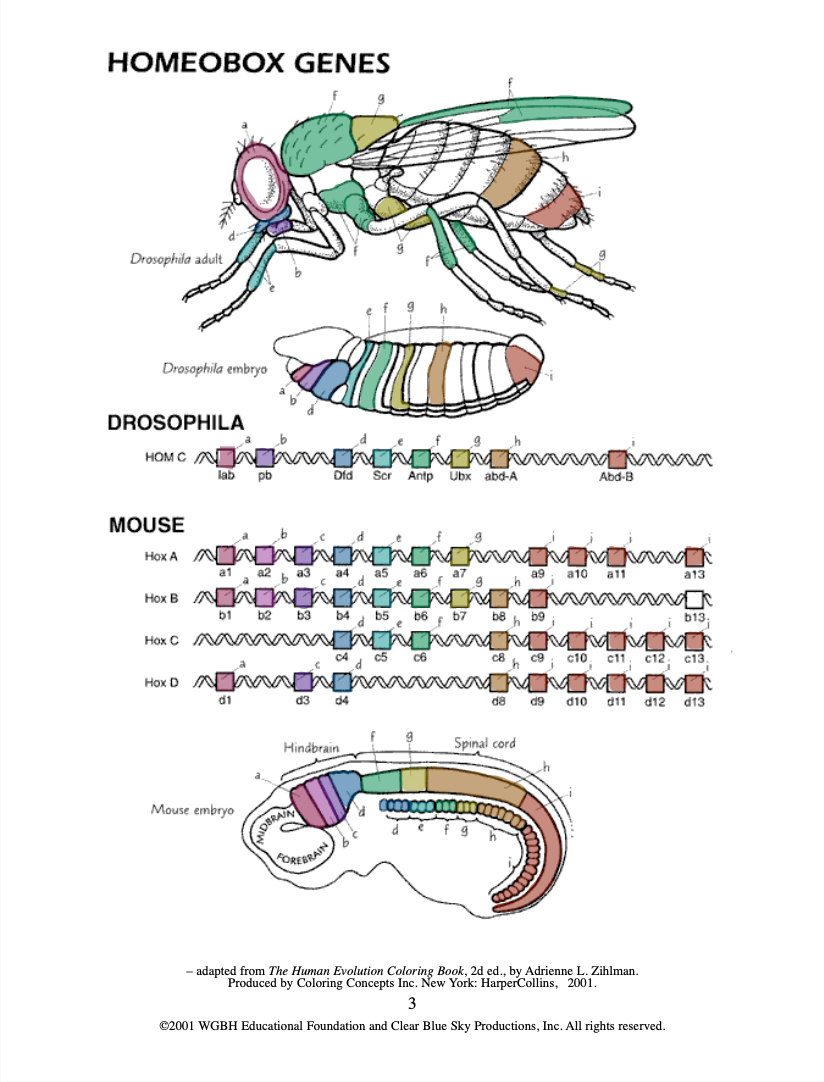
How are Hox genes arranged in all animals?
clusters on chromosomes in same order as body regions they control - head-to-tail sequence
Suggest why these genes are described as master switches.
bc they regulate activation and repression of other genes (controls overall body plan + differentiation of body structures)
Explain why the arrangement of the hox genes in the hox cluster and their expression is referred to as colinearity.
where Hox genes are arranged on chromosome in the same order as body regions they regulate. sequence that they are expressed in embryo development also follow head to tail order
Give 2 pieces of evidence that Homeobox genes give for the evolution of all organisms from simpler ancestors.
With conserved DNA sequence, homeobox sequence is very similar across different species - shows common evolutionary origin.
Similar function across species - Hox genes control body plan development in invertebrates + vertebrates shows shared genetic framework.
Suggest why these genes appear to be conserved (very similar) in all organisms
bc control essential developmental processes and mutations in these genes can lead to severe defects so natural selection strongly preserves the sequence across diff species.
Apoptosis
Distinguish between apoptosis and necrosis.
apoptis is programmed cell death whereas necrosis is the passive accidental death of cells in body tissues from environmental factors
Summarise (with a flow diagram) the sequence of events in apoptosis.
Cell receives a death signal → Activation of internal (mitochondrial) or external (death receptor) pathway → Caspase enzymes activated → Breakdown of cytoskeleton & degradation of organelles → Cell shrinks & membrane blebs → Formation of apoptotic bodies → Phagocytosis of apoptotic bodies by macrophages → No inflammation occurs
Give examples of where/ why apoptosis is required.
embryonic development - removal of webbing between fingers/toes. immune system - removes unnecessary/harmful immune cells. tissues, apoptosis maintains homeostasis (replacing old/damaged cells). helps prevent cancer - destroys cells w/ DNA damage that could lead to uncontrolled division.
Describe what cell signalling events may cause apoptosis.
What may develop if cells fail to respond to cell signals for apoptosis?