Python
Computers perform calculations - makes guesses and new guesses based off distance to answer
Knowledge
- declarative of knowledge is a statement of fact
- Imperative knowledge - recipe/steps (how)
Recipe
- Sequence of simple steps
- Flow of control process that specifies when each step is executed
- A means of determining when to stop
Fixed program computer - old calculator
Stored program - machine stores and executes instructions
-special program (interpreter) executes each instruction in order (moving data, test, arithmetic and logic)
Turing showed you can compute anything with 6 primitives (move left, right, read, write, scan, do nothing) - programming languages add more primitives
Anything computable in one language is computable in any other
Creating
- Expressions - complex but legal combinations of primitives in a programming language
- Expressions and computations have values and meanings in a programming language
Primitive constructs
English - words
Programming languages - numbers, strings, simple operators
Semantics
- Static semantics is which syntactically valid string have meaning
- Proper grammar - syntax placement
Objects
- Programs manipulate data objects
- Objects have a TYPE that defines the kind of things programs can do to them (scalar - can’t be subdivided (number) and non scalar - internal structure (list))
Scalar
- Int - integers
- Float - real numbers - decimals
- Bool - boolean values true and false
- Nonetype - special and has one value , none
- type() to see the type of an object
float(3) will convert int to float
Expressions
- Combine objects and operators to form expressions
- An expression has a value, which has a type
- Syntax for a simple expression <object> <operator> <object>
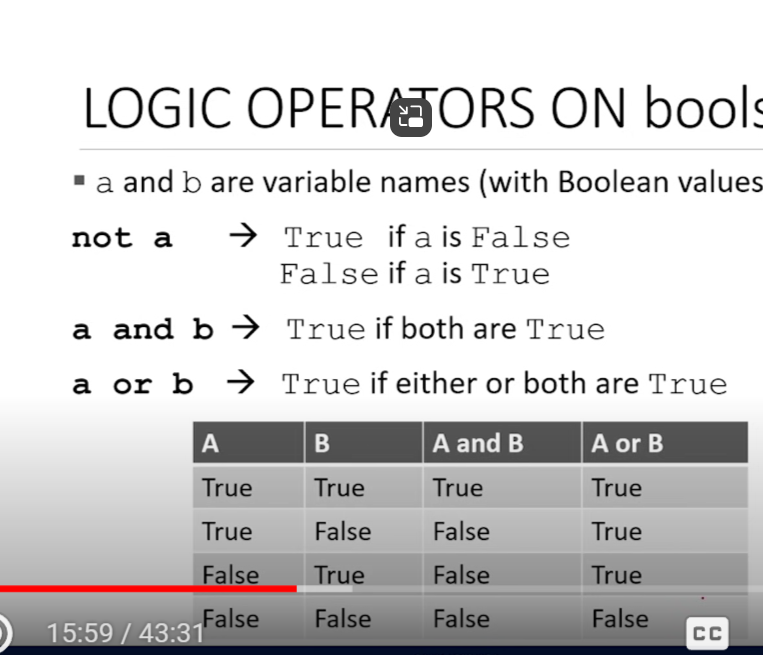
= or ==
= is used to assign value to string but == is used for actual = in terms of math
While loops - don't know iterations (user input)
Can use counter but must initialize
For loops - know number of iterations, counter, can rewrite for while loop but harder other way round
Can break loops by using break statement
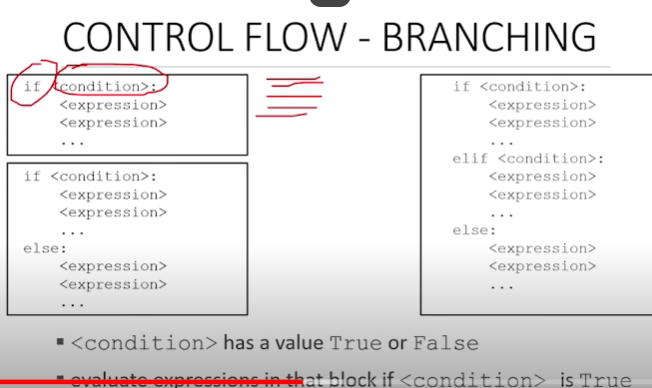
If - else - elseif
Range (start,stop,step) - has to be integers
Indexing to find certain value in code
Strings are immutable - cannot be modified
Algorithms
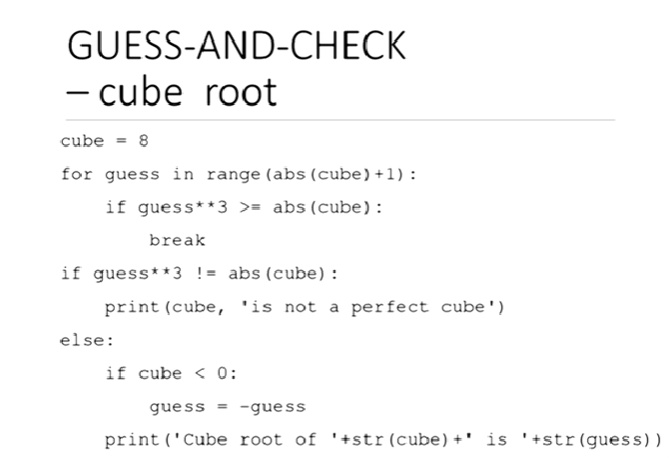
Guess and check -
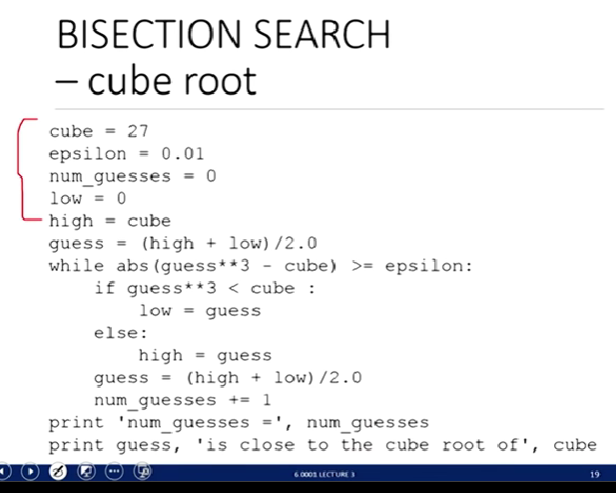
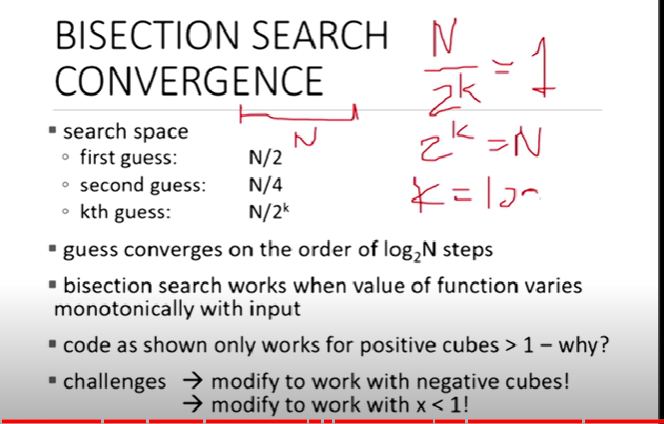
Bisection - eliminating search space with every guess for example guessing a number between 1-100 guess 50 and then eliminate higher or lower
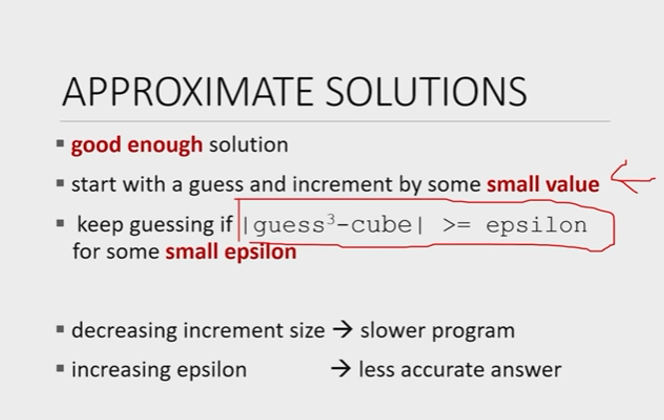
Approximation -
Lecture 4: Decomposition, Abstraction, and Functions
Abstraction idea example - don’t need to know how a projector works to use it can connect with laptop easily
- Achieve through function specifications or docstrings
Decomposition - breaking down to focus on specific inputs. - different devices work together to achieve same goal
- Creating structure in code - in programming divide code into modules to keep code organized and to break up - can then also be reused easier
Functions
- reusable pieces of code
- Name, parameters, docstring, body, returns something ]
Scope
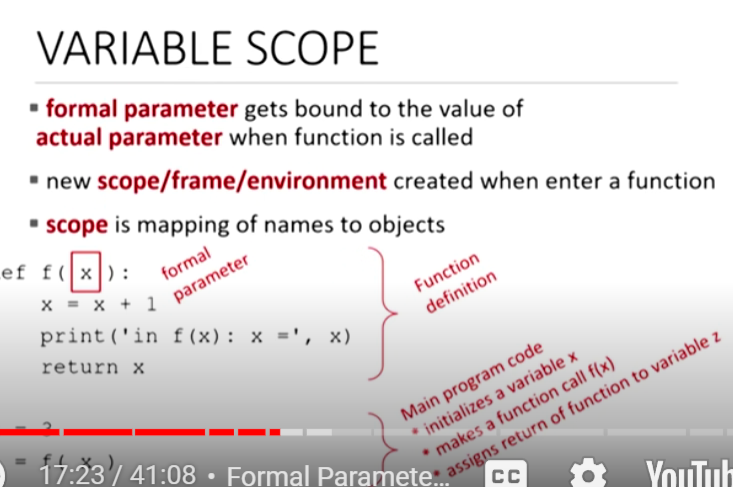
- environment/ frame/ scope created when enter a function
None is not a string - special type
Nested functions
When there is a function call make new scope
Lecture 5: Tuples, Lists, Aliasing, Mutability, and Cloning
Tuples - sequences of anything - collection of any type of data (any data type)
- Once created, can not modify
- Parentheses
- Can use to interpret data and spit out answer
- With a comma its a tuple but without its a string
Lists
- Can modify
- Square brackets
- Iterating over a list- compute the sum of elements of a list - common pattern - list elements indexed 0 to len(L)-1, range (n) goes from 0 to n-1
- Append - function must be defined (e.g cant be integer)
- To combine lists together use concatenation. + operator, to give you a new list
- Mutate list with L.extend(some_list) - some mutations make changes
- Can delete at specific index
- Can convert to strings and vice versa - similar to casting a float to int
- Create a new list and copy every element using chill = {cool:}
- Can have nested lists
Aliases
- Hot is an alias for warm and point to same object - changing one changes the other
- append() has a side effect - printing out same thing when change^
Lecture 6 Recursion and Dictionaries
Recursion - repeating idea multiple times in a similar way
- Algorithmically - divide and conquer - trying to simplify a problem repeatedly = recursive step
- Base case - reduced problem that can be solved directly
- Each recursion call creates its own scope/environment
- Bindings of variables in a scope are not changed by recursive call
- Flow of control passes back to previous scope once function call returns value
Dictionaries
- Stores pairs of data - keys,values
- My_dict = {}
- To look up its similar to indexing a list
- Looks up key and returns value associated (think of grading in a hs class)
- Can add entry, test if key is present, delete entry
- Can get an iterable that acts like a tuple of all keys or values
- Can be any immutable type (can be anything)
- No order guaranteed
- Valuable for procedure calls when intermediate values don’t change
Lecture 7: Testing, Debugging, Exceptions, and Assertions
Unit testing
- Validate each piece of program
- Testing each function separately
Regression testing
- Add test for bugs as you find them
- Catch reintroduced errors that were previously fixed
Integration testing
- Does the overall program work people rush to do this
Testing approaches
Intuition - natural partitions - e.g def is_bigger(x,y) - you would know that some parameters would include =, <, >, etc.
Random testing
Black box testing
- explores paths through specifications
Glass box testing
- Explores paths through code
Explain code to someone who doesn’t know as it will get you to include everything and might catch bug
enumerate() = allows you to keep track of number of loops
Lecture 8 object oriented programming
- Every object has a type, internal data representation(primitive), a set of procedures for interaction with the object,
- 1234 is an instance of an int(type)
- Everything in python is an object and has a type
- Objects are data abstractions that captures an internal representation (data attributes) and an interface to interact with it (procedures, functions)
- Think of data as other objects that make up the class(attributes)
Creating class verse creating instances of class
Coordinate object - defining a point in an x,y plane
Define your own types by using class variable
Class Coordinate(object):
#define attributes here
(the word object means that Coordinate is a python object and inherits all its attributes - subclass)
Instances are the structure of the class but you must create the class first
Methods - functions that only work with this class
- Using dot operator
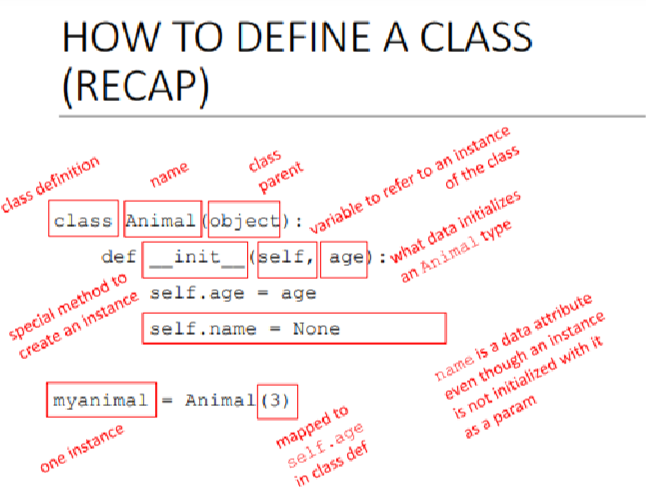
Use _init_ to initialize data attributes
- Self is a placeholder for an instance (instance of object you will perform the operation on)
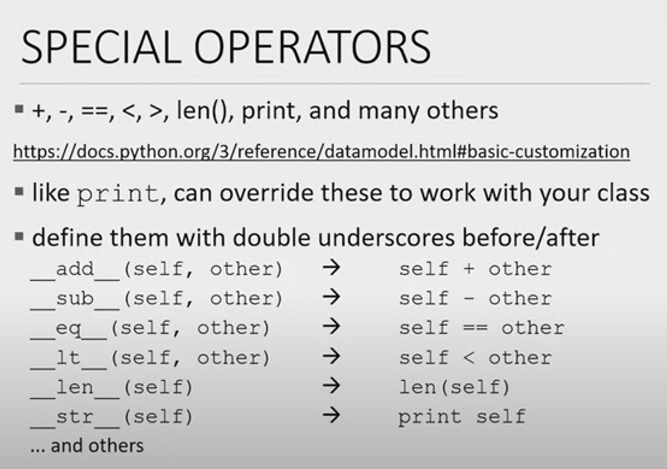
_str_ tells python to print informatively
- Have to use special operators to tell python exactly what to do as it can’t perform everything
Lecture 9 - Python Classes and Inheritance
Implementing the class
- Defining class
- Define data attributes
- Define methods
- Class name is the type and defines data and methods common across all instances
Using the class
- Creating instances of the object type and doing operations with them
- Instance has the structure of a class but is one specific object
Data attributes
- What it is
- How can you represent your object with data?
- For a coordinate: x,y values, for an animal its age, name
Procedural attributes (behaviour/operations/methods)
- How can someone interact with the object?
- What it does
- Coordinate finding distance, animal making sound
Getter and setter methods
- Should be used outside of the class to access data attributes
An instance and dot notation
- Dot notation is used to access attributes though it is better to use getters and setters
Information Hiding
- Author of class definition may change data attribute variable names
- If accessing data attributes outside the class and class def changes can get errors
- Python is not great at this as allows you to access, write and create data and data attributes outside of the class definition however it is not good style to do this
Default arguments
- Used for formal parameters if no actual argument given
Hierarchies
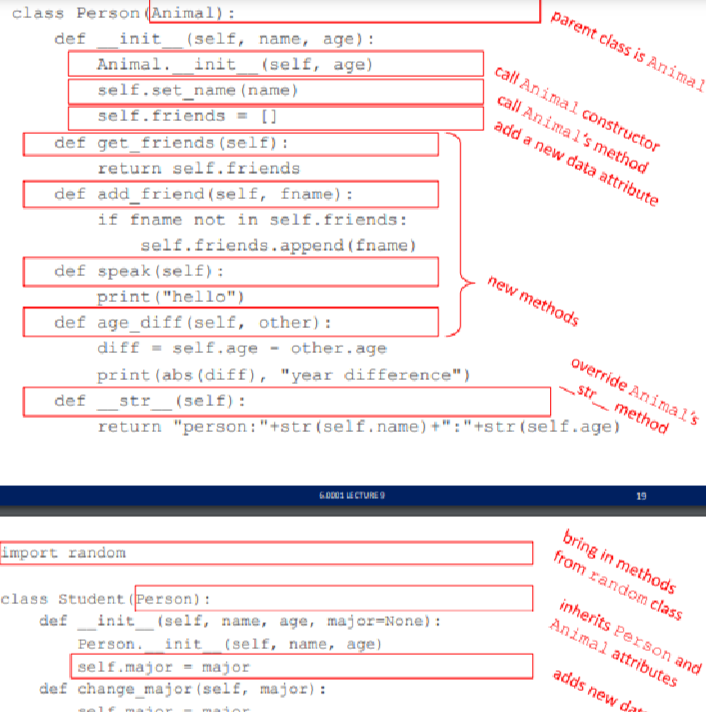
- Parent class (superclass)
- Child class (subclass) - inherits all data and behaviours of parent class but can add more info, behavior, override behavior
Class variables and their values are shared between all instances of a class
Object oriented programming
- Create your own collections of data
- Organize info
- Division of work
- Access info in a consistent manner
- Add layers of complexity
- Like functions, classes are a mechanism for decomposition and abstraction in programming
Lecture 10 - Understanding program efficiency part 1
- Seperate time and space efficiency of a program
CHallenges in understanding computational effiiciency problems
- Program can be implemented in multiple diff ways
- Can solve only using a handfulof different algorithms
Evaluation
- Timer - time module (runnting time can vary between implementations, computers, not predictable based on small inputs
- Counting operations - assume steps take constant time and count operations executed
- Abstract notion of order of growth (best) -
We want to express efficiency in terms of size of input, so need to decide what your input is - can be integer, list , and you decide when multiple parameters to a function
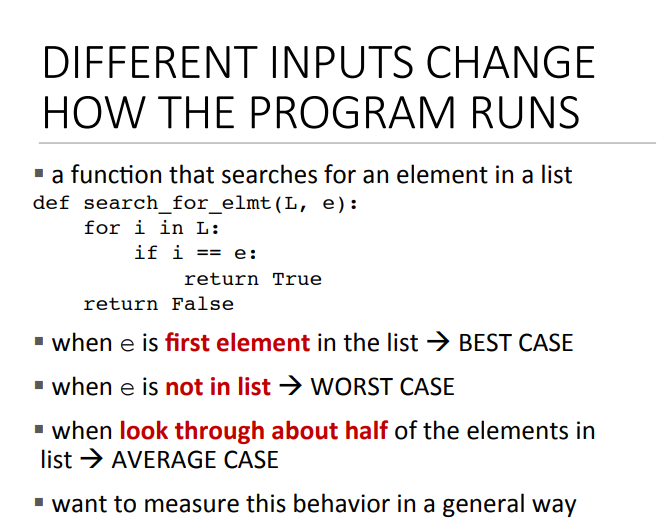
Best case - minimum running time over all possible inputs of a given size
- Constant for search_for_elmt, 1st element in any list
Average case - average running time over all possible inputs of a given size
Worst case - max running time over all inputs
- Linear in length of list for search_for_elmt
Orders of growth Goals:
- Evaluate program efficiency when input is very big
- Express growth of program’s run time as input size grows
- Want to put an upper bound on growth - as tight as possible
- Do not need to be precise - order of not exact growth
- We will look at largest factors in run time
- We want tight upper bound on growth as a function of size of input, in worst case
Measuring order of growth - big Oh or O() notation
- Measures an upper bound on te asymptotic growth
Big Oh is used to describe the worst case
- Occurs often as is the bottleneck when a program runs
- Express rate of growth of program relative to the input size
- Evaluate the algorithm not machine or implementations
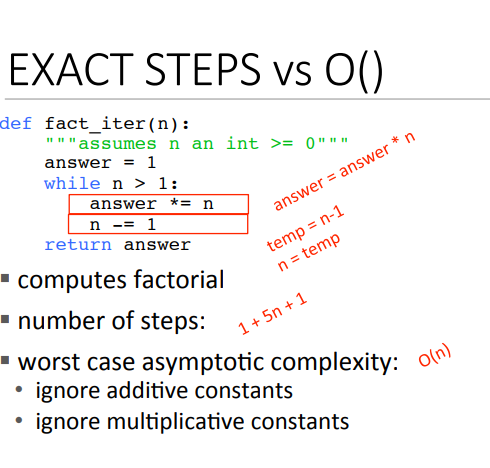
- Want to know asymptotic behavior as problem gets large so will focus on term that grows most rapidly in a sum of terms and will ignore multiplactive constants since we want to know how rapidly time required increases as increase of output
FOCUS ON DOMINANT TERMS JUST LIKE IN CHEM EQUILIBRIUM
Analyzing programs and their complexity
- Combine complexity classes
- analyze statements inside functions
- apply some rules, focus on dominant term
Law of addition for O()
- Used with sequential statements
****Need to add example code
COMBINE COMPLEXITY CLASSES
- Analyze statements inside functions
- Apply some rules, focus on dominant term
Law of multiplication
- Used with nested statements/loops
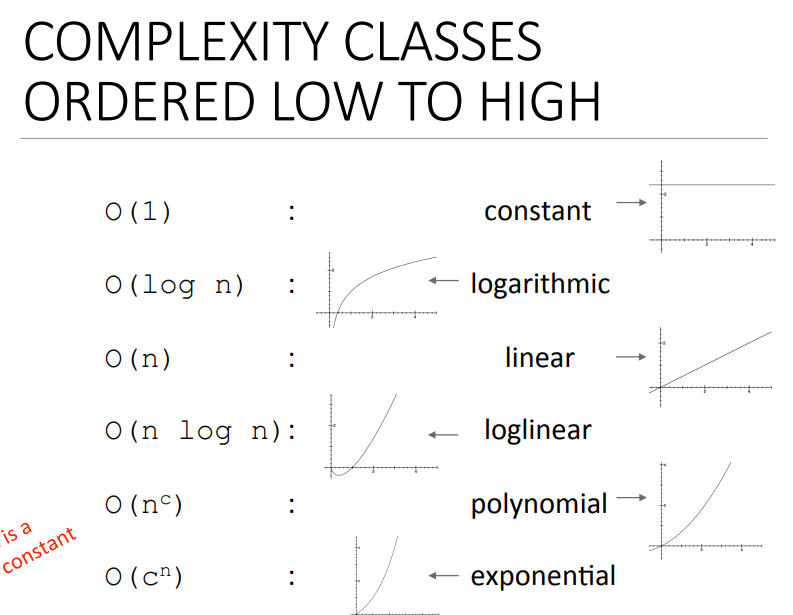
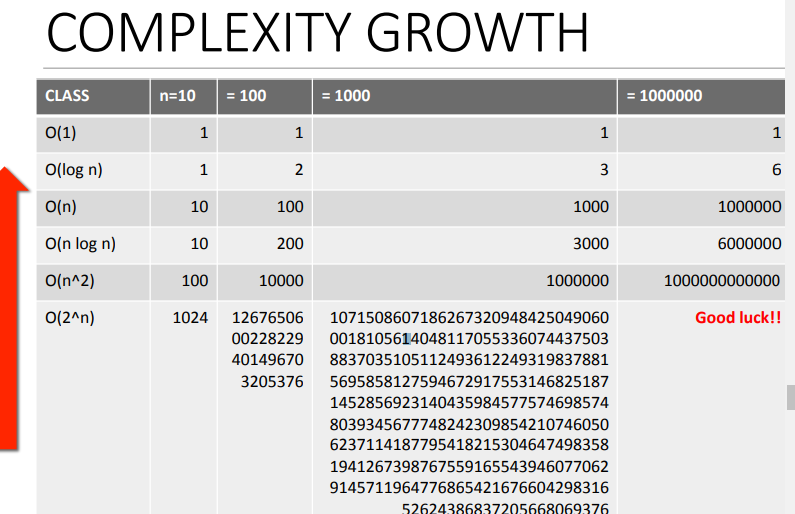
Complexity classes
- O(1) = constant running time
- O(log n) denotes log running time
- O(n) denotes linear
- O(n log n) denotes log-linear running time
- O(nc) denotes polynomial running time where c is a constant
- O(cn) denotes exponential running time (c is a constant being raised to a power based on size of input)
Simple iterative loop algorithms are typically linear in complexity
Linear search or unsorted list
- Must look through all elements to decide it’s not there
- O(len(L)) for the loop - O(1) to test if e ==:[i]
- Overall complexity is O(n) - where is n is len(L)
Constant Time List Access
- If list is all ints - Ith element at
- If list is heterogeneous - indirection and references to other objects
Linear search on sorted list
- Worst case will need to look at whole list - must only look until reaches a number greater than e
- Overall complexity is O(n) - where n is len(L)
- Order of growth is same but run time may differ
Linear Complexity
- Depends on number of iterations
- Number of times around loop is n
Nested loops
- Simple loops are linear in complexity
Quadratic complexity
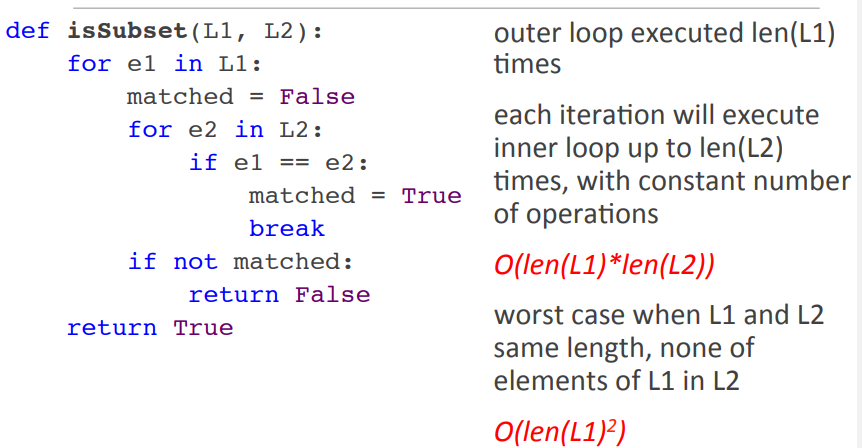
- Find intersection of 2 lists, return a list with each element appearing only once
Def intersect(L1,L2):
Tmp = [ ]
For el in L1:
For e2 in l2:
If el == e2
tmp.append(el)
Res = [ ]
For e in tmp:
If not(e in res):
res.append(e)
Return res
O(len(L!)^2)
O() for nested loops
- Computes n2 very inefficiently
- When dealing with nested loops, LOOK AT THE RANGES
- Nested loops, EACH ITERATING N TIMES
- O(n2)
LECTURE 12; UNDERSTANDING PROGRAM EFFICIENCY PART 2
Constant complexity
- Independent of inputs
- Very few interesting algorithms
- Can have loops or recursive calls but only if number of iterations or calls independent of size of input
Logarithmic complexity
- Complexity grows as log of size one of its inputs e.g. bisection search or binary search of a list
Bisection search
- Pick an index, i, that divides list in half
- Ask if L[i] is larger or smaller than e
- Depending on answer search left or right half of L for e
- Depending on answer search left or right half of L for e
- Complexity of recursion is O(log n) - where n is len(L)
O(log n( bisection search calls
- If original range is of size n, in worst case down to range of size 1 when n/2^k)= 1; or when k = log n
O(n) for each bisection search call to copy list
- This is the cost to set up each call for each lvl of recursion
If you multiply both above you get log linear
- Turns out that total cost to copy is O(n) and this dominates the log due to the recursive calls
Bisection Search Alternative
**** add one of the bisection search implementations
Logarithmic Complexity
- Only have to look at loop as no function calls
- Within while loop, constant number of steps
O() for iterative factorial
- Complexity can depend on number of iterative calls
- Overall O(n) - n times round loop, constant cost each time
O() for recursive factorial
- May run a bit slower
- Still O(n) because the number of function calls is linear is n, and constant effort to set up call
- Iterative and recursive factorial implementations are the same order of growth
Log- linear complexity
- Many practical algorithms like merge sort
- Will return to this next lecture
Polynomial complexity
- Most common polynomials algorithms are quadratic, complexity grows with square size of input
- Commonly occurs when we have nested loop os recursive function calls
Exponential complexity
- Recursive functions where more than one recursive call for each size of problem like TOWERS OF HANOI
- Many important problems are inherently exponential so unfortunate, as cost is high and will lead us to consider approximate solutions as may provide reasonable answer quicker
O(2n)
*add snippet of slide
*complexity of python functions slide
Big Oh summary
- Compares efficiency of algorithms
Using big Oh
- Describe order of growth
- Asymptotic notation
- Upper bound
- Worst case analysis
Searching and Sorting Algorithms
Search algorithm - method for finding an item or group of items wiht specific properties within a collection of items
Linear search
- Brute force search (aka british museum algorithm)
- List does not have to be sorted
Bisection search
- List must be sorted to give correct answer
Searching a sorted list
- Using linear search, search for an element is O(n)
- Using binary search, can search for an element in O(log n)
- To sort a collection of n elements nust look at each one at least once
Amortized cost
- In some cases, may sort a list once then do many searches
- Amortize cost of the sort over many searches
Monkey sort
- Aka bogosort, stupidsort, slowsort, permutation sort, shotgun sort
- To sort a deck of cards - throw in air and if not sorted repeat
- Best case is O(n) where n is len(L) to check if sorted
- Worst case : O(?) it is unbounded if really unlucky
Bubble sort
- Compare consecutive pairs of elements
- Swap elements in pair such that smaller is first
- When reach end of list, start over again
- Stop when no more swaps have been made
- Largest unsorted element always at end after pass, so at most n passes
- O(n2)
Selection sort
- O(n2)
1st step
- Extract min element
- Swap it with element at index 0
Subsequent step
- In remaining sublist extract min element
- Swap it with the element at index 1
Keep the left portion of the list sorted
- At i’th step, first i elements in list are sorted
- All other elements are bigger than first i elements
Merge sort **NEED SNIPPET
Use a divide and conquer approach
- If list is of length 0 or 1, alreayd sorted
- If list has more than one element, split into 2 lists , and sort each
- Merge sorted sublists
- Split list in half until have sublists of only 1 element
- Merge such that sublists will be sorted after merge
- O(n log(n)) - this is the fastest a sort can be