RP3 PT2 - Effect of length of a wire on resistance
PRACTICAL SUMMARY
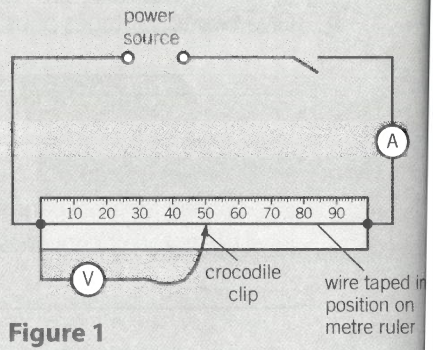
In this practical an ammeter is connected in series and a voltmeter in parallel with a wire and flying lead as seen in the diagram above ( the bottom of the ruler is a wire ) . Then, you vary the length of the wire coming from the voltmeter with a crocodile clip and changing the point which you make contact with the long fixed wire.
CONCLUSION:
Overall, we noticed that when the length of a wire is increased the voltage increases the current stays the same and the resistance increases.
RESISTANCE
To understand why resistance increased imagine that school hallway again - but instead of changing the amount of pupils walking the opposite direction to you imagine making the hallway longer and longer each time, thats going to be more difficult to get to where your going. That’s why its more difficult for the electrons to make it around the circuit - meaning they’re facing more resistance.
VOLTAGE & CURRENT
Carrying on from that analogy, imagine the voltage as like the coffee you have in the morning - it gives you the energy to make it through that long hallway. So the longer the hallway the more coffee you're going to need. That’s why the voltage tends to go up when the resistance does. Lastly, imagine the current as the speed you’re travelling at. When the hallway gets longer, you drink more ‘coffee’ so you can keep walking at the same pace as you would in a normal hallway. That’s why the current stays the same — the extra voltage (coffee) makes up for the extra resistance, so your walking speed, and therefore the current, doesn’t change
If still confused refer to: Yr10 physics electric circuits RP 3 - Part 2 - The effect of length of a wire on resistance