IELTS Speaking Test Preparation Notes
Overview
Speaking Test Overview
The IELTS Speaking Test format has remained unchanged since its introduction in 2000.
Despite rumors of changes, the structure stays consistent worldwide, ensuring uniformity across all test locations.
Test Length: 11 to 14 minutes, with variation possible based on candidate responses.
Structure: Composed of three main sections that assess different speaking skills and abilities.
Scoring: Criteria for scoring is the same across all sections, averaging scores from all parts.
Test Structure
Initial Interaction:
Candidates are shown to their interview rooms.
They wait until called inside by the examiner.
The interview begins with the exchange of names and ID verification, lasting 30 seconds to 1 minute (not counted towards interview time).
Beginning of Test:
Marked by the phrase: "In this first part I'd like to ask you some questions about yourself." Anything said before this point is not evaluated.
Part One Overview
Duration: Approximately 4 to 5 minutes.
Common Misconception: Often mistaken for a "self-introduction" section, but it includes various topics.
Content: Focuses on familiar subjects like background, hobbies, routines, etc.
Topics typically include: Where you live, your studies, your job, hobbies, sports, etc.
Question Count: 2 to 5 questions per topic, leading to a total of 6 to 15 questions.
Longer answers are recommended for higher scores.
PART 1
Question types
Describe question
Structure:
(1) Lead-in phrase
OK then...
Alright...
Well, you know...
Actually...
(2) 1st pointing phrase
...the first thing I should mention is that...
...the point I'd like to begin with is that...
...I could start off by saying that...
...my initial point would be that...
...I need to start off by pointing out that...
...the main thing you need to know is that...
...I suppose I should begin by highlighting the fact that...
...you may (or may not) be aware that in fact...
...I really need to kick off with the point that...
(3) Point 1
(4) Linking word/ phrase + detail about point 1
(5) 2nd pointing phrase
Another point which I could add is that...
A second feature which I should mention is that...
As well as that, I could say that...
On top of that I can also add that...
(6) Point 2
(7) Linking word/ phrase + detail about point 2
(8) 3rd pointing phrase
And I shouldn't forget to mention that...
In addition to what I've just said, I can add that...
Something else that I need to comment on is that...
I guess I could also remark on the fact that...
(9) Point 3
(10) Linking word/ phrase + detail about point 3
So a complete response might look something like this:
―Well first of all, the main thing you need to know is that...(point 1)...In fact...(detail
1)...On top of that I can also add that...(point 2)...which means...(detail 2)...Something else
that I need to comment on is that...(point 3)...So actually (detail 3)...‖
Describe your hometown.
Tell me about your job.
Tell me about your family.
Tell me about your city.
What is your main ambition?
Liking question
The following expressions can be used for all general topics:
I'm fairly/ pretty keen on...
I'm really into...
I'm quite a big fan of...
I simply adore...
I'm quite enthusiastic about...
I generally prefer...(use only when comparing)
(1) Lead-in phrase
(2) 1st pointing phrase/ starting phrases for ―liking‖ include:
Well in general I would say that...
Actually, I suppose that for the most part I'd probably say that...
Well, to be honest I should really say that...
Of course I think I'd have to say that...
Certainly I would definitely say that...
Well, I guess that generally speaking I would certainly say that...
(3) Point 1
(4) Linking word/ phrase + introduce a specific type of the topic of category
....but in particular...
...particularly...
...especially...
...specifically...
...to be more precise...
...to be more specific...
...to be more exact...
...to be more accurate...
(5) linking phrase to introduce the first reason
And I guess this is probably because...
This could be because...
This might be because...
This is due to the fact that...
I suppose the reason has something to do with the fact that...
(6) 2nd pointing phrase
As well as this...
In addition to this...
To add to this...
(7) Point 2
So the complete structure looks like this:
“Well to be quite honest, in general I would say that I'm actually quite keen on...,
but in particular I would probably have to say that I'm really into...you know, things like
...I guess the reason why I'm a fan of ...is because I adore...In addition to this I suppose
I'm so pretty passionate about..., especially...and things like that, and this is due to the fact
that...”
What food do you like?
"In general, I would say that I’m really into Vietnamese cuisine. To be more specific, I would probably say that I’m pretty keen on Vietnamese noodle soup dishes, especially Phở – an iconic Vietnamese dish. This is because, growing up as a Vietnamese, Phở has always held a special place in my heart. For me, it has a magical way of comforting me.
In addition to this, I suppose I’m also quite a big fan of Japanese cuisine. I guess the reason for that is probably because I used to watch a lot of anime when I was a child."
Do you like reading?
Yes, I’m a bookaholic and reading has always been my thing. I would say that I spend most of my free time immersing myself in books. For me, reading is a kind of escapism that allows me to escape from the stress of daily life and dive in another world. And well, I’m into many genres but my favorite would be detective, novel and literature. I suppose this is because these genres always bring me a sense of curiosity and excitement.
So reading is not just a hobby for me but a way to explore new perspectives and connect with different worlds, both real and imaginary.
What do you like about your hometown?
Well, growing up in a small city, I would say that I adore the peacefulness of my hometown. I didn’t realize how much I love it until I move to a bustling city like Hanoi. My city is so peaceful that whenever I visit home, all my stress suddenly disappear, for me it’s like my mental health therapist. And I would add that I’m really keen on the transportation system there, it’s so smooth that I can travel 10km in just like 10 to 15 minutes, which could be double in Hanoi.
Do you like listening to music?
Definitely, music is one of the most important thing for me. I would say that I spend most of my free time listing to music, I even listen to it while working and studying which actually help me focus on my work. I’m into various kind of music, from pop, R&B to classical music. This is because, for me, each genre is suitable for a specific purpose or a situation. For example, if I want to concentrate on my studying, classical music will be the best choice or if I want to cheer myself up, I will go with some dynamic pop songs.
Do you like shopping?
To be honest, I used to very passionate about shopping, especially online shopping.
What do you like about your studies/ job?
Disliking question
The following language can be used to expressed ―dislikes‖.
I'm not so keen on...
I'm not much of a fan of...
I'm not really that fond of...
And for very strong ―dislikes‖ use the following:
I totally detest...
I absolutely loathe...
I really can't stand...
Remember: Give a developed answer to every question. In the past I have heard answers like these:
Do you like animals? - No, I don’t like animals
Do you like reading? - No, I like watching TV instead.
Is there anything you don’t like about your hometown? - No, I like my city.
As a rule, if the examiner asks you if you like something, give a positive answer (yes) even if that answer is not true. In the same way, If the question is ― Is there anything you don’t like about...?‖, you should also give a positive answer(yes).
Speaking positively is much easier than speaking negatively and it is easier to give reasons and examples to say ―why‖ rather than ―why not‖
Remember: Base your answer on language not on fact or truth. You do not get any marks for telling the truth!
“Types of” question
― “Tell me about the different types of public transport in your country”
Don’t list your answer - it should be structured and developed
(1) Begin with an opening phrase:
Well actually...
Of course, you know...
Sure, obviously...
Of course, it goes without saying...
Ok, certainly...
(2) Then use one of the following:
... there’s quite a mixed variety of...
... there’s quite a wide range of...
... there’s quite an extensive diversity of...
... there’s quite a diverse mixture of...
... there’s a fairly broad range of...
So the opening line might be:
― Of course, it goes without saying that there’s quite a mixed variety of public transport in my city.
(3) Now use the following structure to intro duce the first type:
But I guess the most + adj ... would probably be...
However, I suppose the most+ adj ... could possibly be...
Though I think the most + adj ... would potentially be...
Yet I imagine the most + adj ... may well be...
Still, I suspect that the most+ adj ... could perhaps be...
(4) Now use a phrase to add a detail:
The thing with buses is that...
I assume buses are so +adj because...
The point I want to add about buses is that...
And what you have to realise with buses is that
And the explanation for this could be that...
And the basis of this is that...
(5) Now use a linking phrase to introduce a second type:
Besides (buses), ...
As well as (buses), ...
In addition to (buses), ...
Another kind of (public transport) would be...
Another form of (public transport) worth mentioning could be...
A second variety of (public transport) would be something like...
A subsequent category would be something like...
―As well as buses, a second variety of public transport would be something like
taxis.
(6) Add a linking phrase to develop the second type:
And the main characteristic of (taxis) is that ...
And the unique aspect of (taxis) is that ...
And the exceptional aspect with (taxis) is that ...
Add the detail with a linking word to form a complex sentence:
― As well as buses, a second variety of public transport would be something like
taxis. And one exceptional aspect of (taxis) is that ... they are certainly quickest way to get around town. So of you’re in hurry then taxis are the best bet (= the best choice).
(7) Now you need to add a vague end line:
And of course there’s the usual things like...
And obviously you can also find things like...
Likewise, as might be expected, there are things like...
And naturally, there are things like...
So the finished structure might look something like:
―Of course, It goes without saying there’s quite an extensive diversity of....(topic)
Still, I suspect that the most + adj could perhaps be ... (type 1) And what you have to realise with...( type1) is that... In fact/ so/ but/ because ...(detail)
Another form of ....(topic) worth mentioning could be... (type 2) And the main
characteristic of ...(type 2) is that ...(detail) (+ linking word/ complex structure)
An naturally, there’s things like (type2 or 3 other types)‖
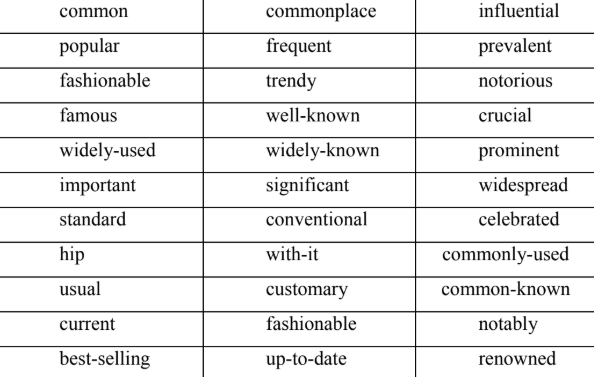
Tell me about the type of sports that are popular in your country?
Sure, obviously there is quite a wide variety of sports in my country. But I suppose the most prevalent one would probably be football. I could tell this is the most well-known sport because people in my country are always get excited when it comes to football matches, and every time when our team win, million of people get down the street with the Vietnam flag to celebrate the victory. As well as football, pickle ball is also a rising star in Vietnam. It only started in 2024 but has attracted many people to participant in it, especially those in the young ages.
What kinds of restaurants are popular in your country?
What types of shop can be found in your local area?
What types of things do people collect in your country?
What hobbies are common in your country?
What types of TV programmes are popular in your country?
“Wh-/How often” question
Look at the following examples:
How often do you go to the cinema?
Where do you usually buy your clothes?
When do you listen to music?
(1) The first step is too select an opening phrase:
Well to be honest ...
Actually to be fair ...
In actual fact ...
Well in truth ...
Well in all fairness ...
In fact, in all honesty ...
(2) Now select a ―depends‖ phrase:
... I think I would have to say that it is really depends.
... I suppose I would have to maintain that it kind of depends really.
... I imagine that it would depend on the situation.
... I guess my answer would be determined by different conditions.
(3) Now select a linking phrase:
Like for instance ...
Like more specifically ...
You know like, to be exact ...
More precisely like ...
Like, to be more direct ...
Notice that all of these linking phrases include the word ―like‖. In these structures
―like‖ is a conjunction used as a meaningless filler word. This is very typical informal native-native speaker English.
(4) It is important to get the next step exactly right. The success of this structure relies on the following conditional grammar structure:
Select one of the following:
If (situation A) ... then I will most likely ...
If (situation A) ... then it’s quite possible that I will ...
If (situation A) ... then as a consequence I will probably ...
If (situation A) ... then I guess it’s quite likely that I will ...
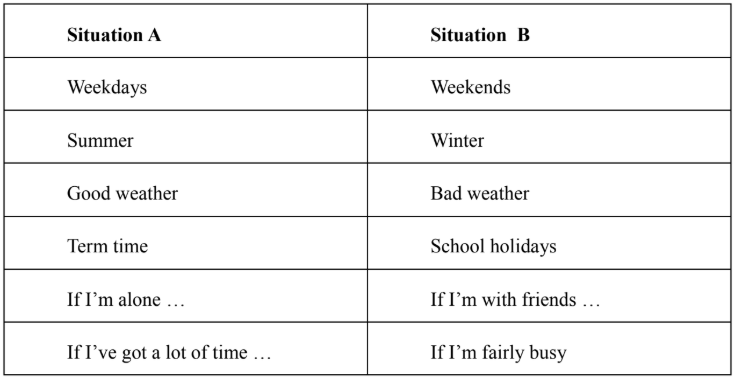
(5) Now you can compare situation A with situation B. Add a compare linking phrase:
Whereas in contrast ...
Whereas on the other hand ...
Though, at the same time ...
While, oppositely ...
(6) Select one of the following:
If (situation B) ... then it’s more likely that I’ll ...
If (situation B) ... then it’s almost certain that I will ...
If (situation B) ... then I will almost always ....
If (situation B) ... then I will most certainly ...
Example
―Well to be honest, I think I would have to say that it really depends. Like for
instance, if I have the money, then it’s quite possible that I will watch a movie in the
cinema, two or three times a month. You know cinema tickets are pretty pricey in China. Whereas in contrast, if I’m broke, it’s more likely that I’ll watch movies at home on DVD; you probably know that DVDs are quite cheap here, especially compared to the price of a cinema ticket.‖
How often do you go to the cinema?
Where do you usually go shopping?
When do you usually read?
At what time of day do you usually listen to music?
Who do you spend your evenings with?
When do you go out in the evenings, what do you usually do?
How often do you play sports?
How often do you eat in restaurants?
“Yes/No” Question
Look at the following examples:
Do people wear special clothes at weddings in your country?
Is watching TV a popular activity in your country?
A better answer is to answer BOTH ―Yes‖ and ―No‖. By doing this you will produce a response with better quality language structures.
(1) First, use an opening phrase:
Well in actual fact, if I think about it, I guess that in many ways ...
OK, well in reality, I suppose that to some extent ...
Alright, I guess that on the one hand ...
Well certainly in some ways ...
(2) Now make your first statement (eg, It’s fairly important ...). Develop the first statement using a linking structure:
... especially when you consider that ...
... particularly if you think about the point that ...
...especially with regard to the point that...
...and this is definitely the case with...
(3) Now you need to introduce your ―No‖ answer. First use a linking phrase:
But you also have to understand that ...
Even so, you could also say that ...
At the same time you could say that ...
(4) After describing your ―No‖ answer, you can ―round-off‖ the answer with one of the following phrases:
So all in all I guess my answer would have to be yes and no.
So on the whole I suppose the answer has to be yes and no.
So all things considered I guess the answer is both yes and no.
So in the main, I suppose the answer is probably yes and no.
Some "Yes / No" questions in Part One cannot use this "Yes and No" style of response. Look at the following questions:
Is watching TV a popular activity in your country?
Can you play a musical instrument?
Are friends important to you?
With questions like this it may be difficult to answer both yes and no. It is probably much easier to give a "Yes" answer. Use the structures given to introduce your "Yes" idea and then develop this single idea with one or two reasons or details.
“Would” questions
Look at the following questions:
Would you like to move to another city, in the future?
Would you like to change your job?
The grammar aspect of these questions is very important. As a basic rule, if the question uses "would", then you need to include at least one example of "would" (or might/could) in your answer.
For most of these questions, you should use the second conditional tense in your answer. In fact the examiner is expecting you to produce an example of this verb tense.
The form of the second conditional is quite simple:
If + past simple, would / could / might + infinitive verb.
eg: If I lived near the sea, I would be able to eat fresh seafood.
If I had the time, I would go for travelling.
Think of one basic second conditional structure for each question: use positive
sentences. Try to use different words for each example.
eg: "Would you like to move to another city in the future?"
"I would like to change cities if I had the chance." Or "If I had the chance I would
like to move to another city."
"Would you like to move to another city in the future?"
"I would like to change cities if I had the chance, because if I lived in a different
city I would make lots of new friends and I could try lots of new kinds of food. Also I
might be able to find a well-paid job.‖
Notice how the first structure used "verb+ing": "I suppose I would possibly
consider moving cities ..."
This structure is much more complex than the basic: ―I suppose I would like to
move to another city...‖
Try to use one of the following structures for your first structure.
I imagine I would possibly think about (verb + ing)...
I guess I would maybe contemplate (verb + ing)...
I would perhaps reflect on (verb + ing)...
PART 2
Structure 4 part
Your overall answer will look something like this:
1. Linking phrase + prompt + linking phrase + details + connective...
2. Linking phrase + prompt + linking phrase + details + connective...
3. Linking phrase + prompt + linking phrase + details + connective...
4. Linking phrase + prompt + linking phrase + details + connective...
A. Opening phrase + the first prompt from card
Ok then, I guess I could start off by answering who the person is...
Alright then, in response to the first question of who the person is...
So to begin with, in reply to the initial point of who the person is...
Ok, I’ll start the ball rolling by touching on the matter of who the person is...
Right then, I’d like to get cracking by pointing out who the person is...
So I suppose I should commence with the first aspect which is who the person is...
Initially then, I’d like to get started by looking at who the person is...
So, to start with I’ll talk about who ethe person is...
So I guess I could kick off by stating who the person is...
Ok so my first point here would obviously be who the person is...
Before you add your content sentence, you need to add another linking phrase:
... and I think I would have to choose... ... and I’d have to go for...
...and I’d probably select... ...and my choice is going to be...
B. The second point + the second prompt from card
Going on to my next point which is why he is famous...
Continuing then with the next point of why he is famous...
Now with regard to the next question of why he is famous...
Next then in response to the point of why he is famous...
Now on the subject of why he is famous...
Now concerning the matter of why he is famous...
Before you explain this point you need to add a second linking phrase (similar to
your first point).
... and what I’d like to add here is that ...
... and what I need to emphasize here is that...
.. and what I ought to stress here is that..
...and the thing that needs to be highlighted here is that..
...and what I have to mention here is that ...
C. The third point + the third prompt from card
Progressing to the subject of why I would like to meet this celebrity...
Moving onto the business of why I would like to meet this celebrity...
Drawing attention to the matter of why I would like to meet this celebrity...
Proceeding with the issue of why I would like to meet this celebrity...
Moving forward onto the area of why I would like to meet this celebrity...
Now add your second linking phrase:
I would like to explain that...
You really have to understand that...
I suppose I should underline the fact that....
D. The fourth point + the fourth prompt from card
Finally then, if there’s time, I could deal with the last question of...
To end with, if I still have time, I could take care of the final question of...
As a final point, if time permits, I’d like to bring in the point of...
To cut a long story short, as my very last point, with reference to the question of...
It will probably unnecessary to develop this point because hopefully the examiner will stop you around this point.
Most people find that when they use this method, they reach the two-minute mark just after saying this final linking phrase.
TOPIC
SECTION 1: PEOPLE
People 4: A character from a story / film / TV programme
Describe a character from a story / film / TV programme
You should say:
Who the character is
When you first saw or heard this story / film / TV programme
What kind of person this character is
Why you like this character.
Topic: Baba
Grammar: present tense, past tense for when you read the story
Word: wealthy person, strong and independent, however a little reserved.
He had a good heart
how he use his strength he has to protect his family
I guess I could start off by answering who the character is, and I’d have go for the father in the kite runner. This is one of my favorite novel of all time and this character leave a lasting impression. Continuing with the next point of when I first read this story, what I have to mention is that I read this novel when I was in the second year at university. Actually before reading this book, I’ve heard about it a countless of time from other people, because it’s really famous. So as a book lover, I thought to myself that I have to give it a go.
Moving forward to the area of what kind of person this character is, and I’d have to mention is that he’s a wealthy businessman, and he is a strong and independent person. He had to raise his son by himself as his wife passed away right after giving birth to his child. However, he is a little conservative. Because the book is told from the son’s perspective, so I remember there are some parts that he shows the disappointment toward his son just because his son doesn’t as strong as him, and because he is differently from others son for example instead of going out for football or play with friend, he choose to stay at home, read book and write story.
If I still have time, I could bring in the point of why I love this character, it is because, he had a really good heart. Throughout the story, there are many time he has helped people around him, he even built a orphanage. And as I mentioned before, he is very strong, so I love how he uses his power to protect his family, like no one could hurt his loved ones.
PART 3
Remember the basic rule should always be : begin with a linking phrase, introduce an idea then develop it a linking structure. Do not list ideas. Separate your ideas with linking phrases. Most Part Three questions only need 3 ideas.
TYPE 1: COMPARING
Time comparison
Are houses nowadays, the same as houses 30 years ago in your country?
(This type of comparison question requires the use of mixed tenses).
Social group comparison
Do men and women like the same types of books?
Do old and young people like the same holidays?
Geographic comparison
Are houses in North China are same as houses in South China?
For this question type you need to use ―comparative‖ structures.
Begin with an opening linking phrase
Well obviously ...
Well clearly ...
Sure, without a doubt ...
Well undoubtedly ...
Well unmistakably ...
Unquestionably .....
Now say that there are some differences
There are a number of underlying differences here.
There are a variety
Now introduce the first difference:
However, I guess that the most significant would be that ...
Mat Clark – IELTS Speaking
171
Though I suppose the most obvious would be that ...
But I would say the most fundamental would be that ...f possible differences here.
There are a range of potential distinctions here.
Now introduce the first difference
However, I guess that the most significant would be that ...
Though I suppose the most obvious would be that ...
But I would say the most fundamental would be that ...
Now use a sentence to describe the first difference
Develop this first difference with a simple linking word: especially, particularly, in
fact, such as, for example, specifically.
Now use your first comparative linking structure
Whereas on the other hand ....
On the contrary ...
Though quite the opposite ...
Now add your next sentence
For example, ―...women are generally more keen on ...
Develop the second part of the first difference with a simple linking word: especially,
particularly, in fact, such as, for example, specifically.
So you have described one difference. Now you need to introduce a second difference.
Begin with a linking word:
In addition ...
Additionally ...
As well as this ...
On top of this ....
Moreover ...
After that ...
Say there is another important difference
... a second key distinction would be that ...
... a subsequent contrast could be that ...
... a futher distinction might be that ...
Are schools nowadays the same as schools in the past?
Are TV programmes nowadays the same as TV programmes in the past?
TYPE 2: PREDICTING
Now you will build your own ―predicting answer structure‖.
Begin with an opening linking phrase:
Certainly, I’m sure that most people would agree that there will be a number of major changes related to this.
I’m sure that in years to come we will be a number of major changes related to this.
I reckon that in the not so distant future, we will witness some major changes with regard to...
Introduce your first prediction:
Initially, I guess that we might begin to see...
To begin with, I’d predict that we will most likely have...
Primarily, it looks quite probable that we are going to have...
First of all, I would envisage that we are going to have...
Use a sentence to describe your first prediction. Try to use basic future tenses when giving details. Try to develop the sentence with a basic linking word.
―Initially, I guess that we might begin to see houses that are made of plastic materials
because these will be much cheaper and easier to construct.‖
Now introduce your second prediction.
At the same time, I suppose it’s quite probable that we may have...
As well as this, some people claim that we will probably start to see...
On top of this, I imagine it’s quite likely that we will soon have...
Likewise, I would imagine that we may even be able to see.
Use a sentence to describe your second prediction. Try to use basic future tenses
when giving details. Try to develop the sentence with a basic linking word.
―At the same time, I suppose it’s quite probable that we may have houses that are
controlled by computer because this will make home life much easier.‖
Now introduce your 3rd prediction. It is now always possible to make 3 realistic predictions, so you can make your final one quite unrealistic.
And who knows, it could even be possible that we’ll see the arrival of ...
And you never know, it could even transpire that we’ll have...
And I know it’s a bit of a crazy thought, but one day we may even have...
And who knows, there’s even a chance that we will have...
TYPE 3: WHY QUESTION
Now build your own ―why structure.
Begin with a linking phrase:
Well in my opinion I guess I would have to say that...
Well in my view, I suppose I would say that...
Will in my estimation, I guess that...
Well generally it’s my belief that...
Now use a structure to say that ―there are many reasons‖:
There are probably a number of factors involved.
There are obviously a number of motives surrounding this idea.
There are unquestionably a number of explanations for this.
There undoubtedly a variety of justifications behind this.
Now introduce the first reason:
The chief cause might be that...
The main basis is probably because///
Introduce the second reason‖
As well as this, a subsequent factor could be because...
At the same time, a secondary motive could be that...
Additionally, a further rationale might be due to the fact that...
If you want to talk about a third reason, you can use a similar structure to the ones
above. Remember try not to repeat the vocabulary, i.e. if you have used ―factor‖ in one
sentence, in your next sentence use a different word, e.g. ―motive‖. The more ―reason‖
words you use, the higher your vocabulary score.
TYPE 4: ADVANTAGES
Now create your own ―advantages‖ structure. (You will build a structure that develops
each advantage.)
Begin with an opening linking phrase that explains that ―there are many advantages‖.
Well I suppose that there are quite a few clear benefits.
Clearly there are a number of obvious merits.
Sure there are few favorable aspects.
Obviously there are a number of positive features.
Now highlight the most obvious:
But I would probably say that for the most part, the one things that really stands out is that...
But it goes without saying that the most apparent would be that...
Although I guess that the most visible would be that ...
However, I guess that the most evident would be that...
Add a simple sentence which describes the advantage: ―...trains are really cheap...‖
Now develop this advantage with one of the following structures:
This is obviously favorable because...
This is undoubtedly positive for the simple reason that...
This is without doubt beneficial because...
Add a simple sentence to explain why it is an advantage: ―...you can travel from one side China to the other for a few hundred yuan...‖
Now introduce your second advantage:
At the same time a second bonus might be that...
Besides this, a second plus point could be that...
As well as this a further favorable aspect would be that...
Add a simple sentence to explain the advantage and develop it with one of the following:
This is clearly advantageous because...
This is definitely valuable since...
This is surely a positive feature because...
For most questions, two advantages should be enough to produce a good quality answer. There is no need to list every advantage.
A common problem for this type of question is when candidates also try to describe disadvantages in their answer. This is unnecessary because usually (now always) the examiner will ask about disadvantages in the next question.
TYPE 5: DISADVANTAGES
Begin with a linking structure to explain that there are some disadvantages:
I think it’s fair to say that there are few negative aspects
I’m sure most people would agree that there are some drawbacks.
Of course there are a couple of shortcomings.
Now introduce your main disadvantage:
I guess the most impractical characteristic would be that...
I suppose the most unfavorable quality might be that...
Unquestionably, the most adverse feature would be that...
Describe the main advantage with a simple sentence, for example ―...trains are often overcrowded...‖
Now use a linking structure to develop this disadvantage:
Most people would agree that this is problematic because...
This is an obvious weakness because ...
This is a clear limitation because...
Add a simple sentence to explain why it is a disadvantage, for example: ―... on a long journey you might not be able to find a seat.‖
Now describe your second disadvantage.
Correspondingly, an additional weak point may be that...
Supplementary to this, a further handicap may be that ...
At the same time, another stumbling block might be that ...
Add a simple sentence and develop it with one of the following structures:
And the trouble with this is that ...
And this can be a hassle because...
This is usually an aggravation because...
So a complete answer to the question might look like this:
―What are the disadvantages of train travel?‖
―I think it’s fair to say that there are a few negative aspects. I suppose the most unfavorable quality might be that trains are often overcrowded at certain times of year. This is a clear limitation because on a long journey you might not be able to find a seat which means you have to stand up for hours. At the same time, another stumbling block might be that train tickets are sometimes difficult to buy, especially around Spring Festival, and this can be a hassle because it means you can’t always travel on the actual day that you want to.‖ When the examiner hears this answer, the first thing he will notice is the appropriate disadvantage language: negative aspects, unfavorable quality, clear limitation, stumbling block, hassle. Because you have used these words in complex linking structures, it affects your score in three ways: fluency-grammar-vocabulary.
TYPE 6: PROBLEMS
As you should now understand, your aim here is to present two problems using appropriate ―problem‖ vocabulary.
Begin with an opening linking phrase to explain that there are problems:
Obviously we can say there are quite a lot of dangers with regard to this issue.
It’s universally accepted that there are a few hazards involved with...
This issue is weighed down with a hew problems.
Now highlight your main problem:
At the outset, the most crucial predicament is that...
First and foremost, one major worry is probably that...
Essentially, one fundamental concern is probably that...
Add a simple statement and develop it with one of the following structures:
This is clearly alarming because...
This fact is unmistakably perturbing because...
This need to be seen as a sensitive matter because...
Now introduce your second problem with one of the following linking phrases:
Additionally, another major cause for concern has to be the fact that...
Equally worrying is the suggestion that...
Another matter which causes unease is the point that...
Add a simple statement and develop it with one of the following:
And the short-term and / or long-term implications of this are that...
And the underlying repercussions of this are that...
And the principal upshot of this is probably that...
So a final answer to our first question might look like this:
―It’s universally accepted that there a few hazards involved with the increase in the
use of private cars. Essentially, one fundamental concern is probably that it leads to an
increase in pollution. This fact is unmistakably perturbing because we are facing huge
global pollution problems at the moment.
Additionally, another major cause for concern has to be the fact that cars consume
huge amounts of our energy resources. And the underlying repercussions of this are that we
will soon be confronted with a global energy crisis.‖
TYPE 7: SOLUTIONS
First, begin with a general statement :
In my view there are a number of actions that could be taken.
I honestly believe that there are a few ways to tackle these problems.
Well I think we could go about this in a number of ways.
Highlight your first solution:
When dealing with first problem, it is the easiest way to work it out would be to..
In reaction to the initial issue, the most effective way to get to the root of the problem
would be to...
Give a brief statement to explain the solution. Now offer a solution to the second problem.
Now taking into account the second challenge, the only way to get to the bottom of this dilemma would be to...
So the complete answer might look like this :
― what are the problems associated with the increase in car use ? ―
(See answer to previous problems)
How could these problems be solved ?
―In my view, there are a number of actions that could be taken. When dealing with the
first problem, the easiest way to work it out would be to develop new technology for car
engines which does not cause serious air poluttion, maybe some special kind of exhaust
filter. Taking on the second problem, the most successful way to confront this would be to
invest heavily on research into alternative energy resources. In fact, I have heard that we
have already produced a car which runs on water.‖
If you are confident enough, you might want to develop these points further, but don’t do it if you are not sure that you have the vocabulary to continue producing good quality language. It is better to produce a medium length that is accurate in its language than a longer answer that contains many mistakes.
Go back to problems question section and practise your ―solution‖ structure for the problems that you thought about for each example question.