11.2: The Psychoanalytic Perspective on Personality
Sigmund Freud: one of the most influential figures of the 20th century and founder of psychoanalysis
Psychoanalysis: Freud’s theory of personality that stresses the influence of unconscious mental processes, the importance of sexual and aggressive instincts, and the enduring effects of early childhood experience on later personality development
The Life of Sigmund Freud
He was born in 1856 in the Czech Republic and moved to Vienna when he was four
He studied medicine, became a physician, and was an outstanding physiological researcher
He was among the first investigators of the new found drug at the time—cocaine
One of his daughters, Anna Freud, later became an important psychoanalytic theorist
Influences in the Development of Freud’s Ideas
Freud’s theory evolved during the decades of self-analysis as well as observation of patients in his private practice
Free association: a psychoanalytic technique in which the patient spontaneously reports all thoughts, feelings, and mental images that arise, revealing unconscious thoughts and emotions
In 1900, Freud published what many consider his most important work, The Interpretation of Dreams. By the early 1900s, he had developed the basic tenets of his psychoanalytic theory and was gaining recognition.
His final decades were tragic, as he fled to London with family members as the Nazis rose to power, and he eventually died of cancer.
Freud’s Dynamic Theory of Personality
He saw personality and behavior as the result of a constant interplay among conflicting psychological forces
Believed that these psychological forces operate at three different levels of awareness: conscious, preconscious, and unconscious.
Conscious Level: All thoughts, feelings, and sensations that you’re aware of at this moment
Preconscious Level: Information that you’re not currently aware of but can easily bring to conscious awareness, such as memories of recent events
Unconscious Level: (Bulk of this psychological iceberg), Freud’s term to describe thoughts, feelings, wishes, and drives that are operating below the level of conscious awareness
You’re not directly aware of these thoughts, but the unconscious exerts an influence on your conscious thoughts and behavior
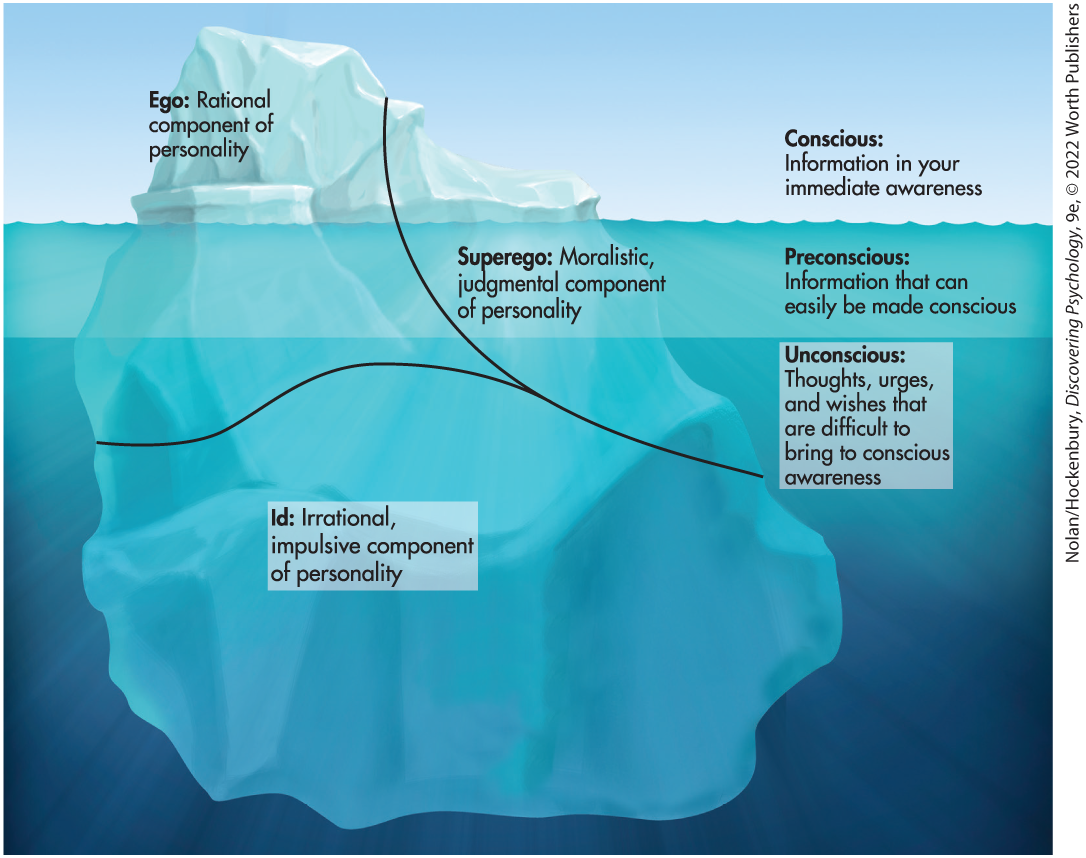
Freud believed that unconscious material often seeps through to the conscious level in distorted, disguised, or symbolic forms.
Ex.) Unconscious wishes and conflicts can be discovered in dreams and free associations
He also believed that the unconscious can be revealed in unintentional actions such as accidents, mistakes, etc.
The Structure of Personality
Freud believed that there are 3 basic structures of personality—id, ego, and superego
ID: the completely unconscious irrational component of personality that seeks immediate satisfaction of instinctual urges and drives
Connected to the biological urges that perpetuate in humans and species—hunger, thirst, sexuality, physical comfort
the ID is ruled by the pleasure principle
Pleasure Principle: the fundamental human motive to obtain pleasure and avoid tension or discomfort
The ID strives to increase pleasure, reduce tension, and avoid pain
Freud believed that the newborn infant is completely driven by the pleasure principle and wants their needs addressed immediately. But the external world can’t or won’t always immediately satisfy the needs.
Ego: In Freud’s theory, the partly conscious rational component of personality that regulates thoughts and behavior, and is most in touch with the demands of the external world
Operates on the reality principle
Reality Principle: the capacity to postpone gratification until the appropriate time or circumstances exist in the eternal world
Ex.) A child may learn to wait their turn rather than pushing a child off the swing from a scolding by their parent
In early childhood, the ego must deal with external parental demands and limitations. Implicit in those demands are the parents’ values and morals. Eventually, the child encounters other advocates of society’s values. Gradually, these move from being externally imposed to internalized rules.
Superego: in Freud’s theory, the partly conscious, self-evaluative, moralistic component of personality that is formed through the internalization of parental and societal rules
Evaluates the acceptability of behavior and thoughts, then praises or admonishes
The Ego Defense Mechanisms: Unconscious Self-Deceptions
The ego has a difficult task of needing to be strong and resourceful to mediate conflicts among the instinctual demands of the id, the moral authority of the superego, and external restrictions
When the demands of the id or superego threaten to overwhelm the ego, anxiety results
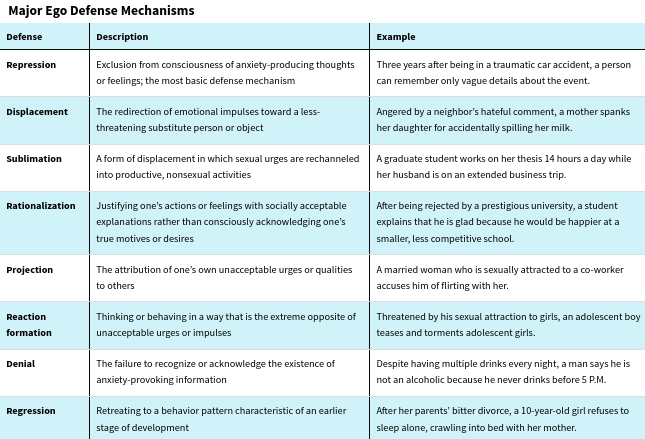
Defense Mechanisms: largely unconscious distortions of thoughts or preceptions that act to reduce anxiety
By resorting to defense mechanisms, the ego can maintain an integrated sense of self while searching for a more acceptable and realistic solution to a conflict between the id and superego
Repression (most fundamental defense mechanism): the unconscious exclusion of anxiety-provoking thoughts, feelings, and memories from conscious awareness
Repression is unconscious forgetting
Ex.) Traumatic events, embarrassments, disappointments, unacceptable urges, episodes of pain or illness
Repression is not an all-or-nothing psychological process
“The repressed material retains its impetus to penetrate into consciousness.”
- Freud
Displacement: the defense mechanism that involves unconsciously shifting the target of an emotional urge to a substitute target that is less threatening or dangerous
Ex.) An employee angered by a supervisor’s unfair treatment may displace their hostility onto family members when they come home from work. The employee consciously experiences anger but directs it towards someone other than the target, which remains unconscious.
Personality Development: The Psychosexual Stages
Psychosexual Stages: age-related developmental periods in which the child’s sexual impulses are focused on different body areas and are expressed through the activities associated with those areas
People progress through five psychosexual stages of development. The foundations of adult personality are established during the first 5 years of life, as the child progress through oral, anal, and phallic psychosexual stages and latency, genital in adolescence.
Fixation: Unresolved Developmental Conflicts
The young child is faced with developmental conflict that must be successfully resolved in order to move on to the next stage
The result of an unresolved developmental conflict is fixation at a particular stage. The person continues to seek pleasure through behaviors that are similar to those associated w/ that psychosexual stage
The Oedipus Complex: A Psychosexual Drama
Oedipus Complex: A child’s unconscious sexual desire for the opposite-sex parent, usually accompanied by hostile feelings towards the same-sex parent
As the child becomes more aware of pleasure, he believed that the child develops a sexual attraction to the opposite-sex parent and hostility towards the same-sex parent
He was named after Oedipus who was abandoned at birth, and he did not know his parents’ identity. As an adult, he unknowingly killed his dad and married his mom
According to Freud, this attraction to the opposite-sex parent plays out as a sexual drama in the child's mind.
Identification: a defense mechanism that involves reducing anxiety by imitating the behaviors and characteristics of another person
Example: a son imitates and internalizes his father’s values, attitudes, and mannerisms
Freud said girls also ultimately resolve the Oedipus complex by identifying with the same-sex parent.
He felt that b/c of the intense anxiety associated with the Oedipus complex, the sexual urges of boys and girls become repressed during the latency stage in late childhood. Children in this stage express a strong desire to associate with same-sex peers.
He believed that the incestuous urges of the Oedipus complex start to resurface in adolescence, but are prohibited by the moral ideals of the superego as well as societal restrictions. So the person directed their urges toward socially acceptable substitutes that resemble the person’s parent
The Neo-Freudians: Freud’s Descendants and Dissenters
Freud’s ideas were always controversial. But by the early 1900s, he had attracted a number of followers, many of whom went to Vienna to study with him. These early followers developed their own personality theories, but they kept the foundations that Freud had established. These theorists were often called Neo-Freudians
In general, the neo-Freudians didagreed with him on three key points:
1.) They took issue with Freud’s belief that behavior was primarily motivated by sexual urges.
2.) They disagreed with his contention that personality is fundamentally determined by early childhood experiences
Believed that personality can also be influenced by experiences throughout the lifespan
3.) The neo-Freudian theorists departed from Freud’s generally pessimistic view of human nature and society
Carl Jung: Archetypes and the Collective Unconscious
Carl Jung was fascinated by myths, folktales, adn religions of many cultures
He was drawn to the new field of psychiatry because he believed it could provide deeper insights into the human mind
He beliebed that people are motivated by a more general psychological energy that pushes them to achieve psychological growth, self-realization, and psychic wholeness and harmony
Collective Unconscious: in Jungs theory, the hypothesized part of the unconscious mind that is inherited from previous generations and that contains universally shared ancestral experiences and ideas.
He described the collective unconscious as containing “the whole spirtual heritage of mankind’s evolution, born anew in the brain structure of every individual”
Contained in these are the archetypes; mental images of human themes and experiences
His concepts have been criticized as being unscientific or mystical
Karen Horney: Basic Anxiety and “Womb Envy”
Karen Horney (HORN-eye) who was a trained Freudian psychoanalyst. She found that her patients were much more worried about their jobs and economic problems than their sex lives like Freud claimed.
She came to stress the importance of cultural and social factors in personality development that Freud ignored.
She stressed the importance of social relationships, especially the parent-child in the development of personality.
She believed that disturbances in human relationships, not sexual conflicts, were the cause of psychological problems
She disagreed that women suffered from penis envy, and that women actually envied their superior status in society
Horney even contended that men suffer womb envy, envying their capacity to bear children
Alfred Adler: Feelings of Inferiority and Striving for Superiority
Alfred Adler was a very sick child but overcame his weaknesses through studying medicine where he became associated with Freud.
From the beginning, he disagreed with Freud’s on many issues. Adler emphasized much more importance of conscious thought processes and social motives
He believed the most fundamental human motive is striving for superiority: the desire to improve oneself, master challenges, and move toward self-perfection and realization.
Evaluating Freud and the Psychoanalytic Perspective on Personality
Reasons why Freud’s theories suck
1.) Inadequacy of Evidence
2.) Lack of Testability
3.) Sexism