Selective Breeding
Natural selection occurs when populations have genetic variations. Some variations are an advantage over others to the population in its particular environment. These advantages may help the organism to catch prey, avoid predators, find mates, or survive environmental changes. Those individuals that possess the most advantageous characteristics live to a reproductive age and are able to pass those characteristics to their offspring through their genes. Selective breeding , as practised by humans for thousands of years, is a form of selection and another bit of evidence for evolution. In contrast to natural selection, this form is artificial and is often referred to as artificial selection. Humans select the animal or plant with the best characteristics and try, through genetic crosses, to create a breed or plant line that retains these desired characteristics. The differences between the 'wild' ancestor and the present day organism (created through artificial selection) can be enormous.
Definition
Natural selection : Natural selection occurs when species have variation and certain traits are selected because they help the species to reach a reproductive age and pass on their genes.
Selective breeding : A form of artificial selection in which organisms with certain characteristics are chosen by humans because they are of some benefit. These organisms are bred to produce offspring that have the same genes and, therefore, the same characteristics.
Be aware
Artificial selection only happens through human intervention.
The difference between the two is that natural selection occurs in nature, but selective breeding only occurs when humans intervene.
Here are two examples of selective breeding:
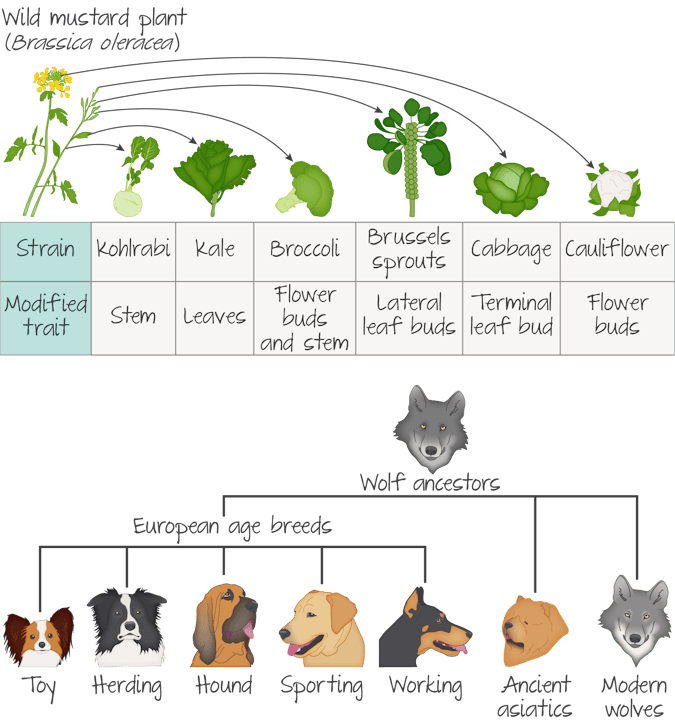
Figure 1. Artificial selection in plants and in dogs.
Exam tip
You are expected to understand how selective breeding of domesticated animalsshows how artificial selection can cause evolution.
If we consider selective breeding of dogs, it becomes very obvious that artificial selection can cause evolution. First of all, we should note that, most, if not all, breeds of household dogs that exist today are the products of selective breeding. The original bloodline is from wolf-like animals. It is thought that the most docile wolves were accepted around human campsites, which was an advantage to the population because they were able to feed on the scraps of food that humans threw out. The wolves that were able to eat could live to a reproductive age and pass on this docile gene to their offspring. This is an example of natural selection, but once humans realised that these animals could be of use to them they began to breed them for these docile traits so that they could be tamed and trained and the domestic dog evolved. Now dogs are continually bred for traits that benefit humans, from the fastest dogs for racing to work dogs to cute companions, there is a lot of variety in the domestic dog species and over 400 breeds exist today. When we compare the inheritable physical features of domesticated dogs with wolves (refer to Figure 2 ), it is clear that evolution has occurred.
Definition
A breed is a group of animals within a species that have specific and similar characteristics.
Today's domestic dog is actually a subspecies of the gray wolf. The scientific name of this wolf is Canis lupus, while domestic dogs are called Canis lupus familiaris or simply Canis familiaris.
As shown in the case of dogs, following several generations of selective breeding, domesticated breeds can differ a lot from their wild ancestors. Selective breeding also accelerates the evolutionary process, as evolutionary changes become visible in a much shorter time interval than might have occurred through natural selection.
Some examples of selective breeding are:
- Breeding egg-laying hens to lay lots of eggs
- Breeding race horses for speed
- Breeding dogs for herding, hunting or simply for specific physical features
- Breeding cattle for increased meat or milk production
- Breeding of crops to be disease- or cold-weather-resistant in order to increase production
- Breeding of plants to produce larger and sweeter fruits.
As with natural selection, variation is the key to selective breeding. Selective breeders, for example farmers or dog breeders, use these variations to pick and choose advantageous traits, breed the organisms, thereby causing the frequency of the trait or alleles to become more common in the following generations. This is strong evidence for microevolutionbecause of the speed in which we can see and measure the results. Differences in breeds show that selection, whether natural or artificial, can cause change in a species.
Definition
Microevolution occurs on a small scale within a species.