Burning Sappho Quote Notation
“The child is fed, and sleeps. The dishes / are washed, and the clothes are ironed and aired.”
Context of production and reception: Written in the late 1950s/early 1960s in suburban Tasmania; reflects post-war Australia’s idealised image of the perfect housewife and mother.
Genre Expectations (form and subject matter): Domestic confessional poetry; repetitive refrain mimics the endless cycle of housework and childcare.
Style/Stylistic Choices: Flat, mechanical listing creates monotony and irony; highlights the soul-destroying routine.
Characterisation and Setting: Narrator trapped in the spotless suburban home; domestic labour defines and exhausts her.
Narrative POV: First-person intimate voice reveals the gap between perfect exterior and inner resentment.
Language patterns: Parallel structure and repetition (monotonous rhythm), passive voice, simple declarative sentences.
Readings: Feminist (critique of unpaid domestic labour), Marxist (alienation through repetitive work).

“Something like hatred forks between / my child and me.”
Context of production and reception: Highly controversial at the time for breaking the taboo of maternal ambivalence.
Genre Expectations: Subverts the romanticised mother-child bond in mid-20th-century Australian poetry.
Style/Stylistic Choices: Brutal honesty shocks and creates uncomfortable recognition in the reader.
Characterisation and Setting: Complex, realistic mother-child relationship full of love mixed with resentment.
Narrative POV: Private admission only possible in the speaker’s secret writing.
Language patterns: Metaphor “forks” (lightning/sudden division), qualified “something like” (shows guilt).
Readings: Feminist (taboo maternal anger), Psychoanalytic (ambivalence and guilt in motherhood).

“Inside my smile a monster grins / and sticks her image through with pins.”
Context of production and reception: Harwood used a pseudonym to safely express rage that polite society would condemn.
Genre Expectations: Gothic horror elements inside domestic lyric poetry.
Style/Stylistic Choices: Vivid violent image creates powerful shock and empathy.
Characterisation and Setting: The “perfect mother” conceals a vengeful inner self.
Narrative POV: Reveals the monstrous double hidden from family and society.
Language patterns: Voodoo imagery, contrast between smile and monster, alliteration.
Readings: Feminist/Gothic (repressed female rage), Psychoanalytic (split personality / shadow self).

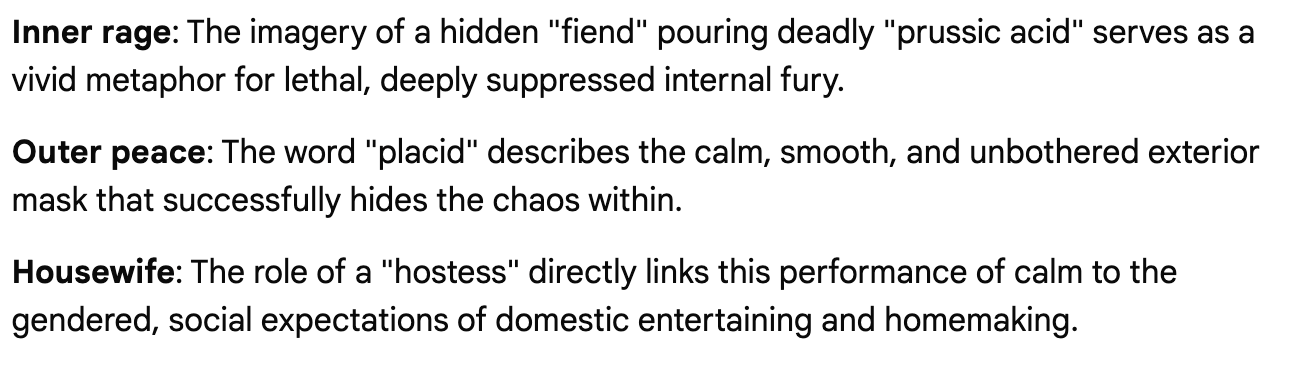
“Invisible inside their placid / Hostess, a fiend pours prussic acid.”
Context of production and reception: Captures pre-second-wave feminist female dissatisfaction and suppressed anger.
Genre Expectations: Dramatic revelation of inner violence beneath social performance.
Style/Stylistic Choices: Sudden escalation from calm to poison creates horror and intensity.
Characterisation and Setting: Placid suburban hostess vs murderous inner fiend; domestic space as site of psychological warfare.
Narrative POV: Speaker exposes what no one else can see.
Language patterns: Alliteration (“placid… pours prussic”), chemical poison imagery, enjambment.
Readings: Feminist (invisible female anger), Gothic (monstrous feminine), Psychoanalytic (repressed id).
“My husband calls me, rich in peace, / to bed. Now deathless verse, good night.”
Context of production and reception: Reflects 1950s–60s marital expectations and the constant interruption of women’s creative lives.
Genre Expectations: Ironic farewell to artistic ambition.
Style/Stylistic Choices: Bitter irony undercuts the romantic domestic moment.
Characterisation and Setting: Husband as both loving and obstructive; marital bed as another duty.
Narrative POV: Sarcastic resignation directed at the reader.
Language patterns: Heavy irony in “deathless verse, good night”, oxymoronic tone.
Readings: Feminist (marital/sexual duty vs artistic self), Autobiographical.

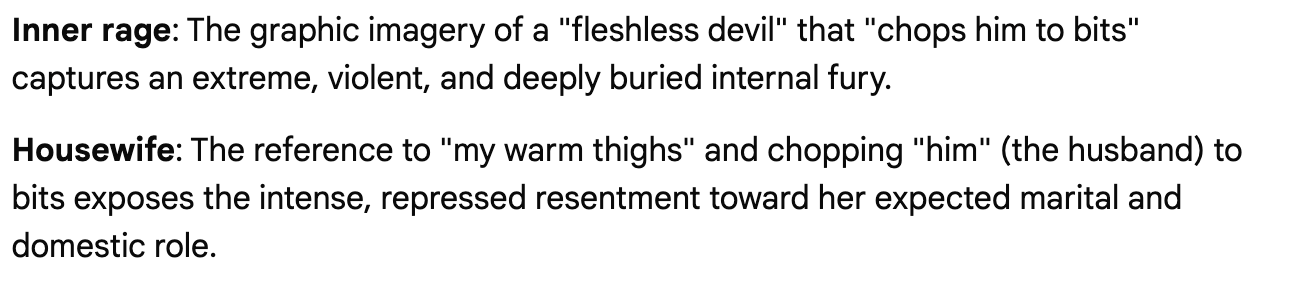
“In my warm thighs a fleshless devil / chops him to bits with hell-cold evil.”
Context of production and reception: Extremely bold and shocking sexual violence for its time.
Genre Expectations: Climactic violent fantasy that closes the poem.
Style/Stylistic Choices: Brutal, visceral image delivers maximum impact and horror.
Characterisation and Setting: Even in intimacy, murderous resentment remains; domestic bedroom becomes a site of fantasy revenge.
Narrative POV: Darkest private fantasy revealed only to the reader.
Language patterns: Violent verbs (“chops”), sensual/horrific contrast (“warm thighs” / “hell-cold evil”), alliteration.
Readings: Feminist (sexual resentment and power reversal), Psychoanalytic (repressed desire turned violent), Gothic.
“All is required, until one wins, / at last, this hour. I start to write.”
Context of production and reception: Harwood often wrote late at night after domestic duties were done.
Genre Expectations: Brief moment of hope in the cycle of frustration.
Style/Stylistic Choices: Sense of hard-won victory creates temporary relief.
Characterisation and Setting: The creative self fighting for existence against all demands.
Narrative POV: Shows the constant struggle and small triumphs of the writing self.
Language patterns: Determined tone, “until one wins” suggests battle, enjambment.
Readings: Feminist (battle for creative space), Existential (struggle for selfhood).

“Right now. Orion first begins / to show. Day’s trivial anger cease.”
Context of production and reception: Night as the only quiet time for the creative/intellectual woman in suburban life.
Genre Expectations: Lyrical shift offering temporary transcendence.
Style/Stylistic Choices: Beautiful cosmic imagery contrasts with domestic triviality.
Characterisation and Setting: Brief escape from the house into the vast night sky.
Narrative POV: Rare moment of calm and poetic voice emerging.
Language patterns: Astronomical imagery (Orion), sibilance and soft sounds for peace, “trivial anger” personifies the day.
Readings: Romantic (yearning for transcendence), Feminist (stolen creative time and space).
