Chapter 5: Puberty
Study notes
The time when an animal becomes sexually capable of producing fertile gametes and exhibiting adult reproductive behavior.
Should not be confused with REPRODUCTIVE MATURITY (sexual maturity) that point where the animals reached its maximum reproductive potential
Female
Usually considered first estrus
Factors to consider
Ex. Conception rates increased if heifers are bred on second estrus rather than first.
Gilts ovulate more at the second and third estrus than first.
Ewe lambs have a shorter breeding season than mature ewes and ovulate less.
Male
Appearance of enough sperm in ejaculate to impregnate females
Again fertility will continue to increase as male ages and sperm production will increase for sometime after puberty.
Factors to consider
Ex. Young males in a pasture mating system should be given fewer females to breed than mature males.
AVERAGE AGE AT PUBERTY
Sheep: 5-9 months
Pigs: 3-7 months
Cattle: 10-20 months
Horses: 15-24 months
Several factors influence age at puberty.
Bodyweight must be sufficient for puberty to occur even if age is reached.
Inadequate nutrition will delay puberty.
Breed can influence age and size at puberty.
Dairy heifers reach puberty at younger ages (11-12 months) and a lower % of adult weight(35%) than beef heifers(14-15 months and 45-55% weight).
Brahma based breeds reach puberty later than Bos taurus breeds.
In sheep, Romanovs are younger and smaller at puberty.
In pigs, a Chinese breed called Meishan reaches puberty at less than half the age of Western breeds.
Decreasing age at puberty is profitable to producers because animals can start returning investment earlier, and total lifetime production will be increased.
Selection for decreased age at puberty can be made. The heritability of age at puberty is much higher than other reproductive traits (.4).
A useful marker for age at puberty is the scrotal circumference.
Sires with large scrotal circumference tend to have progeny with decreased age at puberty.
Larger scrotal circumference indicates higher LH and FSH secretion, which induces puberty in males and females.
Puberty occurs because of increased LH, and FSH secretion stimulates the gonads to increase activity.
In prepubertal animals, gonadotropin secretion is very low, especially LH.
LH is more sensitive to the negative Feedback of steroids before puberty than after.
In males, the decreasing inhibition of LH by testosterone allows LH secretion to increase. LH increases testosterone.
Testosterone Effects:
Increases sperm production.
Stimulates accessory sex gland growth.
Increases male sexual behavior.
Produces male secondary sex characteristics.
FSH secretion also increases in males around puberty. This stimulates the Sertoli cell function.
Takes several weeks from the time of testosterone increase until fertile sperm are present in the ejaculate.
In females, estrogen has a powerful negative effect on LH before puberty. As puberty approaches, this effect weakens, and LH increases.
The increased LH allows follicles to develop to larger stages and produce more estrogen.
Higher estrogen levels eventually start the positive feedback effect and produce a LH surge.
This LH surge causes anovulation, but no estrus occurs because the animal has not seen progesterone before.
At the second ovulation, the female will show estrus and be considered pubertal.
Other factors can influence age at puberty.
Environmental Effects on Puberty
Heat stress will delay puberty in heifers.
Confinement raised gilts to reach puberty at much older ages and heavier weights than those raised outdoors.
Seasonal breeding species must reach the proper size during the right season, or else puberty will be delayed.
Fall born lambs do not reach puberty until about one year old.
By the time fall born lambs to reach the right size and weight, it is spring.
Sheep are short-day breeders, and the increasing day length will inhibit LH secretion until the next fall
Research has shown ewe lambs need to see a period of long days followed by short days to reach puberty.
Poor nutrition can delay puberty by inhibiting LH secretion
Bodyweight is more important than age in determining when puberty occurs.
minimal age must be reached, but small body size may delay puberty
The presence of intact adult males can decrease age at puberty.
Boar exposure often used to induce earlier puberty in gilts (about 160 days of age).
Ram exposure can induce puberty in ewe lambs.
Pheromones cause these effects on prepubertal females due to exposure to adult males.
Pheromone: a chemical substance used to communicate between members of the same species
Males detect pheromones given off at estrus.
Detected by Vomeronasal organ in the roof of the mouth.
The only pheromone isolated from farm species is the one given off by boars.
It is unknown if exposure to females will affect the age at puberty in males.
Poor nutrition will delay puberty in males, similar to females.
However, after puberty, male reproductive performance less affected by nutrition than females.
Section 1: how do we define puberty
Puberty: The time when an animal makes mature gametes and exhibits adult reproductive behavior
reproduction: a series of physiological (formation of gametes and hormones) and psychological (adult mating behavior) that must be properly timed (hormones) and begins at puberty
most mammals, puberty will arrive months or years after birth
Up until puberty all of the body’s energy is going into growing (including development and differentiation) and then maintaining the body frame
the reason the majority of immature animals have very low fat reserves: their rapid growth does not allow fat storage.
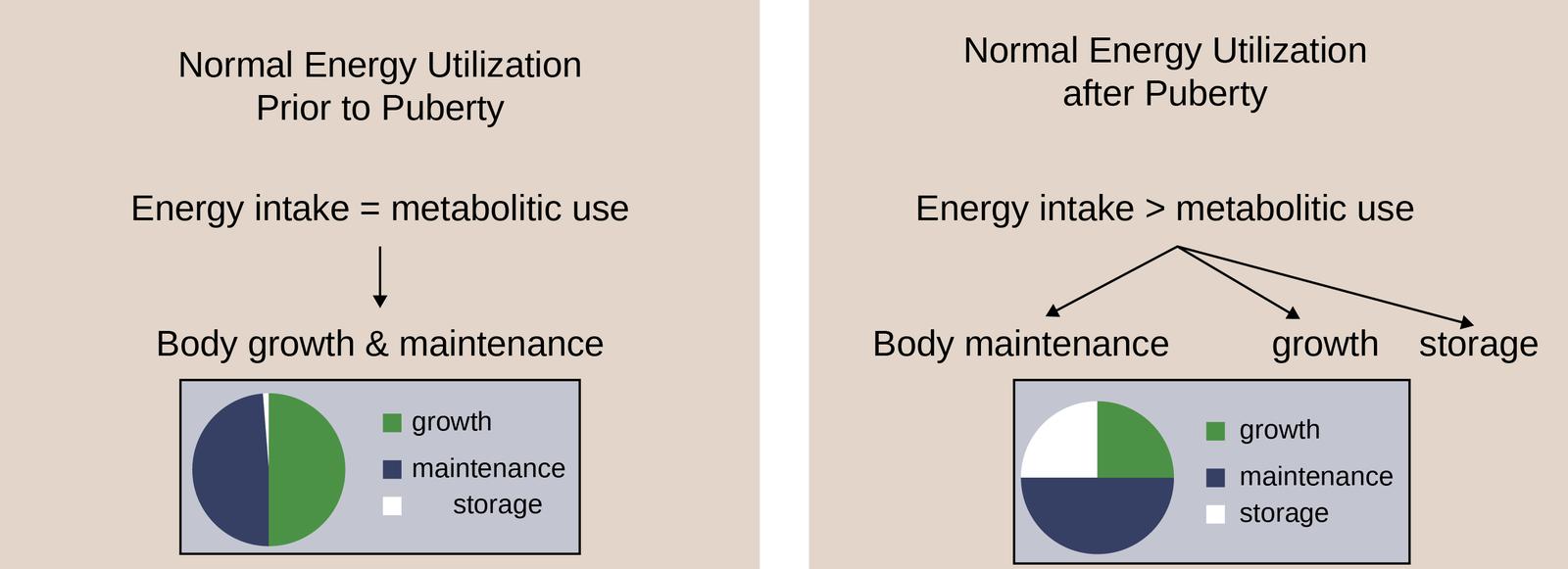
physiologically between the formation of gametes or the psychological behavior the psychological behavior happens first
Both gamete formation and psychological behavior are dependent on the hormones but it takes time to make mature gametes, so animals (especially male animals) may show mating behavior months before they can successfully reproduce
puberty just means an animal has reached the stage in their lives where they can potentially reproduce
Often a female animal will cycle once and then miss one or two subsequent cycles
just means her body is struggling to maintain the physiological conditions that allowed her to cycle the first time
When she reacts to the point where she has routine cycles we would say she has reached sexual maturity
Other factors, such as seasonality, may also play a role in when the animal reaches puberty
puberty will be the determining factor as to when they can think of these animals as possibly revenue generating instead of costing them money in feed and labor
Section 2: How do we define when an animal reaches puberty
to determine if an animal has reached puberty is different in the female than in the male
female: puberty is defined as the animal’s first estrus (first standing heat)
first standing heat may or may not be fertile
studies in heifers have shown conception rates increase dramatically when animals are bred on the second, rather than first heat
In pigs, gilts have been shown to ovulate more eggs on their second heat than their first
Ewe labs tend to have shorter seasons and ovulate less than mature animals.
Puberty in the male is harder to define
textbook definition is when a male has sufficient sperm to impregnate a female and exhibits mature male mating behavior (libido)
can test sperm counts although count alone cannot guarantee pregnancy
young males will continue to show increases in sperm concentration with age until the male reaches sexual maturity; which in males is defined as maximum sperm production
carefully limit the number of animals a young male is placed with to ensure the best chances of pregnancy
Given a normal growth environment (nutrients and weather conditions), we can estimate the time when our animals will arrive at puberty
note each species’ normal range is several months wide
there are a number of factors based on genetics, physiology, and environment, which will determine exactly when the animal arrives at puberty
Species | average age (in months) |
cattle | 10-20 |
horse | 15-24 |
sheep | 5-9 |
swine | 3-7 |
Section 3: Influence of genetics, weight, and body condition on puberty
two major components that control the onset of puberty within the body
genetic component that controls how fast the animal grows, hence the age at which an animal can enter puberty
addressed simply as weight, but it really involves more of the animal’s overall body condition
a rise in steroid hormones helps start puberty
rise is associated with the first mass storage of energy in fat, or more properly termed adipose tissue.
Besides storing fats, adipose tissue is capable of creating steroid hormones.
Therefore as there are more adipose cells created to store fats there are higher levels of steroid hormones in circulation.
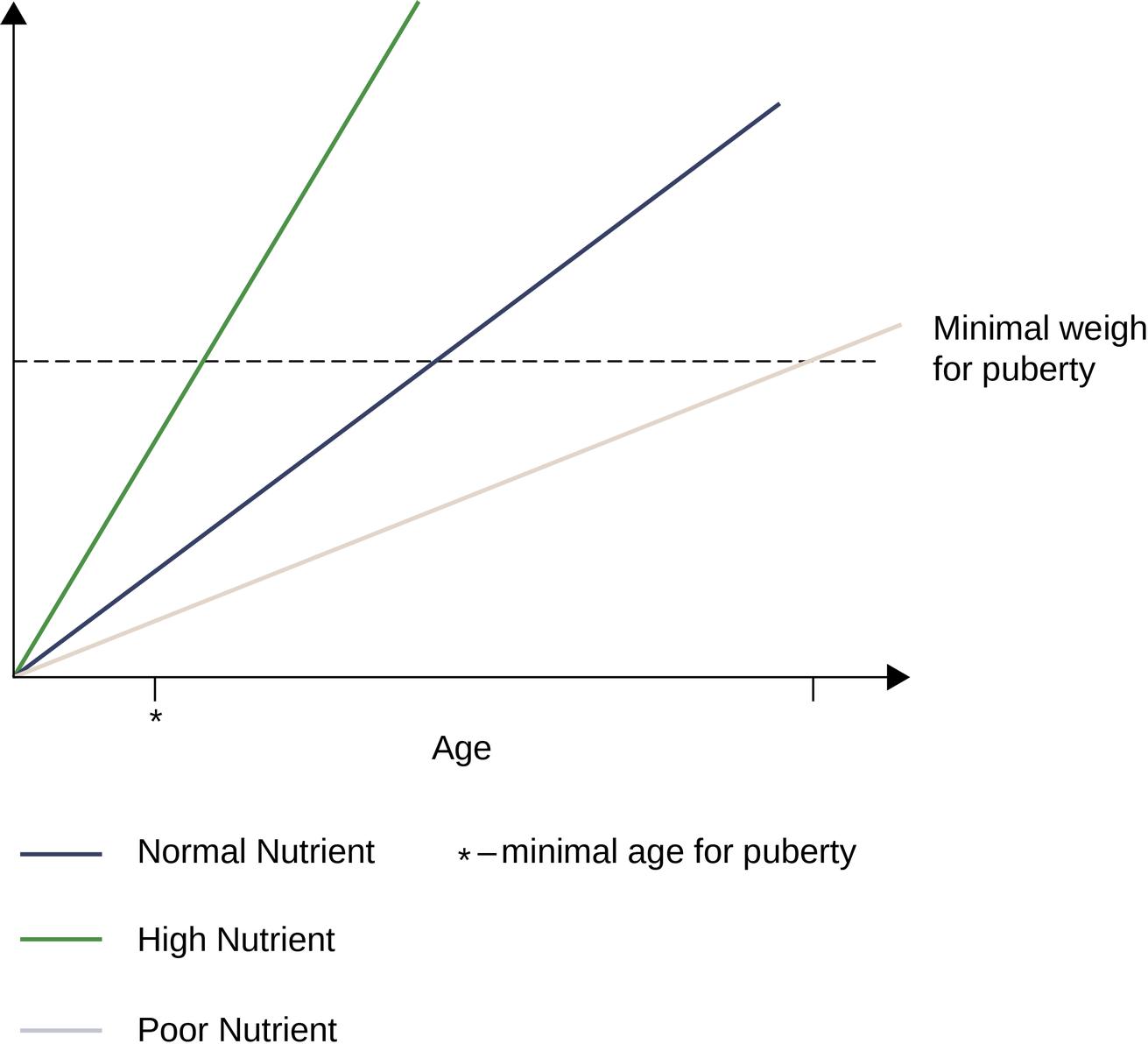
Because the amount of fat storage will be directly correlated with nutrition, animals raised on a normal diet tend to arrive at puberty toward the middle of the genetically determined age range.
Those on high-nutritional diets arrive at puberty earlier, while those on poor nutritional diets will often have puberty delayed
animals with extremely poor nutrition will have a delay in arriving at puberty
Section 4: How the hormones trigger puberty
The process of puberty is dependent on both negative and positive feedback loops.
While similar in males and females, the hormone trigger and the reactions it trigger are different
Section 4.1: Hormonal control of puberty in the male
At birth, luteinizing hormone (LH) release from the anterior pituitary is blocked by negative feedback by a small amount of testosterone produced by the body
just before puberty, it is thought that testosterone levels are rapidly increased as more testosterone is made by the adipose cells.
The rapid increase causes what is termed downregulation of the testosterone receptors.
All receptors bind to testosterone and are then deactivated by the cell (to go back to the analogy of light switches in Chapter 3, think of simply removing the switch).
With the removal of the negative feedback, LH levels rise stimulating normal testosterone production.
At about the same time, FSH levels will rise and cause the Sertoli cells of the testis to make androgen-binding proteins, and the post pubertal pattern of testosterone production and regulation is established
For most domestic mammals it is during this time period, the testis will descend out of the peritoneal cavity into the scrotal sack.
As testosterone levels rise, changes begin to take place in the male animal’s physiology.
Having testosterone levels at the right concentration and in the right production patterns will stimulate the testis to start mature sperm production.
Testosterone directly stimulates cellular meiosis.
Therefore there can be no mature sperm cells before puberty.
Testosterone will also trigger the creation of the male secondary sex characteristics; the larger frame, increased muscling, and deeper vocalization we associate with a bull.
The hormones will also initiate development of maturation and function of the accessory glands of the male reproductive system
As hormones rise, the animal will also begin to show mating behaviors such as the flehmen response in stallions Horse Behavior: Flehmen Response.
The process of puberty will culminate with the production of mature gametes.
However, the production of mature gametes will occur weeks (approximately 60 days) after the initial rise in testosterone.
Section 4.2: Hormonal control of puberty in the female
Prepubertal females have small amounts of circulating estrogens.
These estrogens have an extremely powerful negative feedback on follicle development, preventing follicles development beyond the secondary stage of development.
As discussed in the male, as the female approaches puberty, her body begins to store fats in adipose tissue.
These cells also cause a rapid increase in estrogens.
The estrogens will bind and downregulate the receptors and resent them to the receptors of the estrus cycle.
This allows the anterior pituitary to start releasing LH and follicle-stimulating hormone (FSH) in normal patterns and the follicles will grow to maturity.
The high levels of estrogens will then trigger positive feedback, the LH surge, and ovulation.
Interestingly, the first time this occurs, there is no psychological response (standing heat—referred to as a silent estrus).
This is because the cells in the brain must be exposed to progesterone to make receptors for estrogens.
However, the first cycle will prime the brain with estrogen receptors, which will trigger the psychological response on the next ovulation, and the animal will show standing heat
As testosterone does in the male, higher estrogen levels in the female will trigger the development of secondary sexual characteristics.
Section 5: Other factors influencing puberty
can be argued that the animal’s weight and age have the most influence on puberty, these are not the only factors that influence the arrival of pregnancy the environmental influences and, in some cases, the presence of mature, reproductively intact animals will impact puberty as well
include the availability of nutrition, heat and cold stress, and in some cases, the effects of seasonality.
The effects of poor nutrition should be obvious.
Animals under poor nutritional conditions would have issues developing proper body conditions necessary to support puberty, and therefore puberty would be delayed.
However, overfeeding can also be an issue
Overweight animals may become androgenized, disrupting normal steroid pathways and preventing ovulation.
Heat and cold stresses are again due mainly to the utilization of energy to maintain normal body functions.
The diversion of energy can delay puberty.
This has been especially demonstrated in cattle where fall calves tend to enter puberty sooner than spring calves which experience extreme heat load at the same point they would normally enter puberty.
Further, heat loads have direct effects on sperm production; thus high heat may prevent the animal from making functional gametes.
Seasonal breeders (mainly species like sheep ) can have unique environmental influences in that they cannot reach puberty during the current breeding season; their reproductive potential will be delayed for up to an entire year.
Other animals can also influence the arrival of puberty through the use of pheromones.
Studies in pigs and sheep have demonstrated that housing intact males in the same facility as prepubertal females will cause the female animals to enter puberty earlier.
Further, there is a small amount of evidence that housing intact mature males with prepubertal males may delay puberty in the males.
However, it is unclear if housing prepubertal males with cycling females has any effect on the young male’s arrival at puberty.
Section 6: The producer and puberty
Puberty represents a “changing of gears” if you will, in the animal’s physiology.
True grow, the growth of the animal’s frame, is linked to puberty
True grow: increase in body frame
must recognize the requirements for optimum nutrition during the prepubertal period
Animals cannot be bred if they are not producing gametes. There are limited things the producer can do to cause the animals to achieve pregnancy at earlier ages. Producers of seasonal breeders can carefully follow breeding practices that ensure young animals reach puberty for the next breeding season. Females can be housed with intact mature males in hopes that pheromones will trigger earlier puberty. Young animals can also be given hormonal treatments (GnRH), to trigger earlier puberty.
In the male, the descent of the testis into the scrotal sack will be a good first indication that the animal is approaching puberty. Further, as the testis fills with mature sperm cells, they will get larger and harder. Therefore, the producer can use a simple measurement of increases in the scrotal sack as an indication of oncoming puberty and potential sperm production.
animal’s genetic will play a significant influence on when they arrive at puberty.
Larger breeds tend to reach puberty slightly later than smaller breeds of the same species
Producers must also recognize the influences working with pubertal animals can have on profitability.
For example, recognizing that pigs do not ovulate large numbers of eggs during their first cycle and breeding them on either the second or later cycles will prevent small litter sizes
knowing cattle heifers have limited ovulations on their first cycles and young males have limited sperm may help the producer prevent open animals and lost production days.
Producers must determine what schemes work in their situation to maximize production and profitability.