Intro College Chemistry
Chapter One
Chemistry is the study of the transformation of matter
Scale in chemistry:
Macroscopic Scale
Matter that can be seen with the naked eye and can be held
Atomic Scale
Nanoscale and molecular scale (10^-9 m)
Processes cannot be seen
← Always say the state of matter of reactants + products
S - solid L - liquid G - gas
Scientific Method
Observation/Question → Research topic area → Hypothesis → Test with experiment → Analyze data → Report conclusions
^^^^^^^^^^^^^^Experiment must be reproducible
Matter
Matter→ anything with mass that takes up space
Substances→ Pure, it’s made up of one thing
Elements→ Made up of one type of atom (singular atom or multiple of the same).
Compound→ Multiple atoms bonded together
Mixtures→ Two or more substances physically mixed together. Can also be physically separated
Homogenous mixtures→ Can’t distinguish the two substances in the mixture. One phase, not constant proportions
Heterogenous mixtures→ Has more than one phase, or you can visually distinguish the substances
Diatomic elements:
H, N, O, F, Cl, Br, I → Forms an upside down L on the periodic table
Compounds → Composed of two or more elements via chemical bond. (Ionic or covalent)
Must be in a defined ratio of elements
Chemical property/process
Reaction
Combustion/burning in air
Reaction with other compounds
!!!!Review how to balance chemical reactions!!!!
Density
d=m/v
Usually the units of density are g/ml (not the only option)
Vcube = sidelength^2
Vrectangle = length*width*height
Vsphere = 4/3pi r^3
To find the volume of an object with an irregular shape, usually we use the water displacement measurement method.
deltaV = Vfinal - Vinitial
deltaV = volume of irregular object
Conversion factors (Memorize)
1cm= 10^-2 m
1mm= 10^-3 m
1microm= 10^-6 m
1nm= 10^-9 m
1A0= 10^-10 m
1ppm= 10^-12 m
Volume
1cm^3=1mL
1 L=1000cm^3=1000mL
Accuracy vs Precision
Accuracy: How close the values in a set of measurements are to the accepted value
Precision: How close the values in a set of measurements are to one another
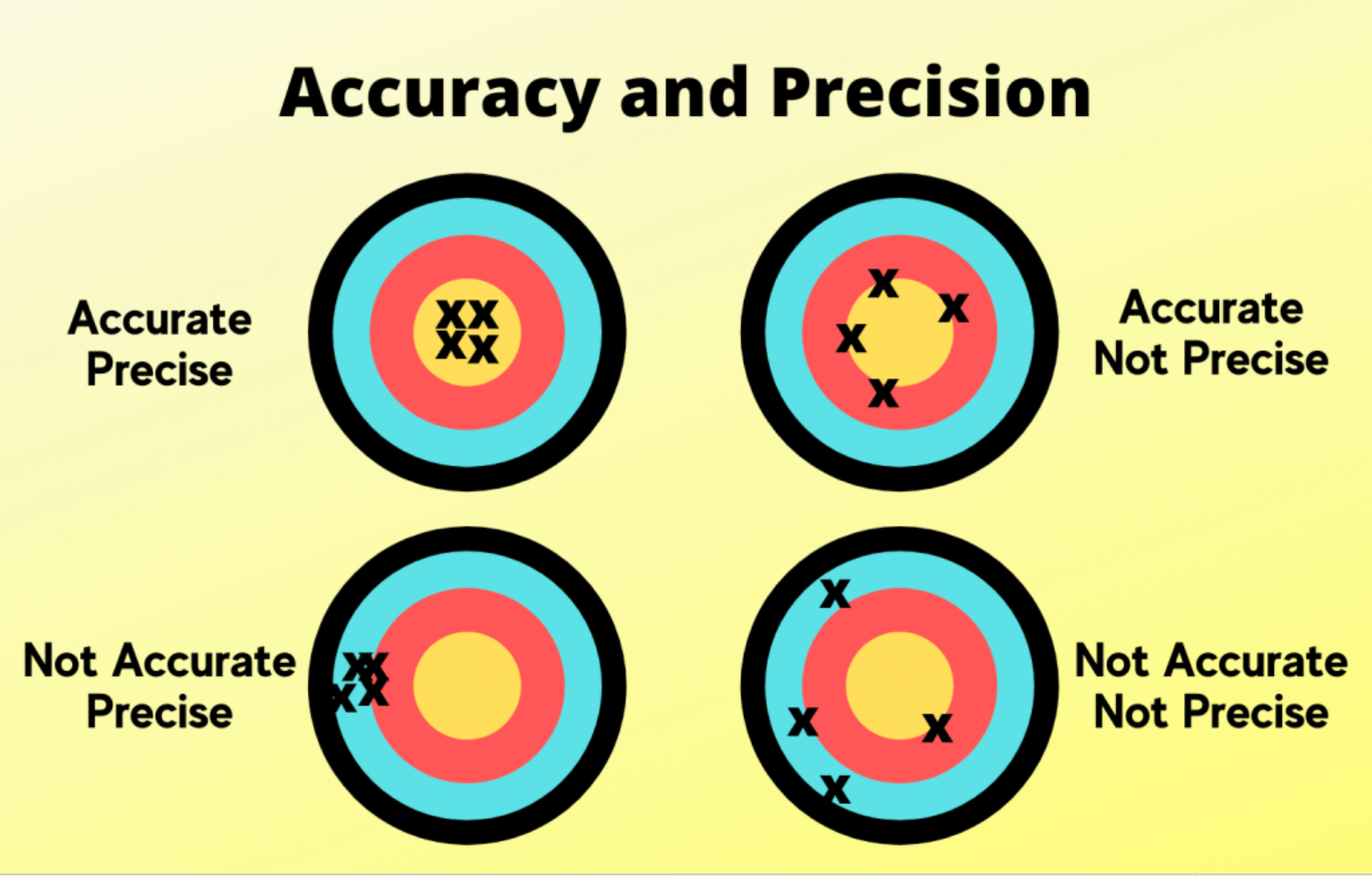
Low standard deviation indicates high precision. Average close to accepted value indicates accuracy.
Significant Figures are defined as all the digits that can be known with certainty plus one uncertain digit.
EXAMPLE: You use a scale that has a certainty of ±1, and it tells you an object has a mass of 249.221g.
^^The 2 and 4 are certain, the 9 is not. So you would report the mass as 249g.
BASIC RULES OF SIG FIGS
All nonzero numbers are significant.
269 has 3 sig figs
A zero between nonzero numbers is significant.
206 has 3 sig figs
A zero is significant at the end of a number that includes a decimal point
22.000 has 5 sig figs
A zero is NOT significant when it is before the first nonzero digit
.00030 has two sig figs
A zero is not significant when it is at the end of a number without a decimal point
12340 has 4 sig figs
Sig figs in calculations
For addition or subtraction, the number of sig figs in the result is equal to the number of sig figs in the least accurate number.
For multiplication or division, the number of sig figs in the result is equal to the number of sig figs in the least accurate number also
Chapter Two
There are 4 main elements that comprise 96.5% of the body.
Oxygen, Carbon, Hydrogen, and Nitrogen
Models of the atom
Rutherford model suggested that atoms had a small, dense nucleus surrounded by orbiting electrons.
Bohr proposed the planetary model, which suggested that electrons orbited the nucleus in fixed energy levels.
The Schrodinger Model is an energy cloud.
Atomic Composition
Protons
+ electrical charge
Mass = 1.672623 x 10^-24 g
Mass = 1.007 atomic mass units (u)
Neutrons
No electrical charge
Mass = 1.009 U
Electrons
Negative electrical charge
Relative mass = .0005 u
→ It is assumed that they have no mass
Atomic Symbol
First letter of atom name
Ex: Carbon = C
First 2 letter of atom name
Ex: Calcium = Ca
First and 3 letter of atom name
Symbol is derived from latin
Isotopes
Isotopes are atoms of the same element that have different numbers of neutrons.
They have the same number of protons and electrons, but different masses
Isotopes are useful in applications like Carbon dating.
When an organism dies, it no longer takes in new carbon. The Carbon 14 decays at a predictable rate.
We measure the remaining 14C and calculate how many half lives have passed.
Average Atomic Mass
The average Atomic Mass is skewed towards the isotope with more abundance.
The abundance of each isotope must add to 100%
MUST KNOW THIS FORMULA FOR EXAM ^^^^
The Periodic Table
Columns: Groups
Rows: Periods
1a
Alkali metals EXCEPT for Hydrogen
2a
Alkaline metals. ALL metals.
3a
Contains galium, which has a melting point slightly higher than room temperature
7a
Hallogens. Contains 3 diatomic elements
8a
Noble Gases (The happy family of the periodic table. The AMERICAN DREAM of the periodic table). Full valence electrons, not interested in bonding. Happy!!! 😃
Know which are metal, which are non-metal, which are metaloid. Know the properties of elements
All metals solid at room temp except mercury (and galium?)
All non-metal elements are solids or gases except Br2 is liquid.
Covalent and Ionic Bonding
Ionic Bonding:
Bonding between metals of group 1A-3A or transition metals with non-metals
NaCl
Total exchange of electrons
Covalent Bonding:
Non-metals together
HCl
Sharing of electrons
Not always equally shared (But sometimes it is!!!)
This happy go lucky class ❣
Ionic
Anions are negative → They gain electrons possess a negative charge
Usually the nonmetal
Cations are positive → They lose electrons and possess a positive charge
Usually the metal
Both want to mimic noble gases - full valence shell. No more no less.
In the name, put the cation before anion
Charge of cations
The transition metals can have multiple different charges– Except for silver and zinc. Ag+ and Zn2+
How to name cations:
Monatomic
Na+ → Sodium cation
Li+ → Lithium cation
Transition metals
Cr2+ → Chromium (II) cation
Cr3+ → Chromium (III) cation
You must specify the charge of transition metals ^^^^^^^^
Except for silver and zinc, which are Silver cation and Zinc cation
Charge of anions
All of group 7a is -1
All of group 6a is -2
All of group 5a is -3
If nonmetals are forming ionic compounds, the nonmetal will have a charge of
group# - 8 = charge
How to name anions
Monatomic anion
Nitrogen → Nitride
Sulfur → Sulfide
Oxygen → Oxide
Polyatomic anions USE FLASHCARDS !!!!!!!!!!!!!!!!!!
Oxoanions
NO3 - → Nitrate
NO2 - → Nitrite
PO4 3- → Phosphate
HPO4 2- → Hydrogen phosphate
OH- → Hydroxide
SO4 2- → Sulfate
SO3 → Sulfite
CO3 2- → Carbonate
MnO4 - → Permenganate
ClO4 - → Perchlorate
ClO3 - → Chlorate
ClO2 - → Chlorite
ClO - → Hypochlorite
CN - → Cyanide
Naming Ionic Compounds
Name of the cation (without the word cation) anion name (without ion)
Ex: CaF2
→ Calcium Fluoride
Electrostatic Force
Force between two charged items: Attractive or Repulsive
+ and + repulse
- and - repulse
+ and - attract
Coulomb’s Law:
F = electrostatic force between ions
k = Coulomb.s constant
q1, q2 = charges on the ions
r = distance between the centers of the ions
The higher the electrostatic force, the lower solubility in water
Higher melting point = stronger electrostatic force
Most ionic compounds form a crystal lattice structure. They typically arrange in groups
Molecular Compounds (COVALENT)
Binary Compounds
Two elements of two nonmetals with a covalent bond
“Some elements are more greedy than others…”
Naming Covalent Compounds
CO → Carbon monoxide
CO2 → Carbon dioxide
You name them like this
Central element comes first, other comes second
1 → mono
2 → di
3 → tri
4 → tetra
5 → penta
6 → hexa
7 → hepta
8 → octa
If the central element is singular you just name it as it is. Second element is named by quantity (and then ion name…)
Inorganic Acid Names

HIO2 - Iodous aci
Allotropes
Elements that exist in more than one elemental form
For example:
Carbon → Diamonds and Graphite
In graphite, the atoms are arranged in sheets. Covalent bonds bind atoms within the sheets, but the sheets themselves have weak bonding forces
Easily slide
Weak
Good conductor
Diamonds are fully formed with covalent bonds, making them far stronger
Very strong
Not a good conductor