The adductor muscles of the Thigh
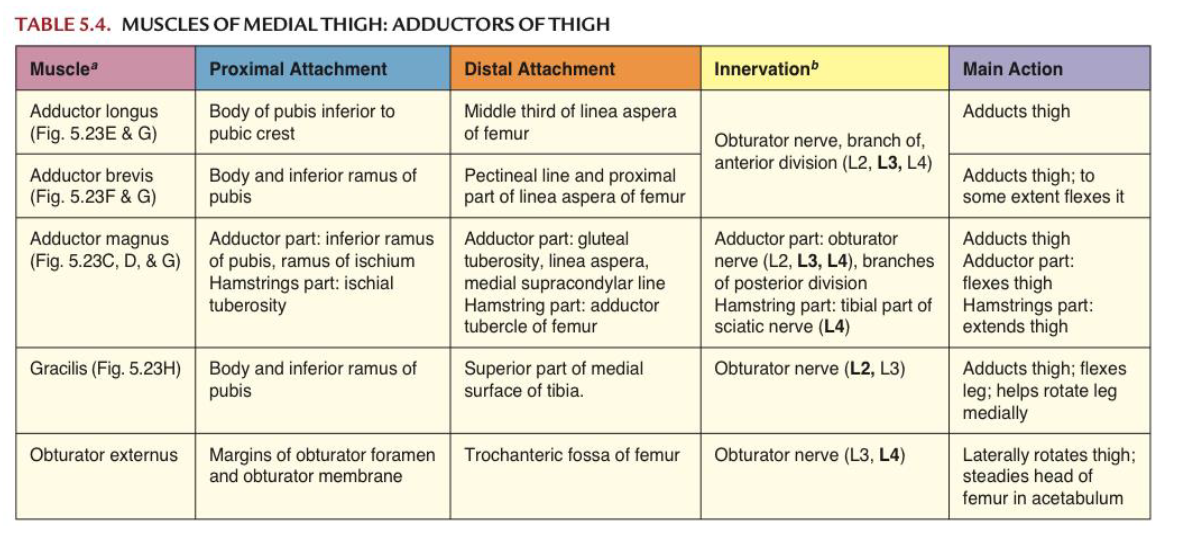
Adductors of the Hip Joint and Their Innervation
The hip adductors are primarily responsible for adduction of the thigh at the hip joint. Here is a detailed overview:
1. Adductor Longus
Origin: Body of the pubis, inferior to the pubic crest.
Insertion: Middle third of the linea aspera of the femur.
Action: Adducts and medially rotates the thigh.
Innervation: Obturator nerve (L2-L4).
2. Adductor Brevis
Origin: Body and inferior ramus of the pubis.
Insertion: Pectineal line and proximal part of the linea aspera of the femur.
Action: Adducts and medially rotates the thigh.
Innervation: Obturator nerve (L2-L4).
3. Adductor Magnus
Parts:
Adductor Part:
Origin: Inferior ramus of the pubis and ramus of the ischium.
Insertion: Gluteal tuberosity, linea aspera, and medial supracondylar line.
Innervation: Obturator nerve (L2-L4).
Hamstring Part:
Origin: Ischial tuberosity.
Insertion: Adductor tubercle of the femur.
Innervation: Tibial division of the sciatic nerve (L4).
Action: Adducts, medially rotates, and extends the thigh (hamstring part).
4. Gracilis
Origin: Body and inferior ramus of the pubis.
Insertion: Medial surface of the proximal tibia (pes anserinus).
Action: Adducts the thigh, flexes the knee, and medially rotates the leg.
Innervation: Obturator nerve (L2-L3).
5. Pectineus
Origin: Pectineal line of the pubis.
Insertion: Pectineal line of the femur, just inferior to the lesser trochanter.
Action: Adducts and flexes the thigh; assists in medial rotation.
Innervation:
Femoral nerve (L2-L3) primarily.
May also receive innervation from the obturator nerve.
Obturator Externus Muscle
Key Features in Innervation
Obturator Nerve (L2-L4): Major nerve for adductor muscles, supplying adductor longus, brevis, magnus (adductor part), and gracilis.
Femoral Nerve (L2-L3): Innervates pectineus, with occasional contributions from the obturator nerve.
Tibial Division of the Sciatic Nerve (L4): Specifically innervates the hamstring part of the adductor magnus.