Psychological Disorders
What is a Psychological Disorder
Where do we draw the line between grief and depression
How does race and wealth affect getting diagnosed with a psychological disorder?
How should we define them? What causes them? How should we classify them?
Defining Psychological Disorders
Psychological Disorder - a disturbance in people’s thoughts, emotions, or behaviors that causes distress or suffering and impairs their daily lives.
Believing that your home must be thoroughly cleaned every weekend is not a disorder — but when compulsive daily cleaning rituals interfere with work and leisure, you may have a psychological disorder
Diagnosing psychological disorders varies across time and culture
“significant disturbance” is super vague
Interferes with normal day to day life; accompanied with distress
Understanding Psychological Disorders
The way we perceive problems influences how we react to them
if you treat it like a bubble it will act like a bubble
Philippe Pinel thought that madness was not demonic possession but a sickness of the mind caused by stress and inhumane conditions
duh
The Medical Model
Medical Model - the concept that diseases, in this case psychological disorders, have physical causes that can be diagnosed, treated, and, in most cases, cured, often through treatment in a hospital.
Physical cause (syphilis) of a mental disorder triggered search for curative treatments for other mental disorders
Discoveries that many genes together influence the brain and biochemical abnormalities that contribute to all major disorders
The Biosocial Approach
Calling them a “sickness” also put the influence of biology up front
Major Depressive Disorder and Schizophrenia happen world wide
People who are diagnosed with one disorder are more likely to be diagnosed with another one
comorbid
Cultures can influence them too
In Latin American cultures, some experience susto — intense anxiety or distress triggered by a traumatic or frightening event, which is believed to cause the soul to leave the body
The eating disorders anorexia nervosa and bulimia nervosa occur mostly in food-abundant Western cultures.
What roles have they been exposed to?
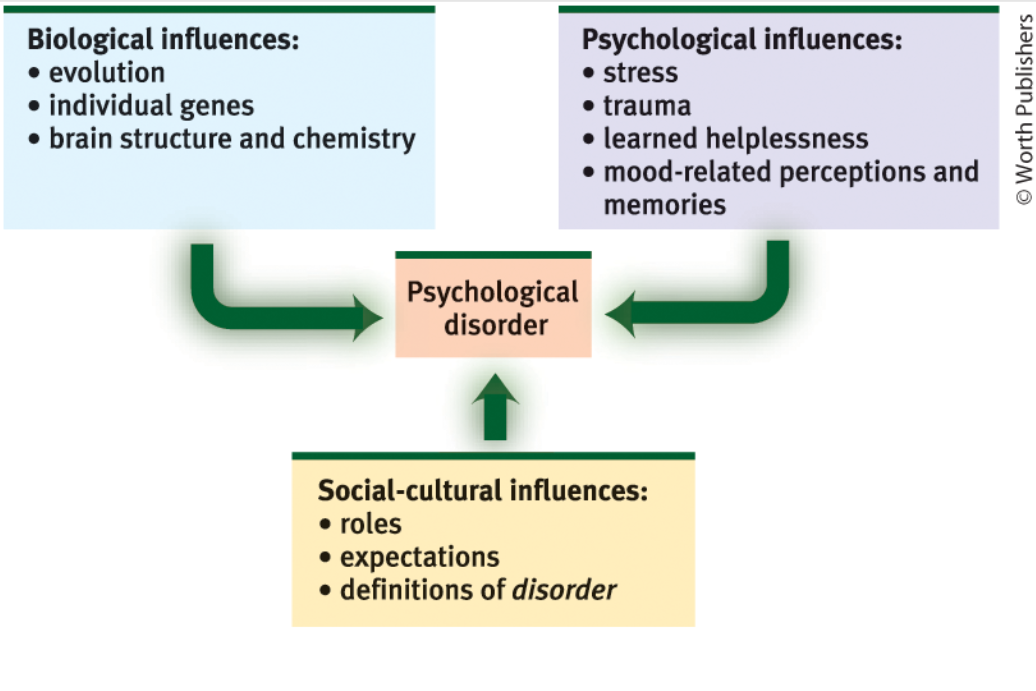
Vulnerability-Stress Model: Individual dispositions combine with environmental stressors to influence psychological disorder
Our mind and body work as one
Emotions can trigger a physical response
A physical response can trigger emotions
Epigenetics - the study of the molecular ways by which environments can influence gene expression (without a DNA change).
Classifying Disorders - and Labeling People
Classification is a quick way to give lots of information
In psychiatry and psychology, classification also attempts to predict a disorder’s future course, suggest appropriate treatment, and guide research into its causes
American Psychiatric Association’s Diagnostic and Statistical Manual of Mental Disorders
The DSM-5 is a categorical approach (symptoms are present or not)
Either have to meet all the criteria, or meet a certain amount
includes diagnostic codes from the World Health Organization’s International Classification of Diseases (ICD), which makes it easy to track worldwide trends in psychological disorders.
Field tests of the DSM-5 have faired either well or poorly
Critics say the DSM-5 casts to “wide of a net” and how almost any behavior could count as a psychological disorder
the DSM-5 classified bereavement grief and distress following loss as a depressive disorder. Critics wondered whether such grief — which one grieving person described as “not a problem to be solved, but a process to be lived through”
Grief depends on the person
Some psychologists take a dimensional approach when it comes to labeling disorders
Examines behavior along a spectrum, not a “yes or no” basis
Diagnostic labels can be subjective opinions, not scientific facts
can make it hard for “mentally ill” people to get a job, get housing
Risks | Benefits |
Subjective opinions disguised as scientific judgements | Clients are relieved to hear their diagnosis has a name |
Labels can be self-fulfilling | Labels guide medical diagnosis and treatment |
People tend to stigmatize those with psychological disorders (sometimes feared as potentially violent) | Diagnostic labels help mental health professionals communicate about their cases and study the causes and treatments of disorders |
Anxiety Disorders, Obsessive-Compulsive and Related Disorders, Trauma- and Stressor-Related Disorders, and Somatic Symptom and Related Disorders
Anxiety is a part of life. It can help or hurt us. Some people, however, are especially prone to fearing the unknown and noticing and remembering perceived threats — as if living with horror movie music playing in the background
Anxiety Disorders
Anxiety Disorders - a group of disorders characterized by excessive fear and anxiety and related maladaptive behaviors to reduce anxiety.
Social Anxiety Disorder - intense fear and avoidance of social situations.
experience heart palpitations, tremors, blushing, and sweating
Not just “being afraid of speaking in front of the class”
Debilitating, a prevalent issue in their life
Generalized Anxiety Disorder
Generalized Anxiety Disorder - an anxiety disorder in which a person is continually tense, fearful, and in a state of autonomic nervous system arousal.
Cannot identify, relive or avoid anxiety
Anxiety is free-floating (not tied to a specific thing)
Often happens along with a depressed mood
Can lead to physical problems, such as high blood pressure
Symptoms:
Excessive and uncontrollable worry that persists for 6 months or more (continuous)
Being jittery, on edge, and sleep deprivation
Arousal of the automatic nervous system
Difficulty concentration
Panic Disorder
Panic Disorder - an anxiety disorder marked by unpredictable minutes-long episodes of intense dread in which a person may experience terror and accompanying chest pain, choking, or other frightening sensations; often followed by worry over a possible next attack.
Can lead people to avoid situations where the panic attacks occur
Specific Phobias
Specific Phobias - an anxiety disorder marked by a persistent, irrational fear and avoidance of a specific object, activity, or place.
That one lady who is scared of olives
People are more likely to have a fear than a phobia
when it affects your life, that is when it is a phobia
Obsessive-Compulsive and Related Disorders
Obsessive-Compulsive Disorder - a disorder characterized by unwanted and repetitive thoughts (obsessions), actions (compulsions), or both.
The compulsions are meant to reduce anxiety caused by the thoughts
Our everyday lives are filled with rituals and habits
But they cross the fine line between typical behavior and disordered behavior when they persistently interfere with everyday living and cause significant distress.
Checking that the door is locked 10 times vs once
Even if you know the thoughts are irrational, the thoughts can become so haunting, and the compulsive rituals so intensely time-consuming, that it feels impossible to stop them
There are other OCD related disorders
hoarding disorder (cluttering their space with acquired possessions they can’t part with)
body dysmorphic disorder (preoccupation with perceived body defects; repeatedly checking their appearance in the mirror)
trichotillomania (hair-pulling disorder)
excoriation (skin-picking) disorder
Trauma- and Stressor-Related Disorders
Posttraumatic Stress Disorder - a disorder characterized by haunting memories, nightmares, hypervigilance, avoidance of trauma-related stimuli, social withdrawal, jumpy anxiety, numbness of feeling, and/or insomnia lingering for 4 weeks or more after a traumatic experience.
Trauma and Stressor Related Disorders - a group of disorders in which exposure to a traumatic or stressful event is followed by psychological distress.
Many of us will experience a traumatic event in our life
two-thirds of people, after traumatic experiences, display resilience by returning to their baseline of healthy functioning
Posttraumatic Growth - positive psychological changes following a struggle with extremely challenging circumstances and life crises.
A heart attack triggers us to live a healthy life
1 in 5 people have PTSD symptoms
Some psychologists think PTSD has been over diagnosed
Somatic Symptom and Related Disorders
Somatic Symptom Disorders - a psychological disorder in which the symptoms take a somatic (bodily) form without apparent physical cause.
Being told the problem is “all in your head” is not helpful
the symptoms are being felt physically
The symptoms differ from person to person
Cultural context affects people’s physical complaints and how they explain them
In China, anxiety disorders are the most common psychological disorder
psychological explanations of anxiety and depression are socially less acceptable there than in many Western countries, so people less often express the emotional aspects of distress
Illness Anxiety Disorder - a disorder in which a person interprets normal physical sensations as symptoms of a disease.
A normal headache is a sign of a horrific disease when in reality it is just a headache
Understanding These Disorders
How do these anxious feelings and thoughts arise?
Learning
Our fear responses can become linked with formerly neutral objects and events through classical conditioning.
anxious or traumatized people learn to associate their anxiety with certain cues
Me and the School Bus
Anxiety or an anxiety-related disorder is more likely to develop when bad events happen unpredictably and uncontrollably
Even a single painful or frightening event may trigger a full-blown phobia, thanks to classical conditioning’s stimulus generalization and operant conditioning’s reinforcement.
Stimulus generalization occurs when a person experiences a fear-provoking event and later develops a fear of similar events.
Reinforcement helps maintain learned fears and anxieties.
Cognition
Cognition plays a factor in what we learn to fear
Why do all wild monkeys fear snakes, but monkeys raised in a lab don’t?
When a snake was present, the lab-raised monkeys repeatedly observed the wild-raised monkeys refusing to reach for food. Can you predict what happened? The lab-raised monkeys also developed a strong fear of snakes that persisted when retested 3 months later
Humans learn what to fear by observing others
Anxiety is often a response to the “fake news” we produce ourselves
tend to be hypervigilant
Biology
Genes
Some people have genes that make them like orchids — fragile, yet capable of beauty under favorable circumstances. Others are like dandelions — hardy and able to thrive in varied circumstances
Even when raised separately, identical twins may develop similar specific phobias
There are genes that are associated with OCD and PTSD
Also gene variations that deal with anxiety disorders
Experience affects whether a gene will be expressed
nature + nurture
Directly and indirectly impact anxiety disorders
The Brain
Traumatic experiences alter our brain, paving fear pathways that become easy inroads for more fear experiences
Social anxiety disorder, generalized anxiety disorder, panic attacks, specific phobias, OCD, and PTSD express themselves biologically as overarousal of brain areas involved in impulse control and habitual behaviors.
Natural Selection
we humans seem biologically prepared to fear the threats our ancestors faced.
Compulsive acts typically exaggerate behaviors that helped them survive.
Substance Use Disorders
Psychoactive Drug - a natural or synthetic chemical substance that alters the brain, causing changes in perceptions, thoughts, moods, and behaviors.
Caffeine is a psychoactive drug!
Substance Use Disorder - a disorder characterized by continued substance use despite significant life disruption.
Some indicators are:
Diminished control
Diminished social functioning
Hazardous use
Drug action
Types of Psychoactive Drugs
A chemical substance that alters the brain, causes changes in perceptions and moods
Depressants
Depressants - drugs (such as alcohol, barbiturates, and benzodiazepines) that reduce (depress) brain activity and slow body functions.
Alcohol
Alcohol slows activity in a part of the brain that controls judgment and inhibitions
Alcohol focuses attention on an immediate arousing situation (say, a provocation) and distracts us from future consequences
Alcohol causes memory troubles as it disrupts long term memory processing
Alcohol slows sympathetic nervous system activity
Alcohol Use Disorder - alcohol use marked by a combination of symptoms that may include tolerance, withdrawal, and a drive to continue despite problematic use.
Small quantities of alcohol increases the risk of becoming an alcoholic
MRI scans show brain shrinkage in women with alcohol use disorder compared with women in a control group
Barbiturates
Barbiturates - drugs that depress central nervous system activity, reducing anxiety but impairing memory and judgment.
Tranquilizers
Prescribed to induce sleep/reduce anxiety
Lethal when combined with alcohol
Opioids
Heroin, medically prescribed substitute (methadone), pain-reliever narcotics (codeine, Oxycodone, Vicodin, Morphine, Fentanyl)
Depress nervous system activity; provide temporary relief from anxiety and pain
Effects on User:
Constricted pupils, slow breathing, and lethargy
Gnawing craving for another fix
Extreme discomfort of withdrawal after building
tolerance
What started the opioid Crisis?
Drug Companies played a large part by aggressively promoting opioid drugs while downplaying the dangers, and by sending millions of pills to pharmacies known to sell the drugs illegally
Some doctors have overprescribed pills, making their patients more likely to become addicted
Social Influence also matters. People with parents and friends who use opioids are more likely to do the same
Stimulants
Stimulants - drugs (such as caffeine, nicotine, and the more powerful cocaine, amphetamines, and methamphetamine) that excite neural activity and speed up body functions
feel alert, lose weight, or boost mood or athletic performance
Potential Addiction
Nicotine
Nicotine - a stimulating and highly addictive psychoactive drug in tobacco products.
Cigarettes, cigars, chewing tobacco, pipe tobacco, snuff, and e-cigarettes
Users develop a tolerance, which means they need more nicotine to feel the same amount of high
The leading cause of preventable death
Repeated attempts at quitting are successful
Half of all Americans who have ever smoked have quit, some with the aid of a nicotine replacement drug and a support group.
Withdrawal symptoms include craving, insomnia, anxiety, irritability, and distractibility
Nicotine reaches the brain within 7 seconds
twice as fast as intravenous heroin
Cocaine
Cocaine - a powerful and addictive stimulant derived from the coca plant; produces temporary alertness and euphoria.
Snorted, injected, smoked
Heightened reactions
increases alertness, reactions and euphoria
Leads to emotional disturbances, suspiciousness, convulsions, cardiac arrest, or respiratory failure
Stimulates the brain’s reward pathways
Methamphetamine
Amphetamines - drugs that stimulate neural activity, causing speeded-up body functions and associated energy and mood changes.
Methamphetamine - a powerfully addictive drug that stimulates the central nervous system with speeded-up body functions and associated energy and mood changes; over time, reduces baseline dopamine levels.
Reduces the brain’s normal level of dopamine it produces
Hallucinogens
Hallucinogens - psychedelic (“mind-manifesting”) drugs, such as LSD, that distort perceptions and trigger sensory images in the absence of sensory input.
begins with simple geometric forms, such as a spiral
more meaningful images, which may be seen as part of a tunnel-like vision; others may be replays of past emotional experiences
People frequently feel separated (or dissociated) from their body and experience dreamlike scenes.
Their sense of self dissolves, as does the border between themselves and the external world
Near-Death Experiences - an altered state of consciousness reported after a close brush with death (such as cardiac arrest); often similar to drug-induced hallucinations.
LSD
LSD (lysergic acid diethylamide) - a powerful hallucinogenic drug; also known as acid.
interferes with the serotonin neurotransmitter system.
Emotions may vary from euphoria to detachment to panic
Depends on the individuals mood and perceptions
Ecstasy
Ecstasy (MDMA) - a synthetic mild hallucinogen and stimulant. Produces euphoria and social intimacy, but with short-term health risks and longer-term changes to serotonin-producing neurons and to mood and cognition.
In a social setting, they will feel intimately connected to the people around them
Causes severe dehydration, and damages serotonin-producing neurons
It helps regulate our body rhythms (including sleep), immune system, and memory and other cognitive functions
Opioids
Opioids - opium and its derivatives, such as morphine and heroin; depress neural activity, temporarily lessening pain and anxiety.
They also include pain-relief narcotics such as codeine, OxyContin, Vicodin, and morphine
if use continues, the brain eventually stops producing endorphins
Drug companies started the Opioid epidemic by aggressively promoting them while downplaying their side effects
Cannabis
Cannabis - a product of the plant Cannabis sativa, which has both psychoactive (THC-containing) and nonpsychoactive (CBD-containing) parts.
THC - the psychoactive ingredient in cannabis.
Inhaled gets to the brain quicker
Eating is slower and an unpredictable pace
Studies find that the THC in a single joint may induce psychiatric symptoms such as hallucinations, delusions, and anxiety
Weed is classified as a mild hallucinogenic
THC and its byproducts can linger in the body for weeks
The more often a person uses cannabis, the greater the risk of anxiety, depression, psychosis, and suicidal behavior
Understanding Substance Use Disorders
Biological Influences
identified genes associated with alcohol use disorder and related nicotine and cannabis use disorders
If an identical rather than a fraternal twin is diagnosed with alcohol use disorder, the other twin also has an increased risk for alcohol problems
Large studies of adopted people, twins, and siblings found evidence of both genetic and environmental influences.
Psychological and Social-Cultural Influences
Those without close, secure attachments with family and friends are more likely to turn to substance use
Alcohol use disorder coincides with a doubled risk of depression and anxiety
By temporarily dulling the pain of self-awareness, psychoactive drugs may offer a distraction from depression, anger, anxiety, or unpleasant experiences
Substance abuse varies across cultures
lower rates within some religious groups
Feeling among youth and young adults that life is meaningless and directionless
Depressive Disorders and Bipolar Disorders
What is the difference between sadness and depression?
27% of college students have been diagnosed with depression
People with major depressive disorder, however, experience hopelessness and lethargy that doesn’t always match the situation, and that lasts several weeks or months
Sadness protects us by forcing us to slow down and conserve energy
After reassessing our life, we can consider how to redirect our energy in ways that may reduce our depression
Depressive Disorders
Depressive Disorder - a group of disorders characterized by an enduring sad, empty, or irritable mood, along with physical and cognitive changes that affect a person’s ability to function.
Major Depressive Disorder - a disorder in which a person experiences five or more symptoms lasting 2 or more weeks. In the absence of drug use or a medical condition, at least one symptom is either (1) depressed mood or (2) loss of interest or pleasure.
The most common of the depressive disorders
You can also feel depressed with milder symptoms that last a much longer period of time
persistent depressive disorder
, feel unusually depressed a week before your period
premenstrual dysphoric disorder
experience parts of depression and anxiety at the same time
mixed anxiety-depressive disorder
feel depressed alongside severe irritability that starts at a young age
disruptive mood dysregulation disorder
Depression is a global health crisis
Bipolar Disorders
Bipolar Disorders - disorders in which a person experiences the overexcited state of mania (or milder hypomania) and usually experiences periods of depression.
Mania - an unusually excited and overly ambitious mood state in which people show dangerously poor judgment, less need for sleep, and increased energy
Bipolar 1 experience rapid cycling between mania and depression
Bipolar 2 switch between depression and a milder hypomania
People have trouble regulating their emotions
Associated with creativity
Understanding Depressive Disorders and Bipolar Disorders
Behaviors and thoughts change with depression.
Depression is widespread, with women at greater risk.
women are more likely to get treatment
Stress and negative events often precede depression.
Compared with generations past, depression strikes earlier and more often, with the highest rates among teens and young adults
Depression sometimes returns
Most people with depression can recover on their own and thrive.
Biological Influences
Genes:
Major depressive disorder and bipolar disorders run in families
But depression is a complex condition. Many genes work together, each producing small effects that interact with other factors to increase depression risk.
Brain Structure and Activity:
Unique brain circuitry that is linked with depression
During depression, brain activity slows; during mania, it increases
Depression causes the brain’s reward centers to be less active
Nutritional Effects
Certain foods, such as refined sugar and red meat, have been linked to inflammation
Inflammation and depression often go hand in hand
The Mediterranean diet has a low risk of developing depression
Psychological and Social Influences
Our life experiences act upon our genetics
Negative Thoughts and Negative Moods
Women’s higher risk of depression can be connected with our increased amount of “ruminating”
Twice as likely to take an antidepressant
People with depression respond to bad events in a negative, self-focused way
blaming themselves
Learned helplessness
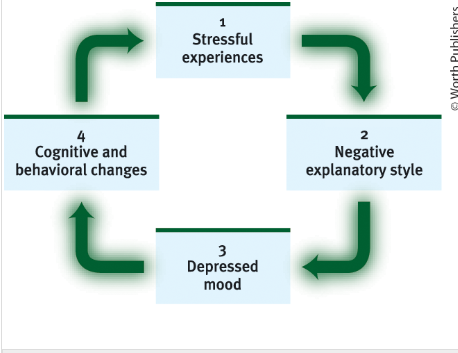
What comes first: The pessimistic explanatory style or the depressed mood?
Tendency to recall experiences that fit our current mood state-dependent memory
Depression’s Vicious Cycle
Depression is brought upon by events that disrupt our sense of who we are and why we matter
disruptions in turn lead to brooding, which is rich soil for growing negative feelings
That negativity causes others to reject us
Risk of Harm to Self and Others
Understanding Suicide
Women are much more likely than men are to attempt
Men are twice as likely to die
More likely to use a violent method
Depressed people are at a greater risk to attempt
Yet people seldom elect suicide while in the depths of depression, when energy and will are lacking. The risk increases when they begin to rebound and become capable of following through
People — especially older adults — may choose death as an alternative to current or future suffering, a way to switch off unendurable pain or relieve a perceived burden on family members.
Arise when people feel like they don’t belong or are a burden to others, when they feel demoralized, or when they are unable to experience joy
Difficult to predict
some researchers look at epigenetic marks to determine increase level or risk
Verbal hints, giving possessions away, a sudden mood change, or withdrawal and preoccupation with death
Ongoing research focus on suicide risk
App studying teen volunteer's’ tone of voice, language, photos, music choice, sleep disturbances, and angry worse
Suicide Preventing AI algorithms
If people are talking about suicide, they are not just “doing it for attention”
TAKE IT SERIOUSLY
don’t be afraid to call 911
People desire death when two fundamental needs are frustrated to the point of extinction:
need to belong with or connect to others
Need to feel effective with or to influence others
States that have high gun ownership are states with high suicide rates
Non-suicidal Self-Injury (NSSI)
Takes many forms
cut or burn their skin, hit themselves, pull their hair out, poison themselves, or insert objects under their nails or skin.
Less able to tolerate emotional distress
gain relief from intense negative thoughts through the distraction of pain.
attract attention and possibly get help.
Relieve guilt by punishing themselves.
get others to change their negative behavior (bullying, criticism).
fit in with a peer group.
Does not lead to suicide
Feeling the physical pain helps them to release whatever they are dealing with
People who do this are very good at hiding that they are doing this
Does Disorder Lead to Danger?
Mass shootings, and the media coverage that follows, often reinforce public perceptions that people with psychological disorders are dangerous
Clinical prediction of violence is unreliable
Better predictions of violence are alcohol or drug use, previous violence, gun availability, or brain damage
Most violent criminals and mass murderers are not mentally ill, and most mentally ill people are not violent
People with disorders that commit violent crimes often are doing them due to delusions/hallucinations
More likely to be the victim of a crime than the perpetrator
Schizophrenia
Schizophrenia - a disorder characterized by delusions, hallucinations, disorganized speech, and/or diminished emotional expressions.
Psychotic Disorder - a group of disorders marked by unusual ideas, distorted perceptions, and a loss of contact with reality.
Separation with what is real and what they think is real
Symptoms of Schizophrenia
Positive symptoms: describe the presence, or addition, of atypical behaviors or perceptions
hallucinations and delusions
Thinking everyone is in love with you
Negative Symptoms: describe the absence, or subtraction, of typical behaviors or perceptions
diminished facial expressions and decreased speech
Disorganized symptoms: incoherent behaviors.
Staying frozen/immobile and mimicking others speech
Hallucinations and Delusions
hallucination - a false perception, often hearing or seeing things that are not there, that may accompany psychotic disorders.
“I’m hearing the voice of the devil” - probably a serial killer
most common hallucination are hearing voices
Delusions - a false belief, often of persecution or grandeur, that may accompany psychotic disorders.
“The CIA is out to get me” - probably JFK
Disorganized thinking may be caused by a breakdown in selective attention
Disorganized Speech
Jumbled ideas may make no sense even within sentences, forming what is known as word salad.
Disorganized Motor Behavior
Some people with schizophrenia experience catatonia, characterized by motor behaviors ranging from a physical stupor (remaining motionless for hours), to senseless, compulsive actions (such as continually rocking or rubbing an arm), to severe agitation.
Diminished Outward Emotional Expression
Exhibit fewer emotions than are typical
Their facial expressions may be muted, and this flat affect may suggest that their ability to experience emotions is diminished.
Is this true though?
And in their everyday lives, people with schizophrenia report similar levels of emotion to people with no psychiatric history
More likely to express socially inappropriate emotions
Onset and Development of Schizophrenia
24 million people have Schizophrenia
Onset happens in when young people enter adulthood (25-ish)
Men tend to be diagnosed more often than women, and to be struck earlier and with more severity
Chronic Schizophrenia is harder to fully recover from
Social Withdrawal
Social anhedonia, the lack of pleasure in social interactions, is a related symptom
Acute Schizophrenia
Chronic Schizophrenia
Understanding Schizophrenia
Brain Features
Does schizophrenia have a biological key?
An excess number of dopamine receptors were found in schizophrenics after their death
high level of dopamine may intensify brain signals in schizophrenia, creating positive symptoms such as hallucinations and paranoia
drugs that block dopamine receptors often lessen the positive symptoms of schizophrenia, such as delusions or hallucinations
People with Schizophrenia also often have cognitive difficulties
Reduced activity in the frontal lobe
unusual corpus callosum
Fluid-filled brain cavities called ventricles become enlarged; cerebral tissue also shrinks
The greater the shrinkage, the greater the disorder
Prenatal Environment and Risk
low birth weight, mother’s diabetes, father’s older age, and lack of oxygen during delivery are all risks
External Maternal Stress also plays a role
A large Israeli study showed that maternal exposure to terror attacks during pregnancy doubled children’s risk of schizophrenia
Might a mid-pregnancy viral infection impair fetal brain development?
evidence suggest that fetal-virus infections contribute to the development of schizophrenia.
Genetics and Risk
Why are only some people at risk for it?
The roughly 1-in-270 lifetime odds of any person being diagnosed with schizophrenia become about 1 in 10 among those who have a sibling or parent with the disorder
Identical twins also share a prenatal environment. So, is it possible that shared germs as well as shared genes produce identical twin schizophrenia similarities?
Sharing a placenta raises the odds of later sharing a schizophrenia diagnosis.
Children adopted by someone who develops schizophrenia do not “catch” the disorder
Only at a higher risk if their biological parent has it
Influenced by many genes interacting with each other
Eating Disorders, Personality Disorders, and Dissociative Disorders
Eating Disorders
Anorexia Nervosa - an eating disorder in which a person (most often an adolescent girl) maintains a starvation diet (often despite being significantly underweight), and has an inaccurate and negative body self-perception (also called body dysmorphia); sometimes accompanied by excessive exercise.
Focus on limiting calories
Excessive exercise
Health Risk
Bulimia Nervosa - an eating disorder in which a person’s binge eating (usually of large amounts of high-calorie foods) is followed by weight-loss-promoting behavior, such as vomiting, laxative use, fasting, or excessive exercise.
Eat tons of food → Feel bad about it→ Get rid of it (vomit, fasting, exercise)
Binge Eating Disorder - an eating disorder in which a person has significant binge-eating episodes, followed by distress, disgust, or guilt, but without the behavior to compensate that marks bulimia nervosa.
Eat a ton→ feel bad about it→ don’t get rid of it
2.6 million Americans have an eating disorder
Understanding Eating Disorders
Identical twins share these disorders more often than do fraternal twins — with 50 to 60 percent heritability for anorexia
Ongoing studies focus on the genome of anorexic patients
Environment matters:
Families of those with anorexia tend to be competitive, high-achieving, and protective
people with eating disorders often have low self-esteem, feel body dissatisfaction, set impossible personal standards, and ruminate about falling short of expectations and how others perceive them
Ideal body shape changes across culture and time
Today’s culture sends a message that “fat is bad”
Most people diagnosed with an eating disorder improve
Personality Disorders
Personality Disorders - a group of disorders characterized by enduring inner experiences or behavior patterns that differ from the person’s cultural norms and expectations, are pervasive and inflexible, begin in adolescence or early adulthood, and cause significant distress or impairment.
Inflexible and enduring behavior pattern that impairs social functioning
Can be eccentric or odd, dramatic or impulsive, or without emotion
Begins in adolescence or early adulthood and stay with the person throughout their life
Antisocial Personality Disorder - a personality disorder in which a person exhibits a lack of conscience for wrongdoing, even toward friends and family members; may be aggressive and ruthless or a clever con artist.
More prevalent in men than women
Antisocial behavior often subsided after adolescence
experience social challenges and have a lower emotional intelligence
Sometimes called sociopaths or psychopaths
Understanding Antisocial Personality disorder
Both biological and psychological
Genetic vulnerability of those with antisocial and unemotional tendencies appears as low arousal
Twin and adoption studies reveal that genetic relatives of people with antisocial and unemotional tendencies are at increased risk for antisocial behavior
Nature and nurture
The cortex, which may help regulate strong feelings, is smaller and thinner in people with antisocial criminal tendencies
fall far below normal in aspects of thinking, such as planning, organization, and inhibition
the traits such as fearlessness and dominance (if channeled into positive directions) can lead to athletic stardom, adventurism, or courageous heroism
Dissociative Disorders
Dissociative Disorders - a controversial, rare group of disorders involving a disconnection (dissociation) between the person’s conscious awareness and their memory, identity, emotion, perception, and behavior.
Dissociative Identity Disorder
Dissociative Identity Disorder - a rare dissociative disorder in which a person exhibits two or more distinct and alternating identities. (Formerly called multiple personality disorder.)
Understanding DID
Between 1930 and 1960, the number of North American DID diagnoses was 2 per decade. By the 1980s, when the DSM contained the first formal code for this disorder, the number had exploded to more than 20,000
Disorder is less prevalent outside of North America
Some people are skeptical
Don’t we act like different persons depending on who we are with (friends vs boss)
Psychiatrists can often “go fishing” for multiple identities which can lead to people acting out on their fantasies
Short history of DID
Role of PTSD?
Other people believe it is a real disorder
They cite findings of distinct brain and body states associated with differing identities
Dissociation is found in other disorders such as anxiety, depression and schizophrenia
Some clinicians include dissociative disorders under the umbrella of posttraumatic stress disorder as a natural, protective response to traumatic experiences during childhood
Neurodevelopmental Disorders
Neurodevelopmental Disorders - a broad category that includes developmental differences of the central nervous system (usually in the brain) that start in childhood and affect thinking and behavior.
Neurodiversity
Not just autism!
Dyslexia, ADHD, any learning disability
How your brain is wired!
Autism Spectrum Disorder
Autism Spectrum Disorder - a disorder that appears in childhood and is marked by limitations in communication and social understanding, and by intensely fixated interests and repetitive behaviors.
An umbrella that covers a spectrum of different variability
High functioning to low functioning
1 in 31 kids in the US has ASD
Researchers are debating whether autistic people have an atypical theory of mind
Gets diagnosed in every 4 boys for 1 girl
Autism in women often presents differently
girls often get diagnosed later in life due to new research
Underdiagnosis of ASD among young people of color in general and Black youth in particular
Biological factors contribute to ASD
Prenatal factors such as maternal infection, toxins, psychiatric drug use, or hormones
Heritability of ASD is near 80%
No single autism gene
Why is reading/recognizing faces hard with people with Autism
The underlying cause seems to be poor communication among brain regions that typically work together to let us take another’s viewpoint.
ASD-related genes interacting with the environment
They can make friends, but find it hard to emotionally relate to them
Childhood vaccines have no connection to autism!
Neurodiversity - differences in thoughts and behaviors, such as in ASD or ADHD, as part of an expected variation from the general (neurotypical) population; may present strengths as well as challenges.
Attention-Deficit/Hyperactivity Disorder
Attention-Deficit/Hyperactivity Disorder - a psychological disorder marked by extreme inattention and/or hyperactivity and impulsivity.
ADHD is often described as “a disorder of self-regulation”
Diagnosis and treatment, often with a combination of cognitive-behavioral therapy and stimulant drugs, have helped many
The earlier the treatment the better
The symptoms must be pervasive, persist for at least 6 months, and impair people’s lives
Inattention is because they are not being selective about what to pay attention to. People with ADHD struggle to determine what is worth paying attention to
Intellectual Developmental Disorder
Intellectual Developmental Disorder - a disorder indicated by an intelligence test score of 70 or below and difficulty adapting to the demands of life.
Multiple different types of IDD (down syndrome)
Must meet two criteria:
An intelligence test score indicating performance in the lowest 3 percent of the population — about 70 or below
70 is two standard deviations below the mean
Difficulty adapting to the typical demands of independent living, as expressed in three skills:
conceptual (language, reading, and concepts of money, time, and number)
social (interpersonal skills, being socially responsible, following basic rules and laws, and avoiding being victimized)
practical (health and personal care, occupational skill, and travel)
Disorder | Characterized by |
Attention-deficit/hyperactivity disorder |
|
Autism spectrum disorder |
|
Communication disorders |
|
Intellectual developmental disorders |
|
Motor disorders |
|
Specific learning disorder |
|