PSY 4521: Diversity and Stess
GENDER
US Women report more stress than men
Women less likely to report low stress levels than men.
Stress does seem to be decreasing from the year 2007-2014
Women (and men’s) stress levels are higher than “healthy” levels of stress.
Women are more likely to report every stress symptom
Highest are fatigue, feeling nervous or anxious, and feeling overwhelmed.
Married women more likely to report high stress
33% of those survey
Why are married women so stressed?
73% of women with kids under 18 work outside the home
93% of men with kids under 18 also work outside the home
Women with children work a second shift at home, being a caregiver.
Women professors with kids work a second shift at home, especially during their 30s.
Mothers are more likely yo do food prep, housework, and caregiving than Dads on workdays.
Mothers with kids under 6 are more likely to report caregiving activities on workdays and spent more time doing them.
Moms and Dads did different kinds of caregiving
Mothers reported more stress during caregiving
Dads did more recreational and weekend activities
Mom’s activities were more likely to include an infant and solo parenting.
In other words,
The overwhelming majority of working mothers of young children engage in the second shift of unpaid household labor on days when they also work for pay, and they do so at rates and with time investments that far exceed those of working fathers.
How can we solve this problem?
UN Sustainable Development Goal
Reducing women’s unpaid labor
COVID increased caretaking more for working moms than dads
Gender minorities face unique stressors
Gender related rejection and victimization
Non-affirmation of gender identity
Gender-related discrimination
Internalized transphobia
Negative expectations
Concealment
By creating community connectedness and pride as resilient factors in LGBTQ+ lives, these can greatly benefit mental and physical wellbeing.
Distal Stress factors
Gender-related discrimination
Gender-related rejection
Rejection by friends, family, school, etc. because of gender identity and expression.
Gender related victimization
Non-affirmation of gender identity.
Repeatedly explain gender identity or correct pronouns
Experiencing more distal stressors is associated with poorer mental health
This is especially true in the non-affirmation category.
RACIAL DISCRIMINATION
Facets of Racial Trauma
Historical trauma
Discrimination
Microaggressions
Vicarious racism
Discrimination: Treatment of an individual or group based on their actual or perceived membership in a certain group or social category in a way that is worse than how people are usually treated.
REPRESENTATIVE STUDIES
Majority of Hispanics, Blacks, and Asians in US report discrimination or unfair treatment due to race/ethnicity.
These forms differ by group.
Black people were more likely to have someone be suspicious of them, acted like they were not smart, or had been treated unfairly when being hired.
Asian people were more likely to be subjected to slurs and jokes
White people were more likely to be assumed they were being racist or prejudiced (helppp)
Hispanic people, second to black people, were more likely to be assumed dumb/not smart.
White and Black individuals differ widely in views of how Black people are treated.
Black individuals more likely than white to say that Black individuals are treated less fairly than whites across all situations.
Dealing with the police
Criminal justice system
Hiring, pay, and promotions
Applying for a loan or mortgage
In stores or restaurants
Voting in elections
Seeking medical treatment.
People tend to underestimate the amount of discrimination other groups experience relative to the ratings of those groups.
Most groups are more concerned about their inner circle than others despite facing the same issues.
Young children report being treated unfairly/negatively because of their race/ethnicity.
Mainly applies to Black and Native American individuals.
DISCRIMINATION ASSOCIATED WITH POORER MENTAL HEALTH
Individuals who report experiencing discrimination also report higher stress levels
Prevalence of perceived racial discrimination highest among Blacks and Native Americans
Study sampled over 35,000 adults in US
Measuring racial disclination as difference in obtaining healthcare, receiving treatment, in public settings, jobs, schools, police/courts, housing, being called a racist name, and/or being made fun of, picked on, or threatened.
Measured outcome by the development of several psychiatric disorders in past year.
Racial discrimination associated with greater risk of developing mental health diagnosis.
More likely to develop PTSD or GAD
DISCRIMINATION ASSOCIATED WITH POORER PHSYCIAL HEALTH
Discrimination and Premature Aging
Context: Short telomeres associated with premature aging
Telomeres: Structures on the tips of all chromosomes which gradually get shorter with age.
93% of Black men within the study reported racial discrimination.
African American men with highest levels of discrimination and high anti-black bias had the shortest telomeres.
In a 25-year study, it found that racial discrimination among Black men and women were associated with faster telomere shortening over a 10-year period.
Discrimination and Allostatic Load
Context
Allostasis: Process of adaptation to acute stress.
Involves the output of stress hormones that act to restore homeostasis in the face of a challenge.
Allostatic Load: Price the body pays for being forced to continually adapt to adverse psychosocial or physical situations.
Types of Discrimination
Major lifetime discrimination
Childhood racial discrimination
Past-year discrimination
Everyday weight discrimination
Biomarkers Include
Cardiovascular
Blood pressure
Immune system
White blood cell count
Metabolic system
BMI
Neuroendocrine
Cortisol
Various kinds of discrimination were associated with higher allostatic load across several studies.
One study, high discrimination and low social support associated with highest allostatic load.
VICARIOUS RACISM/DISCRIMINATION
Vicarious Racism: Experiencing racism experienced by other members of your own group(s)
Hearing about or seeing acts committed against friends/family
Witnessing acts in person or on news
Racist rhetoric from public figures or racist posts on social media.
This may be personally threatening even for people not being directly target
Actions that devalue my group can negatively effect my self-concept and mental health.
What happens to you could happen to me.
Hate Crime Incidents
Majority or race-based, followed by religious and sexual orientation.
Reports are increasing over time.
Idea of Linked Faith
What happens to someone from my own racial/ethnic group affects me personally.
Study on Vicarious Racism on Black/Latinx Students
Frequently reported experiences of personal racial discrimination
Went to school in a predominantly white college.
Negative Affect of Discrimination
Interpersonal Discrimination: Associated with experiencing more anger, anxiety, loneliness, and depression both within days and between students across days.
Vicarious Racism: Associated with more anxiety within days and more anger, anxiety, and depression between students across days.
Black people are 2.9x more likely to be killed by police than white people in the U.S.
Effect of George Floyd’s Murder across the US Population
Spikes in anger and sadness all reported across the US population.
“Largest spike - by far - every observed in Gallup data” this is despite the already high levels due to COVID.
Blacks and Younger people had greater increases in anger and sadness
Anger and sadness also higher in MN and particularly Minneapolis compared to other states.
Blacks have higher increases than Whites on standard measures of anxiety and depression from before to after Floyd’s murder.
This increase equates to about 1 million more blacks screening positive for depression as a result of vicarious racism.
MICROAGGRESIONS
Microaggressions
Terms first coined by Chester Pierce, Harvard Psychiatrist, in the 1970
In a highly cited 2007 article, the term was further expanded.
“Brief and commonplace daily verbal behavioral, and environmental indignities, whether intentional or unintentional, that communicate hostile, derogatory, or negative [racial] slights and insults to the target person or group.”
THREE CATEGORIES OF MICROAGGRESSION
Microinsults: Rude, insensitive, demeaning behaviors/remarks about a person’s race, often done unconsciously.
Assigning a degree of intelligence to a person based on their race.
Treating person as lesser/second class citizen
Pathologizing cultural values/communication styles
Assumption of criminality.
Microinvalidations: Comments/behaviors that exclude/negate thoughts/feelings/reality of people of color, also often done unconsciously.
Belief that racial minority citizens are foreigners
Color blindness/don’t see race.
America is a melting pot
Race plays minor role in life success
Everyone can succeed if they work hard enough mentality
Denial of own racism
I’m not racist! I have Black friends!
Microassaults: Explicit racial derogations characterized by verbal or nonverbal attacks meant to hurt intended victim.
Name calling
Avoiding interactions
Purposefully discriminatory actions
More likely to be a conscious effort
More like “old fashioned racism”
Environmental Microaggressions and underlying messages
University buildings all named after White males
People of color underrepresented on TV
Overcrowded public schools in communities of color
Overabundance of liquor stores in communities of color.
Racial and Ethnic Microaggressions Scale
Assumption of inferiority
Second-class citizen/criminal
Microinvalidations
Exoticization/Assumptions of similarity among group
Environmental microaggressions
Workplace/school microaggressions
Dilemmas Posed by Microaggressions
Clash or racial realities
Whites tend to think discrimination is declining and that they are not racist.
Invisibility of unintentional bias
Who’s interpretation is “right”?
Perceived minimal harm of microaggression
People of color told they are overreacting
Catch-22 of responding
Did not process fully what happened in the moment. Unsure how to respond or confront individual.
Microaggressions and Well-being among Asian American Students
Microaggressions were common
78% of sample reported at least one microaggression over the 2 week period.
Microaggressions were reported on 18% of study days (once a week)
Microinvalidations most common
Experiencing microaggressions associated with lower physical and mental well-being.
Students who reported more microaggressions reported more negative moods, less positive moods, and more physical symptoms across two weeks.
On days when students experienced microaggressions, they reported more negative mood and somatic symptoms on that day AND the next day.
Analyses controlled for neuroticism
Similar Results in a study of Black HS students
97% reported at least one race-related microaggressions
Average of 1-2 per day over a 2-week period
Most common were..
Stared at by strangers
Overheard or told an offensive joke
Been treated rudely or disrespectfully.
On days when students experienced microaggressions, they reported more depression on that day AND the next day.
LGBTQ+ Microaggressions
Language that puts down LGBTQ people
Assumptions of universal LGBTQ experiences
Discomfort/disapproval of the LGBTQ experience
Assumption of sexual pathology/abnormality
Gender Microaggressions (Experienced by 7 undergraduate women)
Invisibility
Intersectionality
Microaggressions that tap into other identities
Caretaker
Women-dominated occupations
Encouragement to pursue less demanding careers.
Presumed incompetence
Sexual objectification
Environmental invalidations
RACIAL UPLIFTS
Racial Uplifts: Naturally occurring positive race-related events in everyday life.
Neglected countertheme in scientific work on race, ethnicity, and culture.
Potential resource for coping with discrimination.
Daily uplifts associated with greater well-being
Between-Person: Students who experienced more uplifts reported less negative affect. more positive affect, and higher self-esteem.
Within-Person: On days with more uplifts, negative affect was lower and positive affect and self-esteem were higher.
These Uplifts include
Ethnic bonding
Listening to music by someone who shares race/identity with another.
Overcoming obstacles
Someone shared with me their immigrant experience and how they overcame educational and economic hardship.
Biculturalism
Had personal communication with someone by switching between English and my native ethnic language.
Cultural Bridging
Took someone I know to a place or event that reflected my ethnic heritage.
Globalism
Shared a story that I had seen on an Asian news program or website.
Outgroup regard
Watched an American TV show in which the main character was an Asian/Asian American and was portrayed in a positive light.
HISTORICAL TRAUMA
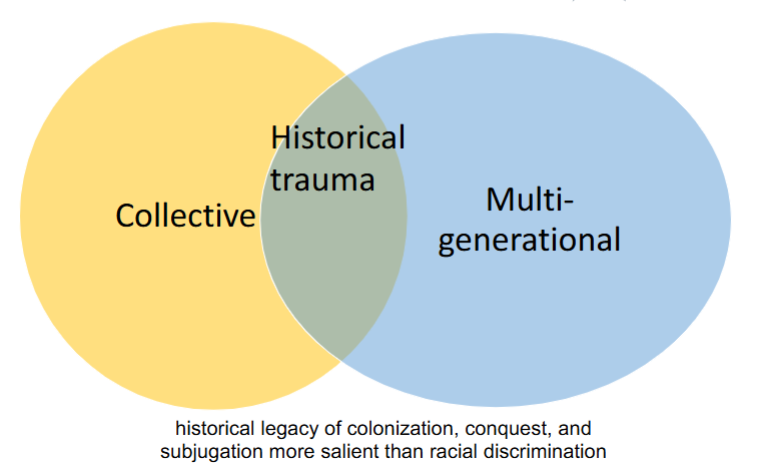
Historical Trauma: Cumulative emotional and psychological wounding across generations, including lifespan, which emanates from massive group trauma.
Historical trauma is
Trauma that is collective
Experienced by a group of people who share an identity, affiliation, or circumstance.
Experienced over time and across generations (multi-generational)
Can affect generations that didn’t directly experience the events.
Native American Experience
Population of indigenous people in North America dropped from 9-18 million to less than 200,000 by the 19th century.
Due to warfare, genocide, and infectious disease (smallpox)
Historical Trauma Response
Unresolved, complicated, and/or prolonged grief from cumulative losses.
PTSD
Depression
Substance abuse
Comparison to Other Trauma Types
Historical Trauma: Loss
Criterion A Trauma: Fear
Moral Injury: Guilt/shame
Historical Trauma construct is used to explain poorer mental and physical health among Native Americans.
Compared to whites, Native Americans have higher death rates; much more likely to die from diabetes, chronic liver disease, and suicide as well as accidents and homicides.
Two Main Types of Studies
Studies using historical loss self-report scales
Studies assessing whether ancestor attended Indian boarding school.
General findings for historical loss self-report
Many Native Americans do think about these losses at least occasionally and these thoughts cause distress.
most studies find significant relations between scores on the Historical Loss or Historical Loss Associated Symptoms scale and health outcomes including substance abuse, depression and anxiety symptoms, and suicidality.
In one study, about 20% said they think about losing their culture and losses from effects of alcoholism at least daily.
Sadness and anger most common emotions.
Scores on symptom scale related to more PTSD symptoms, substance dependence, anxiety/mood disorder diagnosis; historical loss only associated with substance dependence.
General findings for studies assessing whether ancestor attended Indian boarding school.
Measure of historical trauma is whether one of their ancestors attended a government supported boarding school.
Schools designed to assimilate Indigenous children into their mainstream society to “kill the Indian, and save the man”
Findings: Generally fared worse on health outcome measures
Suicidality, depression symptoms, substance use
Why is there a Link?
Many children were exposed to physical, sexual, and emotional abuse in boarding schools.
They were also deprived of traditional parental role models.
Damage from boarding school abuse, loneliness, lack of love, and lack of parenting are seen as key factors in the illnesses that plague tribes today.
The damage can pass from one generation to the next and manifest in high rates of poverty, substance abuse, domestic violence, depression, and suicide.
Historical Loss and Well-being among Native American College Students
Sample: 242 Native American college students
Measures: Historical loss, well-being, distress, ethnic identity.
Results:
On average, students reported thinking of historical loss on at least a weekly basis.
Thinking more often about historical loss was associated with lower well-being and higher distress.
There was a weaker relationship between historical loss and lower well-being for students with stronger ethnic identities.