Judgment and decision making
Economics vs. Psychology
Decision making: process of making choices among possibilities and the results od rhtose choices
Economist (normative approach) vs. flawed (descriptive aproach) what theyd actually do
Expected value
Optimal logic = maximizing value or ‘utility’
Expected value = (probability of an outcome) x (utility of the outcome)
Suggests highes expected val
Daniel Kahneman & Amos Tversky (1979)
Are we rational? No
Beer preference (irrationality)—Lee, Frederick, & Ariely (2006)
asked people to rate beers
beer, MIT brew (had balsamic vinegar and made it sweeter)
taste the two and see which you like better
blind: was just told that they were different but didn’t say what the difference was
before condition: would tell subjects what was the difference between the two then tasted
After condition: had beers, then told them the difference
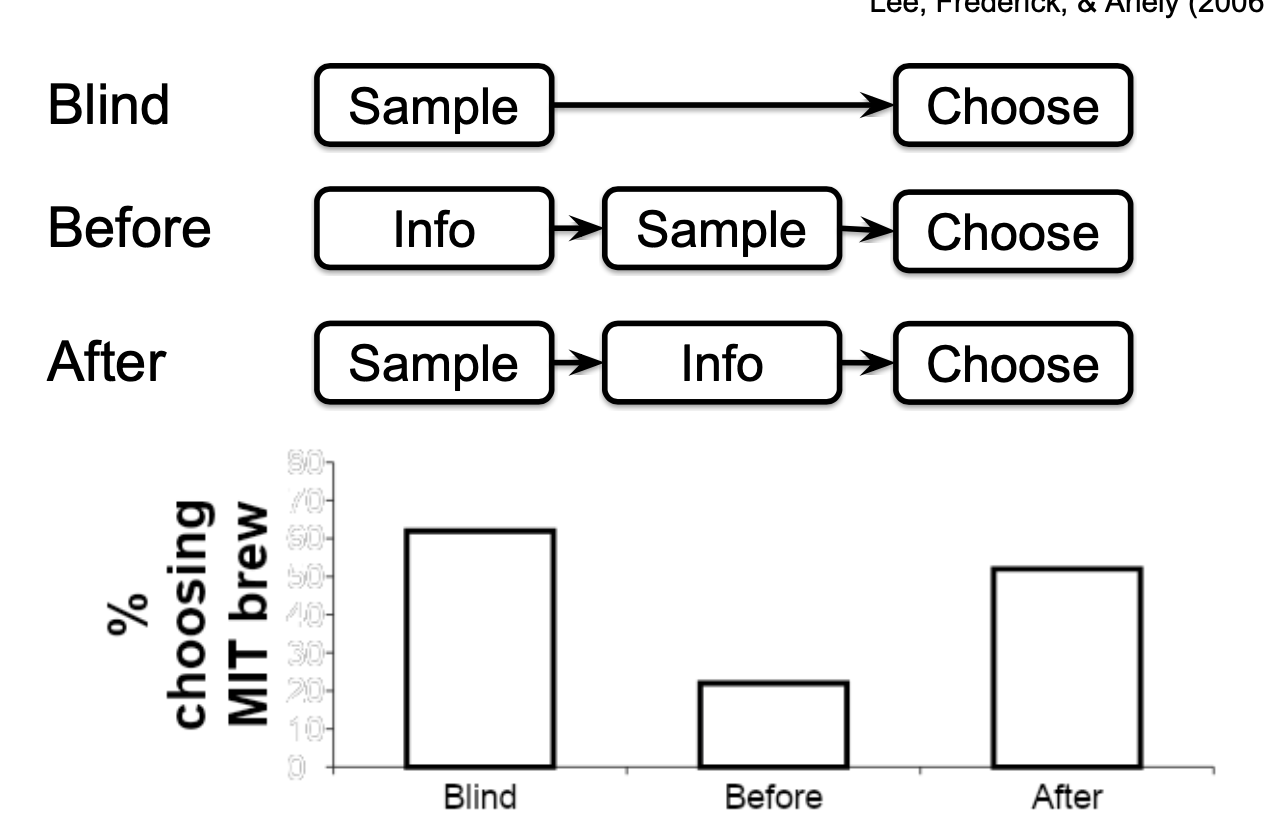
Shows how preferences can be pushed around by information
knowing ahead of time changes how you taste
Heuristics
Availability
Relying too strongly on readily available information, shortcut to coming up with decisions
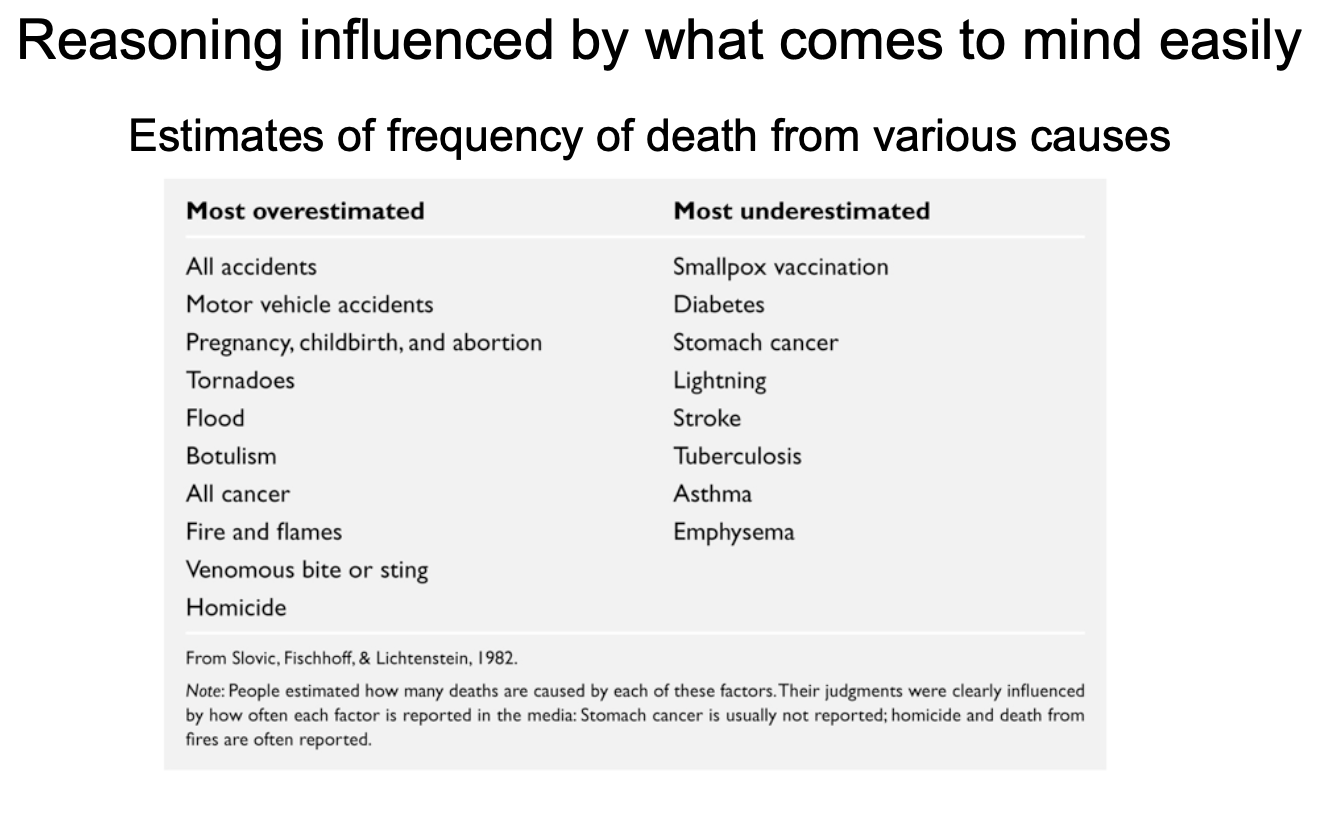
Kahneman & Tversky, 1973
Are there more words in English that begin with the letter ‘R’ or words that have ‘R’ as the 3rd letter?
Do more US states begin with the letter ‘M’ or end with the letter ‘A’?
The summer of the shark
2001: "Time magazine cover summer of the shark, actually down around 15%
2003 CNN article: 70% of Americans believe sharks are dangerous. 72% believe that shark populations are just right or too high.
Population decline
Attacks down 15% actually
Hamster vs. Shark more likely to be injured by hamster
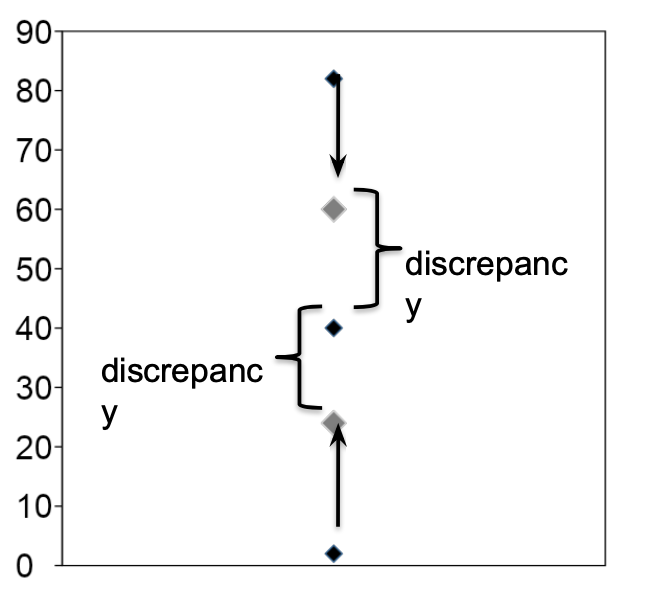
Anchoring—Slovic and Lichtenstein (1971)
When given an anchor value, guess closer to it
One group of subjects; Have the eagles apprearred in exactly 100 playoff games, if not, how many have they appeared in
Other group: have the eagles appeared in exactly 2 play off games? if not, how many?
Base Rate Neglect
Base rate; how common things occur
Ignore base rate information and be influenced by the distinctiveness of features of the case
Example: Disease X occurs in 1 of a 1000 people. If the false positive rate is 5%, what is the chance that a person with a positive test has the disease?
Classic “Engineers & Lawyers” Study-Kahneman & Tversky, 1973
Jack is very good at math and generally does not like being around people. He’s not big on politics and enjoys working with his hands.
Is Jack more likely to be a lawyer or an engineer?
1/2 participants told there is a group of 100 with: 30% engineers & 70% lawyers
1/2 participants told there is a group of 100 with: 70% engineers & 30% lawyers
both were just as likely to say jack was an engineer based on description
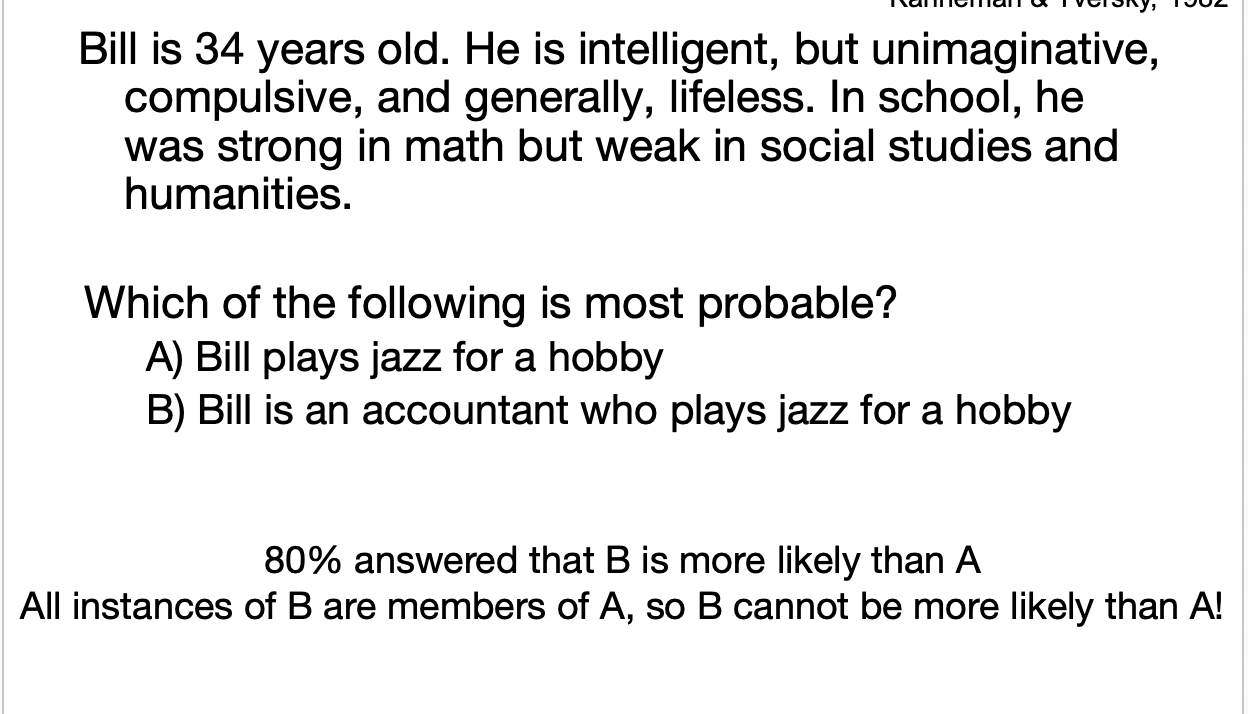
Conjunction Fallacyand COnjuction Errors —Kahneman & Tversky, 1982
Reasoning that a conjunction is more likely either premise alone
can’t be more likely than either event alone
Representativeness
Assuming a member of a group is representative of the whole group
Based on how well it matches the prototype of that group
Assumption that a sample represents the group
ex. “I once met a person from there, they are the nicest people!”
Influences on Decision Making
Framing Effects
How you ask a question will affect the answer.
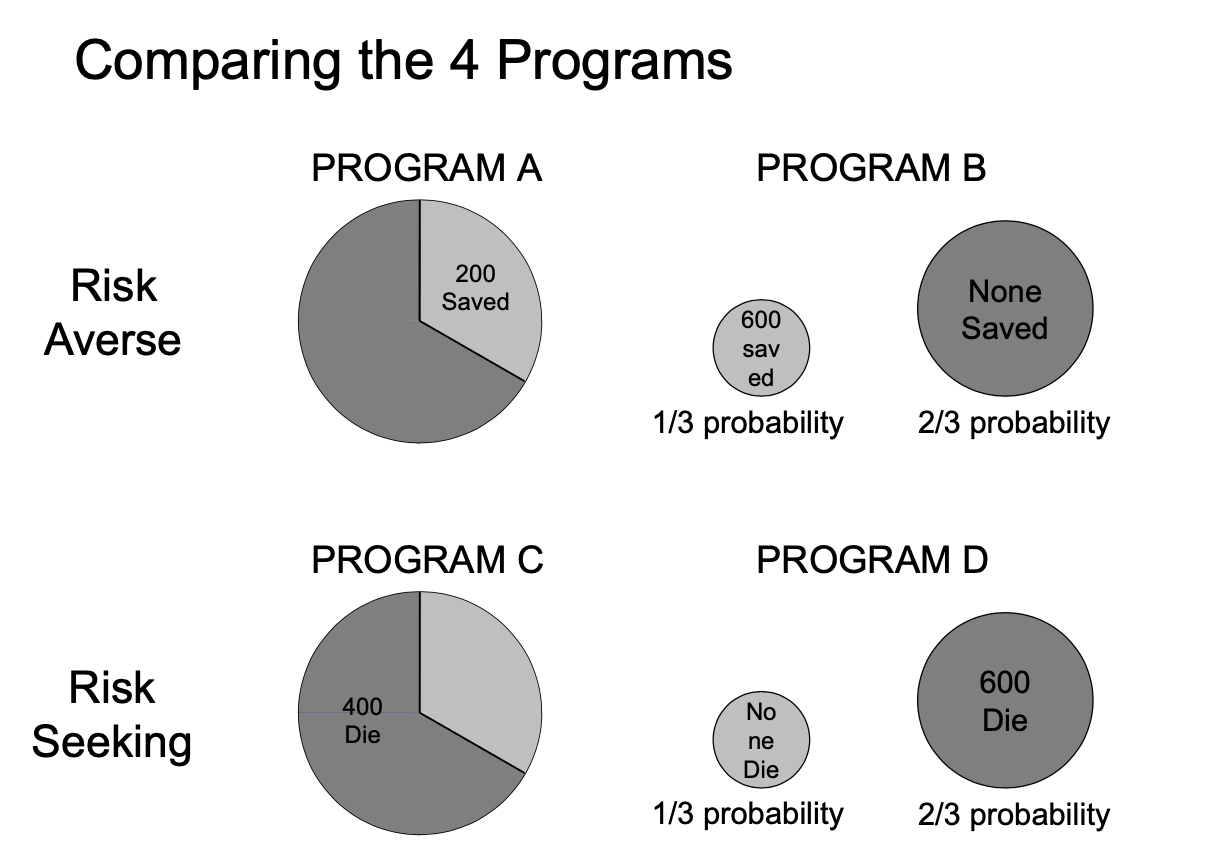
Version 1 Kahneman & Tversky (1981)
There is a new disease and one of two programs must be adopted to counteract it. In total, 600 people are affected.
PROGRAM A: 200 people will be saved
PROGRAM B: There is a 1/3 probability that 600 people will be saved and 2/3 probability that no one will be saved.
Version 2
There is a new disease and one of two programs must be adopted to counteract it. In total, 600 people are affected.
PROGRAM C: 400 people will die
PROGRAM D: There is a 1/3 probability that no one will die and a 2/3 probability that 600 will die.
Emotion
Is decision making free of the influence of emotion?
Somatic Marker Hypothesis
Emotions guide decision making
Brain area involved seems to be ventromedial prefrontal cortex
Iowa Gambling Task—Bechara, Damasio, & Damasio (2000)
subjects are given 4 decks of card, 2 good and 2 bad
draw cards from diff decks, 100 cards total
each card has a dollar penalty or dollar reward
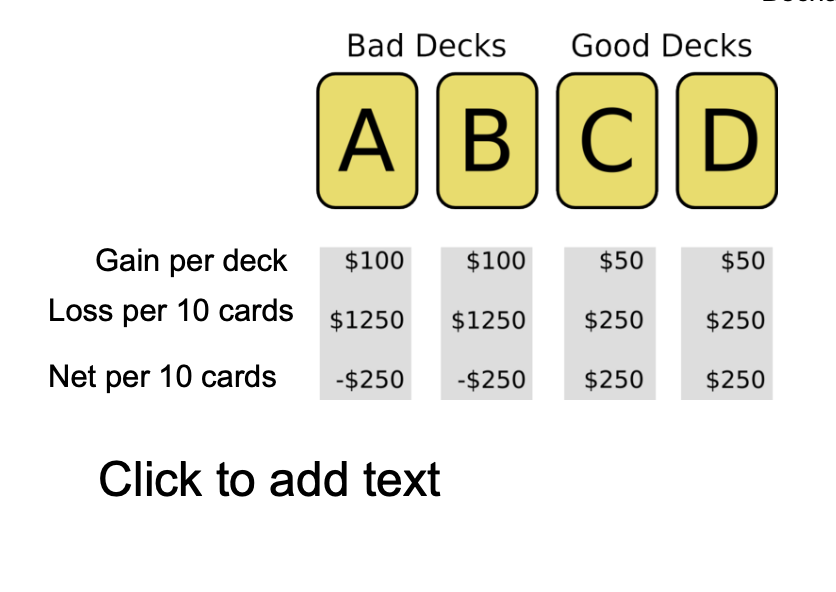
studied ppl who have damange in VM (emotion contrl center) if they have better or worse decision making
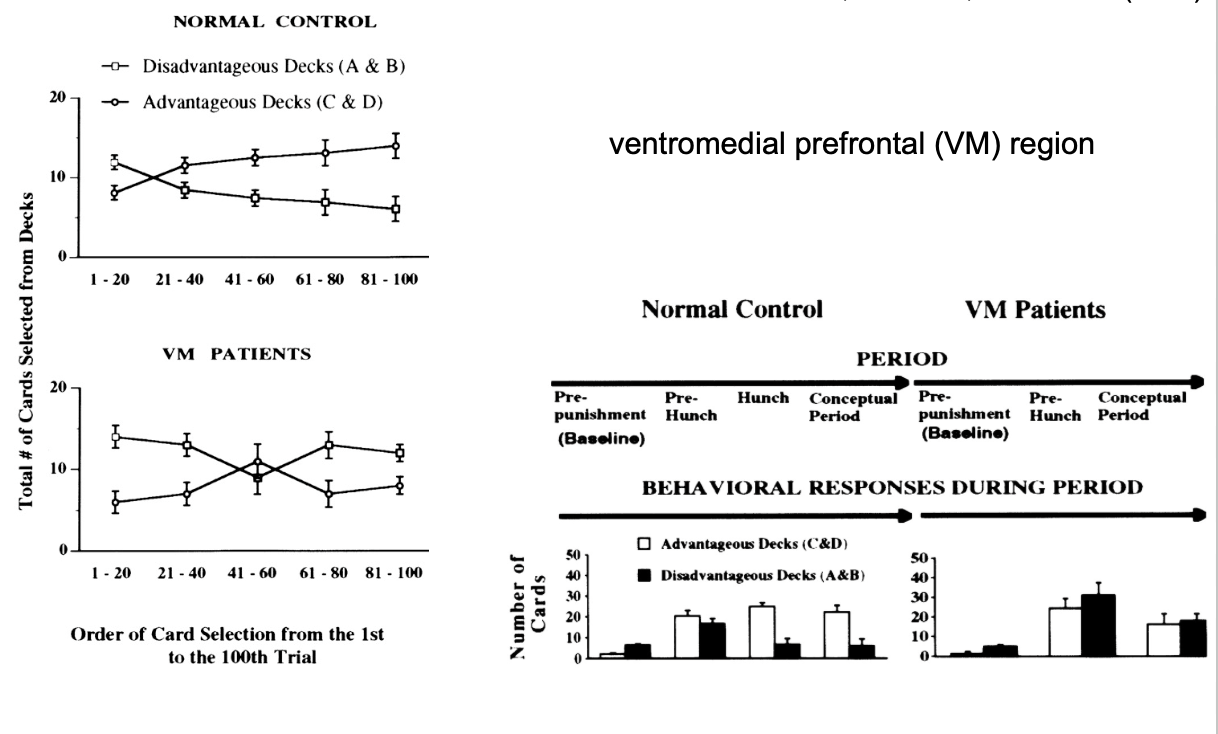
shows learning