Econ - The nature of the economic problem
The Nature of the Economic Problem
The Basic Economic Problem:
“Unlimited wants exceeding finite resources”
Consumers
Consumers of goods and services
Workers
Suppliers of their time and effort
Firms/Companies
Producers of goods and services
Government
Producers of public goods
What is the concept of scarcity?
This is when there are unlimited demand for goods and services by customers as there are unlimited wants, but Earth’s resources are scarce. Thus, the result means that wants continue to exceed supply due to unlimited wants.
Examples regarding consumers:
Students can only study a limited amount of subjects at school
Families can only choose one restaurant to eat at
You can only buy a limited amount of clothes
Examples regarding workers:
Choosing between career paths
Refine their skills further or choose employment
Balance multiple jobs
Examples regarding companies:
Amount of employees to hire
Amount of raw materials needed
Amount of machines and factories required
Examples regarding governments:
Spending on hospitals
Spending on schools/education
Spending on the army
The nature of the economic problem
Resource allocation- The Three basic economic questions
What do produce?
How to produce?
Who to produce for?
Companies and firms need to ask themselves:
What should we produce?
as resources, labor, materials are limited
choosing one thing over another
what are their priorities?
How to produce it?
what is the best way to produce the best goods and services that consumers want
how to mix the factors of production as to satisfy the market and efficiency
Who to produce for?
who should receive the products?
how much money should we charge?
Economic goods and free goods
Economic products
requires the use of resources to produce
opportunity cost involved as it utilized factors of production in order to be made
Opportunity cost:
the potential benefits lost from the option not selected, whether explicit or implicit
Free good
takes no resources to create
sunshine
oxygen
no opportunity cost because it did not utilize factors of production
Factors of production and their rewards
Factor of production is the economic resources of land, labor, capital, and enterprise
Required of any economic good or service
Resources:
Capital
“Goods used to produce other goods and services”
Manufactured goods that makes another good
Producer good
Offices, factories, machines, railways, and tools
The reward of capital is interest
Financial institutions/owners of capitals are rewarded interest charged because lending involves risk. The payment received must exceed the interest paid.
Enterprise
CEO or leader of company: risk bearing/key decision makers
will have willingness to make risks
organize factors of production
decides on what is produced
The reward of enterprise is profit
If done right, they will take in massive profits if successful, the risk is seen as an investment, running an organization
Land
gift of nature available for production
farms need land to grow crops
offices need land
natural resources used for production of goods: water/oil/wood
The reward for land is rent
The users of the land will always have to pay rent. The landowners receive rental income. The rental income is to compensate landowners for the scarce resource. The profit needs to exceed rent
Labor
Human effort used in producing goods and services
All human effort
Mental and physical effort
Road sweepers, bankers, teachers
The rewards for labor is salaries
The wages are paid to workers in exchange for their labor time and resources for production, in exchange for their productivity
Quality and quality of factors of production
In order to increase the amount of CEOs in the economy, they need to lower taxes on companies, reduce government regulations
In order to increase the quality of enterprise, there should be a good education system and access to schools
Quality of the land is the soil type, how fertile the soil is, the weather in the region, etc,.
Quantity can be increased by land reclamation
Capitals depend on how much investments are made over a period of time
new machines run more efficiently with time
tech increases the quality and quantity of goods produced
Education, training, higher concentration and motivation, working with complex machinery, healthcare will increase the quality and quantity
Opportunity Cost
Opportunity Cost - “The best alternative foregone”
Consideration of alternatives
Cost of decisions in terms of the best alternative presented
Decision makers will choose the option that gives them the greatest benefit (e.g. profit)
Consumers
decide on what to buy (purchasing goods and services)
thus, they give up the benefits of purchasing another product
Workers
decide on which business to work on - workers working in one company sacrifices working for another
specializing in a particular profession means giving up the opportunity to pursue other jobs
Producers
choose between competing business opportunities
decide how best to allocate its resources
Governments
opportunity cost of which public goods to spend on
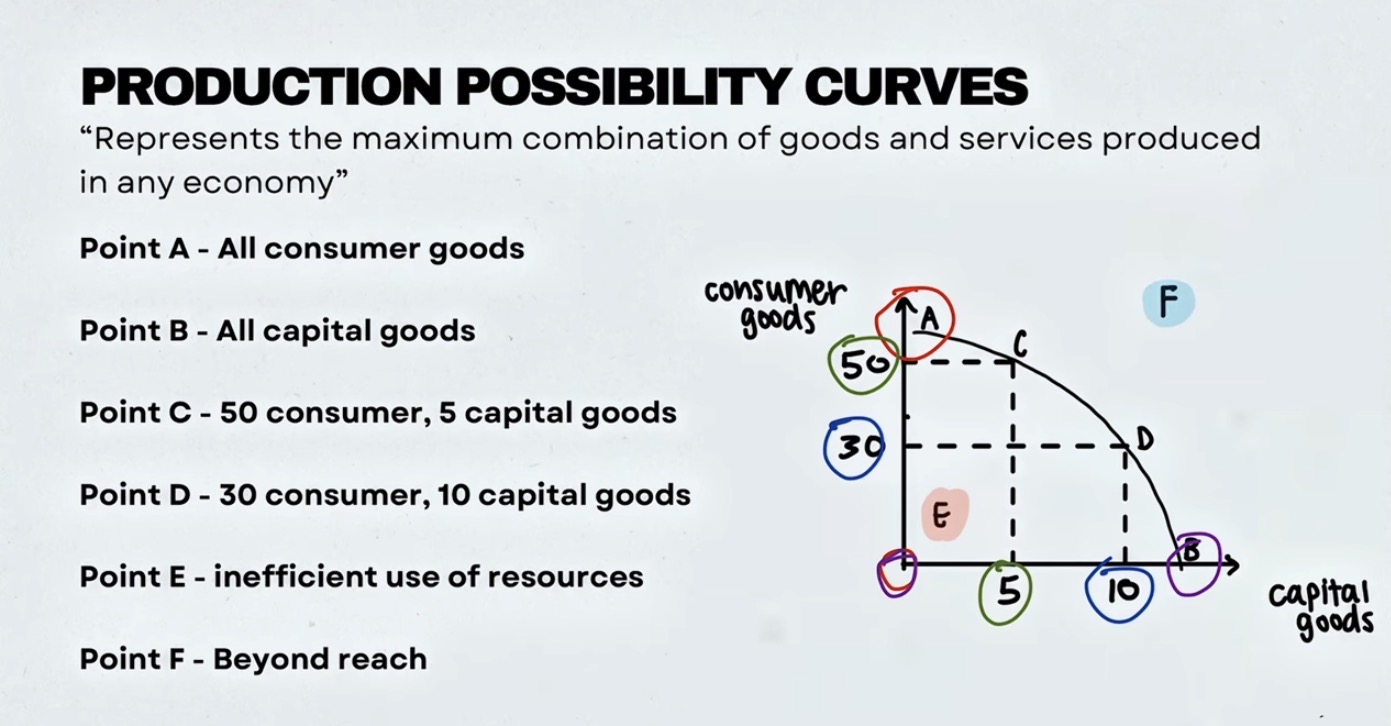
Production Possibility Curves (PPC)
Production Possibility Curves - “Represents the maximum combination of goods and services produced in any economy”
PPC Diagram
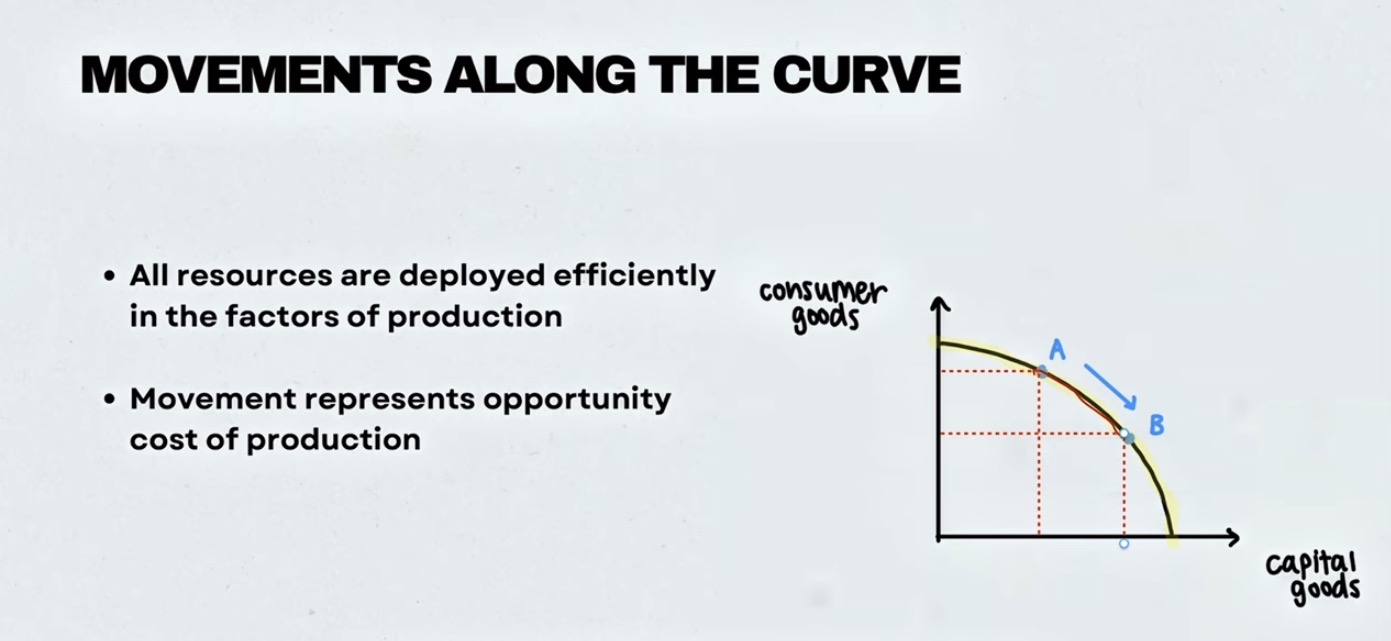
Movements along a PPC
When an economy is operating along the curve, it shows that all resources are deployed efficiently in the factors of production.
Moving from Point A to Point B represents an opportunity cost.
In order to move, it needs to sacrifice some consumer goods to make more capital goods
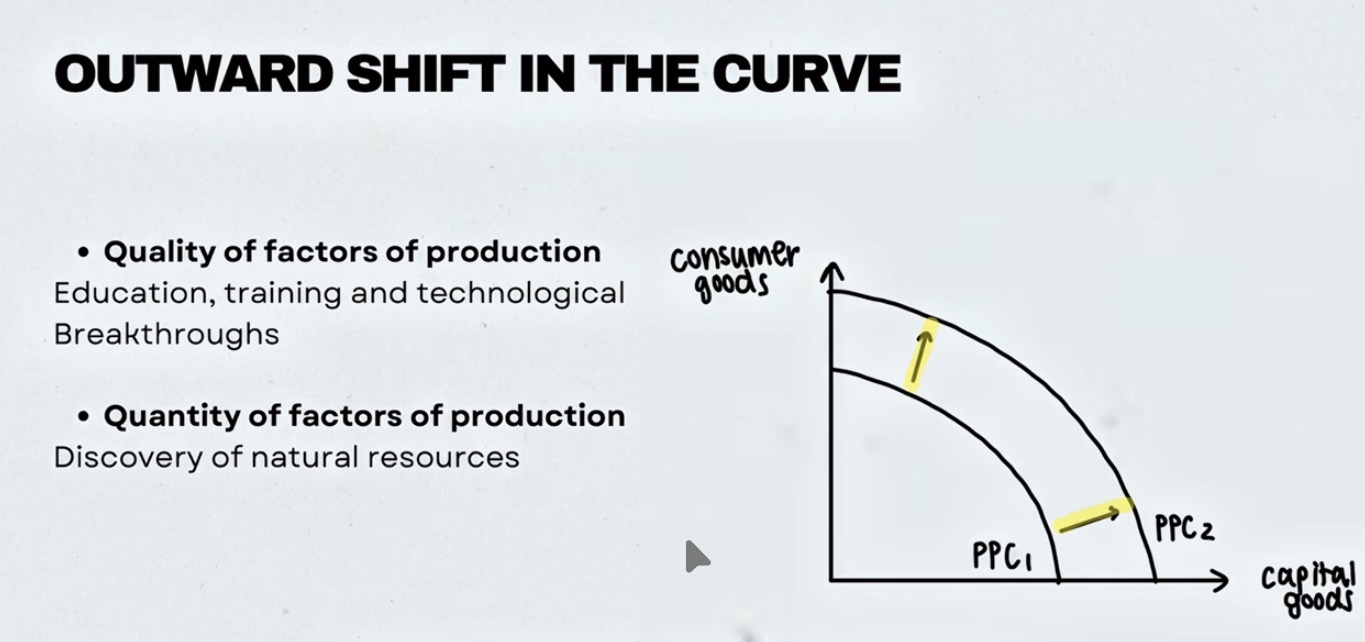
Shifts along the PPC
Outward shift of the curve
Quality of factors of production increase
Quantity of factors of production increase
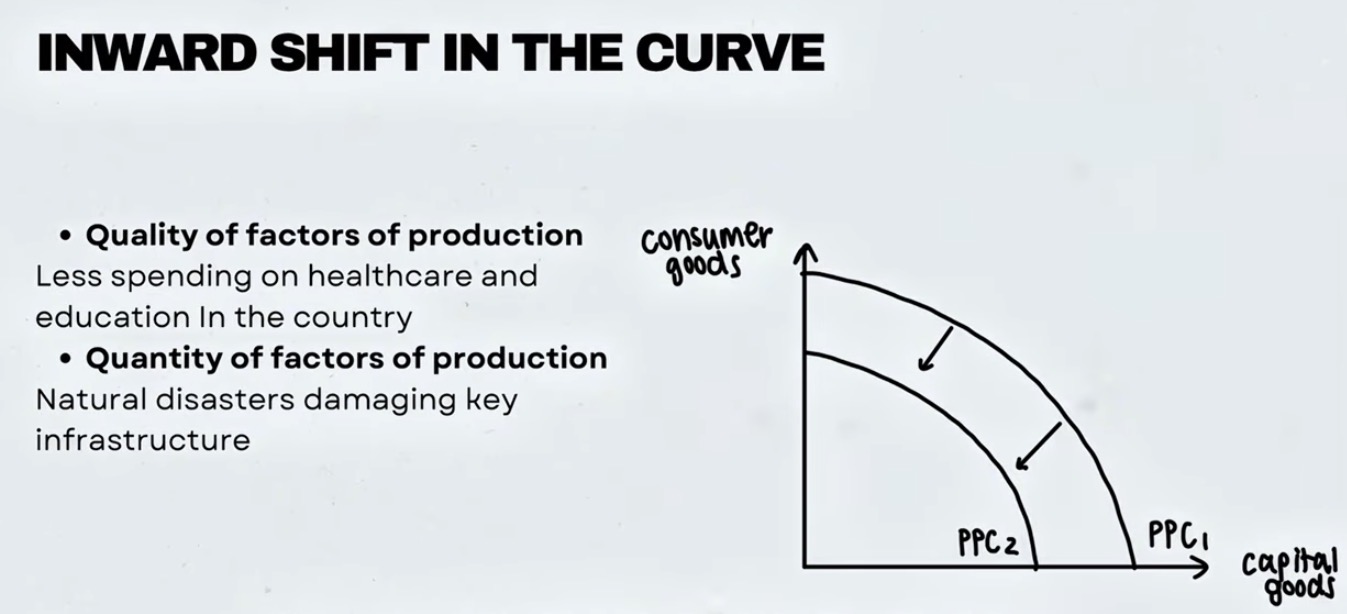
Inward shift of the curve
Quality of factors of production decrease
Quantity of factors of production decrease