Offender profiling : The bottom-up approach
Key terms
The bottom-up approach - profilers work up from evidence collected from the crime scene to develop hypotheses about the likely characteristics, motivations and social background of the offender. (profilers work up from evidence collected from the crime scene to develop hypotheses)
Investigative psychology - a form of bottom-up profiling that matches details from the crime scene with statistical analysis of typical offender behaviour patterns based on psychological theory. (establishes patterns of behaviour forming a statistical database)
Geographical profiling - a form of bottom-up profiling based on the principle of spatial consistency: that an offender’s operational base and possible future offences are revealed by the geographical location of their previous crimes. (the location of crimes is a clue, ‘marauder’ operates close to home and ‘commuter’ operates far.)
Interpersonal coherence - offender’s behaviour at crime scene reflects their everyday behaviour and thus is a clue.
Forensic awareness - individuals who have been the subject of police interrogation before ‘cover their tracks.’
The bottom up approach
Aim - to generate a picture of the offender, their likely characteristics, routine behaviour and social background through systematic analysis of evidence at the crime scene.
Investigative psychology
The discipline of investigative psychology is an attempt to apply statistical procedures alongside psychological theory, to the analysis of crime scene evidence.
The aim is to establish patterns of behaviours that are likely to occur across crime scenes.
This is in order to develop a statistical database which then acts as a baseline for comparison.
Specific details of an offence can then be matched against this database to reveal important detail about the offender, their personal history, family background, can also determine whether a series of offences are linked.
Interpersonal coherence is that the way an offender behaves at a scene including how they interact with the victim, may reflect their behaviour in more everyday situations. Eg while some rapists want to maintain maximum control and humiliate their victims, others are more apologetic. This might tell police something about how the offender relates to women more generally. Time and place is also a key variable.
Forensic awareness describes those individuals who have been the subject of police interrogation before, their behaviour may denote how mindful they are of ‘covering their tracks’
Geographical profiling - Kim Rossmo 1997
Geographical profiling uses information to do with the location of linked crime scenes to make inferences about the likely home or operational base of an offender - this is also known as crime mapping.
It can also be used in conjunction with the psychological theory to create hypotheses about how the offender is thinking as well as their modus operandi. The assumption is that serial offenders will restrict their work to geographical areas they are familiar with and so understanding the spatial pattern of their behaviour provides investigators with a ‘centre of gravity’ which is likely to include the offender’s base (often in the middle of the spatial pattern) It may also help investigators make educated guesses about where the offender is likely to strike next - jeopardy surface
Canter’s circle theory (Canter and Larkin 1993) proposed 2 models of offender behaviour
the marauder - who operates in close proximity to their home base
the commuter - who is likely to have travelled a distance away from their usual residence.
The pattern of offending is likely to form a circle around their usual residence, becomes more apparent the more offences there are.
Spatial decision making can offer the investigative team important insight into the nature of the offence i.e if it was planned, transport, mental map.
Evaluation
Evidence supports investigative psychology
David Canter and Rupert Heritage conducted a content analysis of 66 sexual assault cases. The data was examined using the statistical technique smallest space analysis - computer program that identifies correlations across patterns of behaviour.
Several characteristics were identified as common in most cases, such as the use of impersonal language and lack of reaction to victim. These characteristics will occur in different patterns in different individuals, this can lead to an understanding of how an offender’s behaviour may changes over a series of offences or in establishing whether two or more offences were committed by the same person. This supports the usefulness of investigative psychology because it shows how statistical techniques can be applied.
Evidence supports geographical profiling
Samantha Lundrigan and David Canter (2001) collated information from 120 murder cases involving serial killers in the USA. Smallest space analysis revealed spatial consistency in the behaviour of all killers. The location of each body disposal site was in a different direction from the previous sites, creating a centre of gravity, the offender’s base was invariably located in the centre of the pattern. The effect was more noticeable for offenders who travelled short distances (marauders)
This supports Canter’s claim that spatial information is a key factor in determining the base of an offender.
Scientific basis
Canter’s argument is that bottom-up profiling is more objective and scientific than the top-down approach as it is more grounded in evidence and psychological theory, and less driven by speculation and hunches.
With the aid of advanced artificial intelligence, investigators are able to manipulate geographical, biographical and psychological data quickly to produce insights and results that assist in the investigation.
Similarly the field of investigative psychology has recently expanded to include areas as suspect interviewing and examination of material presented
Wider application
another advantage of bottom up approach has is that it can be applied to a wide range of offences.
techniques like smallest space analysis and the principle of spatial consistency can be used in the investigation of crimes such as burglary and theft as well as more serious offences like murder and rape.
Mixed results for profiling
Case of Rachel Nickell
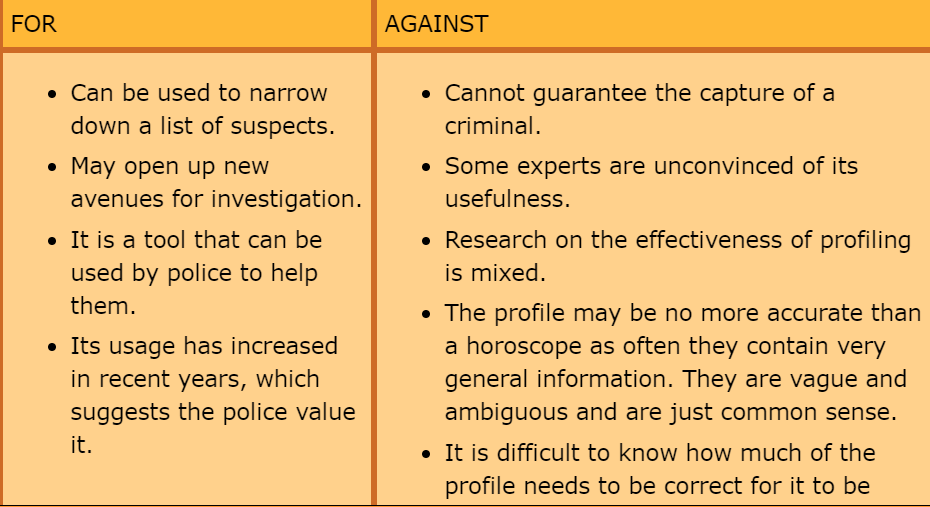
Gary Copson 1995 surveyed 48 police forces and found that the advice provided by the profiler was judged to be useful in 83% of cases, but in only 3% did it lead to accurate identification of the offender.
Richard Kocsis et al 2002 found that chemistry students produced a more accurate offender profile on a solved murder case than experienced senior detectives.