Chapter 13 Federal Reserve
Overview:
The chapter deals with the structure and activities of central banks, with a primary focus on the Federal Reserve System of the United States.
What is a Central Bank?
Functions of a Central Bank:
Banker’s Bank: Provides services to the banking sector.
Lender of Last Resort: Offers emergency funds to banks facing liquidity issues.
Regulator: Oversees the banking system to maintain stability.
Government’s Bank: Acts as the bank for the government.
Controller of Money Supply: Implements monetary policy to manage the money supply in the economy.
Federal Reserve
Historical Context:
Initial resistance to the establishment of a central bank characterized by:
Fear of centralized power.
Distrust of moneyed interests.
Absence of a lender of last resort led to bank panics, notably:
Panic of 1907: Highlighted the necessity of a central bank.
Federal Reserve Act of 1913: Instituted the Federal Reserve System with a structure featuring checks and balances while remaining decentralized.
Structure of the Federal Reserve:
The Federal Reserve Act aimed to diffuse power along:
Regional lines.
Between the private sector and the government.
Among bankers, business people, and the public.
Entities included in the Federal Reserve System:
Federal Reserve District Banks
Board of Governors of the Federal Reserve System
Federal Open Market Committee (FOMC)
Federal Reserve District Banks
Characteristics:
Function as quasi-public institutions owned by private commercial banks in their districts that are part of the Fed system.
Board of Directors:
Each district elects six directors; three additional directors are appointed by the Board of Governors.
Director Categories:
A Directors: Professional bankers.
B Directors: Prominent leaders from industry, labor, agriculture, or consumer sectors.
C Directors: Appointed by the Board of Governors, these members are prohibited from being bank officers, employees, or stockholders.
Directors elect the bank president, subject to Board of Governors approval.
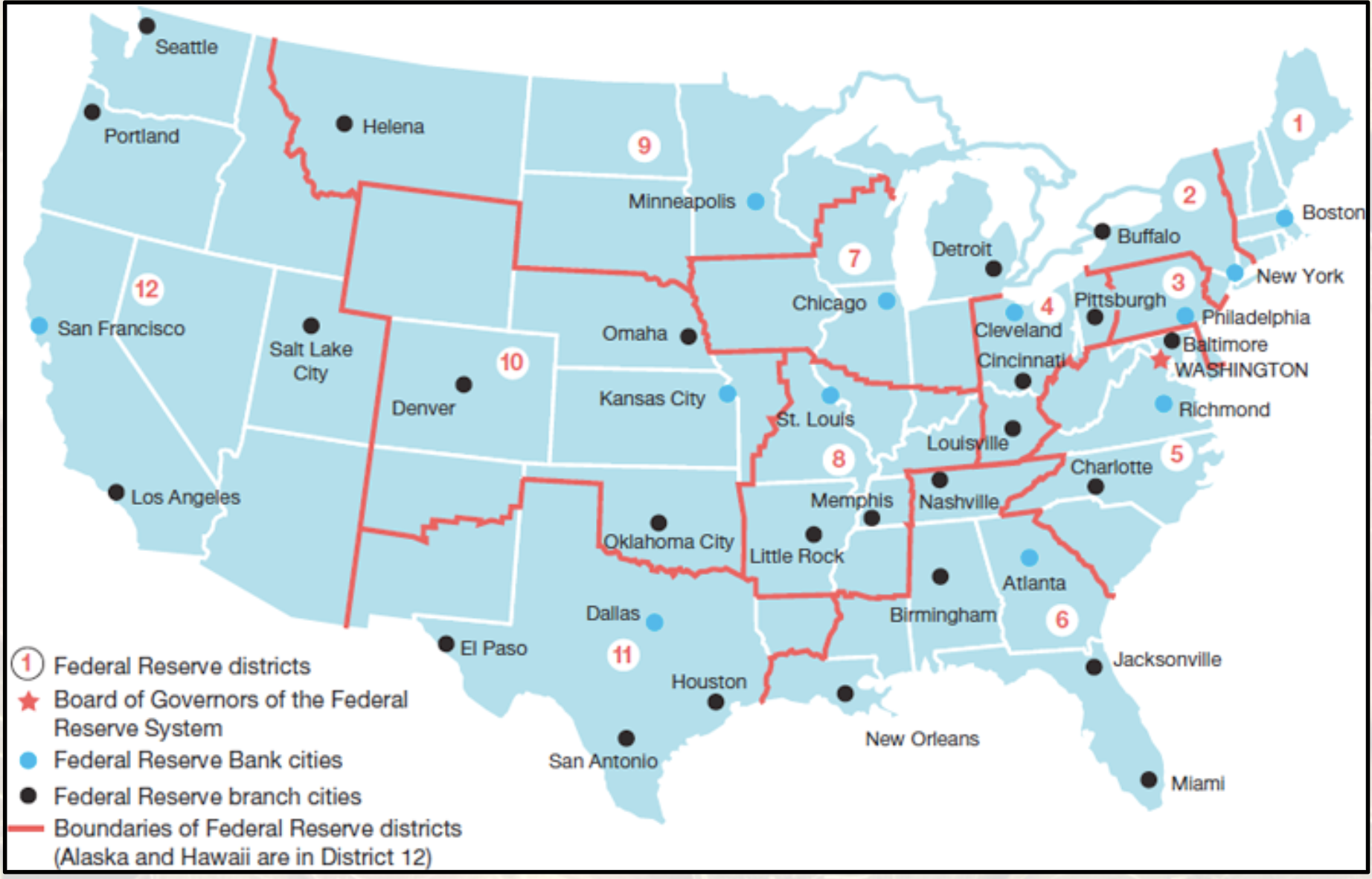
Functions of District Banks:
Clear checks.
Issue new currency and withdraw damaged currency from circulation.
Administer and make discount loans to banks in their districts.
Evaluate proposed mergers and bank activity expansions.
Serve as liaisons to the business community and the Federal Reserve.
Examine bank holding companies and state-chartered member banks.
Collect data on local economic conditions.
Employ professional economists for monetary policy-related research.
Role of the New York District Bank:
Significance derived from:
Hosting many of the largest commercial banks in the US.
Involvement in bond and foreign exchange markets.
Unique membership as the only Federal Reserve Bank in the Bank for International Settlements (BIS).
The president serves as the only permanent voting member of the FOMC among Federal Reserve Bank presidents, acting as vice-chair alongside board leadership.
Board of Governors
Composition:
Seven members based in Washington, D.C.
Appointed by the president and confirmed by the Senate.
14-year non-renewable terms.
Members are required to represent different districts.
The chairman is designated from the governors, serving a four-year term.
Responsibilities:
Votes on conducting open market operations.
Sets reserve requirements for banks.
Controls the discount rate through a structured review and determination process.
Sets margin requirements for borrowing against securities.
Determines salaries for Federal Reserve Bank presidents and officials while reviewing budgets.
Approves bank mergers and new applications for banking activities.
Specifies allowable activities for bank holding companies.
Oversees foreign banks operating within the US.
Additional Roles:
Advises the president regarding economic policy.
Testifies before Congress.
Represents the Federal Reserve System in media engagement.
May represent the US in international economic negotiations.
Research Importance:
The Federal Reserve employs the largest number of economists globally.
Economists analyze incoming economic data to inform policymakers about economic trends and potential impacts of monetary policies.
Federal Open Market Committee (FOMC)
Operations:
Meets eight times annually.
Composed of:
Seven Board of Governors members.
President of the Federal Reserve Bank of New York.
Presidents from four additional Reserve banks.
The Chairman of the Board of Governors also chairs the FOMC.
Issues directives to the trading desk at the Federal Reserve Bank of New York.
Power Dynamics:
Primary power resides with the Board of Governors, who hold significant influence over the District Bank Directors, including veto rights over District bank presidents.
Majority voting holds at FOMC meetings, indicating centralized decision-making authority in Washington, D.C.
Independence of the Federal Reserve
Significance of Independence:
Central bank independence is crucial to prevent inflationary bias and influence from political cycles in monetary policy decisions.
Avoids risks associated with facilitating government funding for significant budget deficits.
Essential control of monetary policy to prevent principal-agent problems that can worsen within political environments.
Arguments for Independence:
Reduces political pressure that may lead to biased inflationary measures.
Minimizes potential coordination challenges between fiscal and monetary policies.
Provides autonomy critical in managing economic conditions effectively.
Critiques of Independence:
Perceived as undemocratic and unaccountable.
Difficulties emerge in synchronizing fiscal and monetary efforts.
Historical usage of independence has faced critiques regarding its effectiveness.
The Federal Reserve's Performance:
The institution has notably succeeded in controlling inflation, particularly with advancements in data availability and technological improvements.
European Central Bank (ECB)
Framework:
Established with a structure mimicking that of the Federal Reserve.
Central banks in member countries perform functions akin to those of Federal Reserve banks.
Notable structure includes:
Executive Board: Comprising a president, vice-president, and four additional members.
Each serves eight-year, non-renewable terms.
Governing Council oversees broader policies.
Distinct Features:
National Central Banks maintain control over their individual budgets alongside the ECB.
Monetary operations remain uncentralized, lacking direct supervision over financial institutions.
Independence of the ECB:
Among the most independent central banks globally, featuring long terms for Executive Board members.
Budgetary independence and legislative changes necessitate a revision of the Maastricht Treaty.
Impact of the ECB and Euro on Member States:
Advantages of joining the Eurozone include:
Reduction in transaction costs.
Diminished inflation rates.
Lower interest rates.
Risks associated with Eurozone membership:
Loss of focus on individual nation’s monetary policy.
Reduced capacity to deflate currency, which complicates debt reduction and export encouraging strategies.