22.5 Free energy
Why do reactions happen?
Feasibility
Feasibility is used to describe whether a reaction is able to happen and is energetically feasible (spontaneous can also be used)
The energy - a reaction can happen if the products have a lower overall energy than the reactants.
Free energy
The overall change in energy during a chemical reaction is called the free energy change (delta G) and is made up of two of types of energy
1) The enthalpy change delta H. This is the heat transfer between the chemical system and the surroundings
2) The entropy change at the temperature of the reaction (T delta S) This is the dispersal of energy within the chemical system itself.
The Gibbs’ equation - shows the relationship between the two types of energy
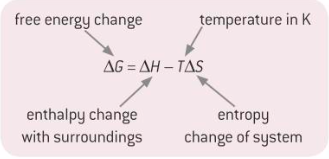
Condition for feasibility
The feasibility of a reaction depends on the balance between (delta H) and (T delta S) in the Gibbs’ reaction. For a reaction to be feasible, there must be a decrease in free energy.
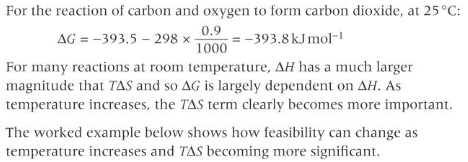
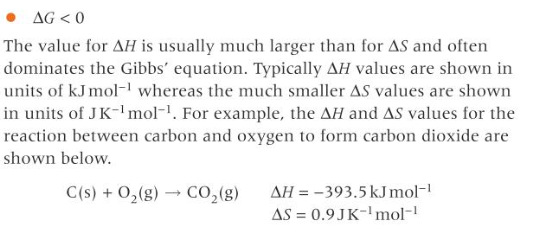 In the Gibbs’ equation, the value and units of delta S must be changed to kJK-1mol-1 by dividing by 1000. This then matches the kJ in the delta H.
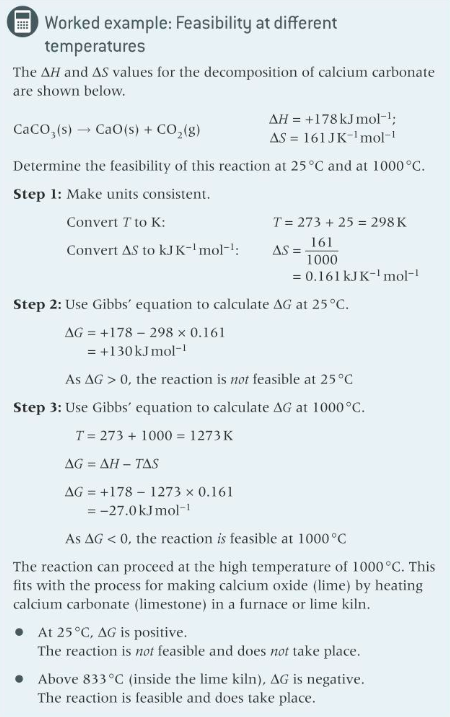
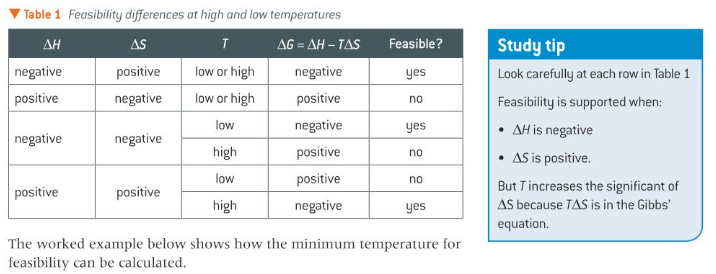
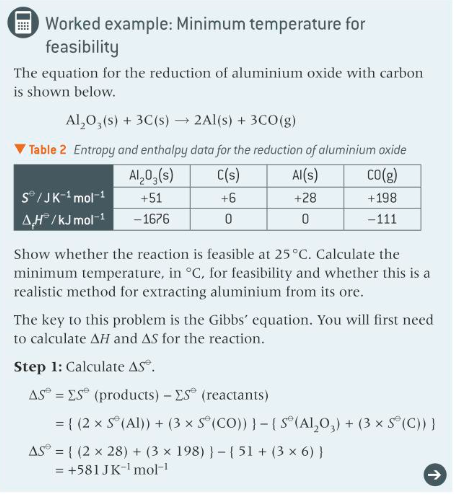
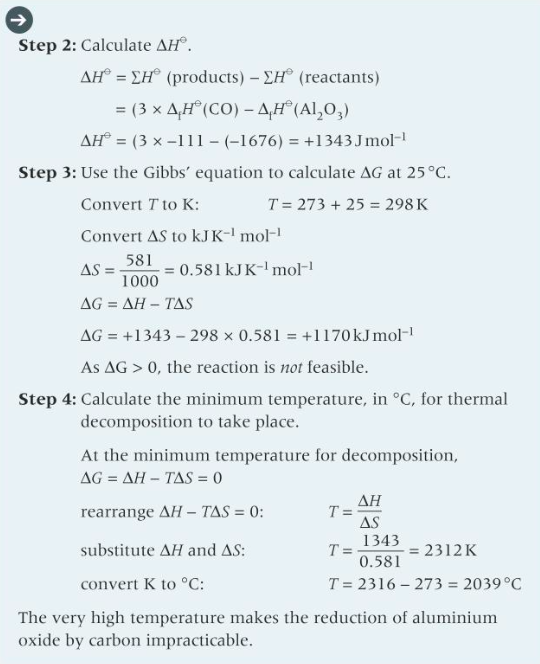
How can endothermic reactions take place at room temperature?
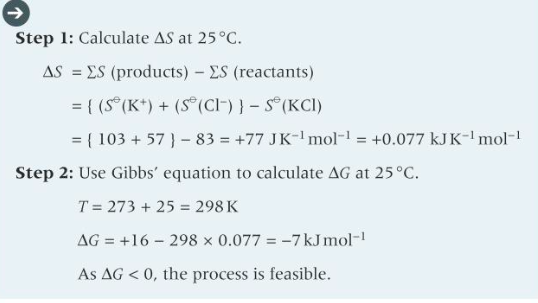
Some ionic compounds dissolve in water at room temperature in an endothermic process, cooling down the water. For example, the enthalpy change of solution of potassium chloride KCL (s) is endothermic.
To find out why endothermic processes can take place at room temperature, you need to use entropy and free energy.
Limitations for predictions made for feasibility
The free energy change is useful for predicting feasibility, but many reactions that have a negative delta G and do not seem to take place.
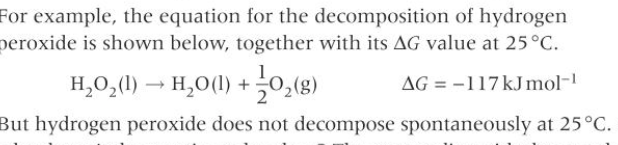
Answer lies with the very large activation energy resulting in a very slow rate.
Reaction takes place with and MnO2 catalyst, which allows the reaction to take place via an alternative route with a lower activation energy, the reduced energy barrier then allows the reaction to take place.
So although the sign indicates the thermodynamic feasibility, it takes no account of the kinetics or rate of reaction.