23.2 Biomass transfer through an ecosystem
All organisms found within an ecosystem require a source of energy to perform the functions needed to survive.
The sun is the source of energy for almost all ecosystems on Earth, through the process of photosynthesis, the Sun’s light energy is converted into chemical energy in plants and other photosynthetic organisms. This chemical is then transferred to other non-photosynthetic organisms as food.
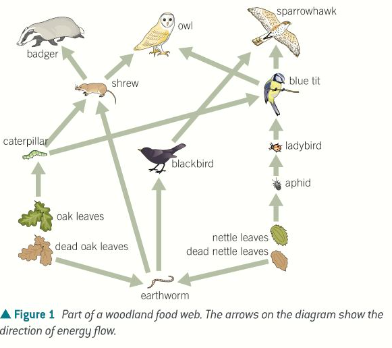
Trophic levels
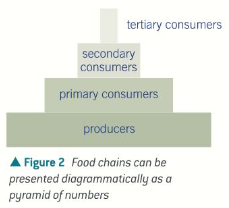
Trophic levels are diagrams that show the transfer of biomass (mass of living material or CO2) therefore energy through the organisms in an ecosystem.
First trophic level - always producer which is an organism that converts light energy into chemical energy by the process of photosynthesis.
The subsequent trophic levels are all consumers which are organisms that obtain their energy by feeding on other organisms.
2nd trophic level is occupied by a primary consumer - an animal that eats a producer.
The following are secondary, tertiary, quaternary. Food chains rarely have more trophic levels that this as there is not sufficient biomass and stored energy left to support any further organisms.
Decomposers are also important - they break down dead organisms releasing nutrients back into ecosystem.
Measuring Biomass
Biomass - is the mass of living material present in a particular place or particular organism. It is an important measure in the study of food chains and food webs as it can be equated to energy content.
Calculating biomass
multiply the biomass present in each organisms by the total number of organisms in that trophic level. - it does not take into account seasonal changes.
Water must be discounted as the presence of varying amounts of water in different organisms makes this technique unreliable unless very large samples are used.
Organisms have to be killed and dried, they are placed in an oven at 80’c until all water has evaporated. (indicated by 2 identical mass readings)
To minimise destruction of organisms only a small sample is taken.
MEASURED IN GRAMS PER SQUARE METER OR GRAMS PER CUBIC METRE (WATER)
Carbon compounds are a store of energy.
Efficiency of biomass and energy transfer between trophic levels
When animals eat, only a small proportion of the food they ingest is converted into new tissues, it is only this part of biomass that is available for next trophic level to eat.
Energy available for each trophic level is measured in kilojoules per metre squared per year to allow changes in photosynthetic production and consumer feeding patterns throughout the year.
ecological efficiency - the efficiency with which biomass or energy is transferred from one trophic level to the next.
The amount of which biomass or energy converted to new biomass by each trophic level in a food chain can be represented by a pyramid of energy.
Efficiency at producer level
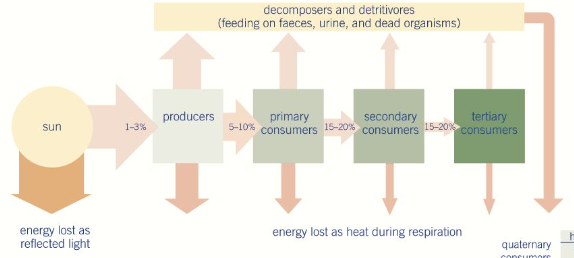
Producers only convert 1-3% of the sunlight (solar or light) they recieve into chemical energy and hence biomass. Because
not all solar energy available is used for photosynthesis - approximately 90% is reflected, some is transmitted through the leaf and some is of unusable wavelength.
other factors may limit photosynthesis such as water availability.
a proportion of the energy is lost as it is used for photosynthetic reactions.
The total solar energy that plants convert to organic matter is called gross production.
However the plants use 20-50% of this energy in respiration. The remaining is converted into biomass. This is the energy that is available to the next trophic level and known as the net production.
Energy available for next trophic level is calculated by
Net production = gross production - respiratory losses
Can use for primary production and secondary production.
Efficiency at consumer level
Consumers at each trophic level convert at most 10% of the biomass in their food to their own organic tissue, this is because
not all of the biomass of an organism is eaten e.g roots and the bones may not be consumed
some energy is transferred to the environment as metabolic heat, as a result of movement and respiration.
some parts of an organism are eaten but are indigestible - these are parts that are egested as faeces.
some energy is lots from the animal in excretory materials such as urine.
Only around 0.001% of the total energy originally present in the incident sunlight is finally embodied as biomass in a tertiary consumer.

Human activities can manipulate biomass through ecosystems
Human civilisation depends on agriculture, this involves manipulating the environment to favour plant species that we can eat (crops) and to rear animals for food or their produce.
Plants and animals are provided with their abiotic conditions they need to thrive such as adequate watering and warmth
Competition between other species are removed (pesticides eg) as well as the threat of predators (creating barriers)
In natural ecosystem, humans would occupy the second, third or fourth trophic level.
Agriculture creates very simple food chains. In farming animals or animals produce for human consumption, only 3 trophic levels are produced.
producers - animal feed
primary consumers - livestock
secondary consumers - humans
In cultivating plants for human consumption, there are just 2 trophic levels - producers (crops) and primary consumers (humans) - this means that minimum energy is lost since there are few trophic levels present that in the natural ecosystem.
This ensures that as much energy as possible is transferred into biomass that can be eaten by humans.